How to Reduce Key-Person Risk Without Doubling Headcount
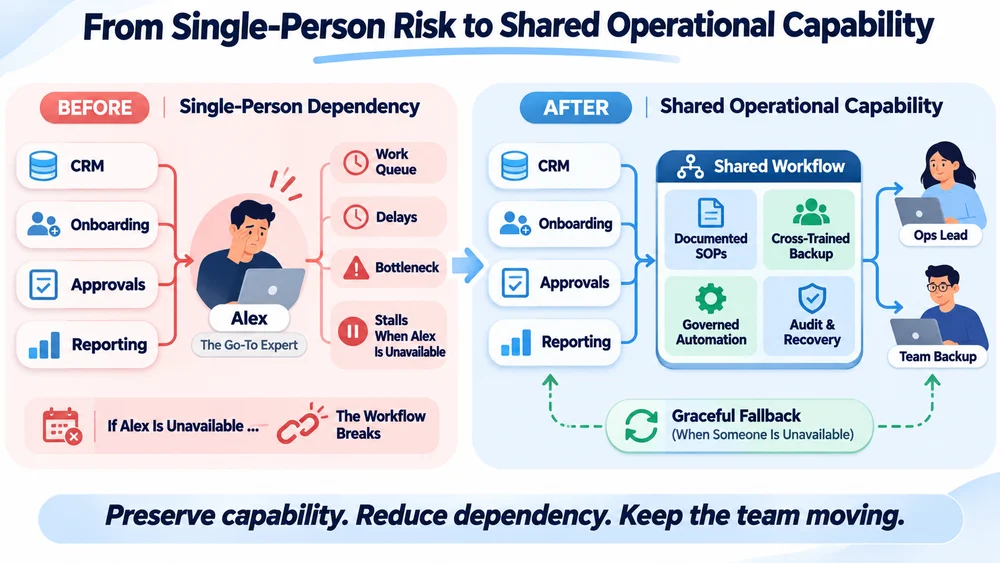
Compare hiring, cross-training, SOPs, and governed workflow automation to reduce key-person risk. Includes a 12-month capacity model and an absence-test playbook.
Read the analysis
Loading…
Research and practical analysis on AI workflows, enterprise agents and the operational challenges of growing startups.
Compare hiring, cross-training, SOPs, and governed workflow automation to reduce key-person risk. Includes a 12-month capacity model and an absence-test playbook.
Read the analysis
Explore the problem, compare your options, then work through implementation.
Reduce founder bottlenecks, knowledge silos and single-person dependencies.
Start reading AI Workflow ImplementationChoose workflows, define permissions and build reliable execution.
Start reading Investment & Operating LeverageCompare priorities, implementation costs and operating returns.
Start reading27 articles

A practical operating model for extending startup runway by automating capacity-intensive workflows while protecting customer growth and delivery quality.

A practical way to measure the labor, handoffs, rework, and cash-flow friction inside a growing startup—and decide which workflow deserves an implementation budget.

A practical model for exposing coordination, rework, exception handling and delayed execution in Series A/B operating workflows—then converting the evidence into a funded automation decision.

A practical Series A/B operating-budget decision: compare a new hire with an AI workflow using capacity, fully loaded cost, first-year cash requirements, operational risk, and acceptance metrics.

A practical operating model for B2B SaaS teams to increase customer onboarding capacity with controlled AI workflows, measurable acceptance criteria, and a fully costed hiring comparison.

A Series A/B operating-budget case comparing a new hire, an additional SaaS tool, and an implemented AI workflow—using fully loaded labor costs, a $50K spending envelope, and explicit acceptance thresholds.

A practical operating-leverage measurement system for Series A/B startups: accepted outputs, touch time, loaded costs, quality, cash realization, and a fully auditable hypothetical quote-to-order workflow case.

A reproducible B2B SaaS sales-operations model comparing 7 SDRs and 3 account executives with 3 account executives supported by an automated SDR workflow—using identical outbound volume and conversion assumptions.

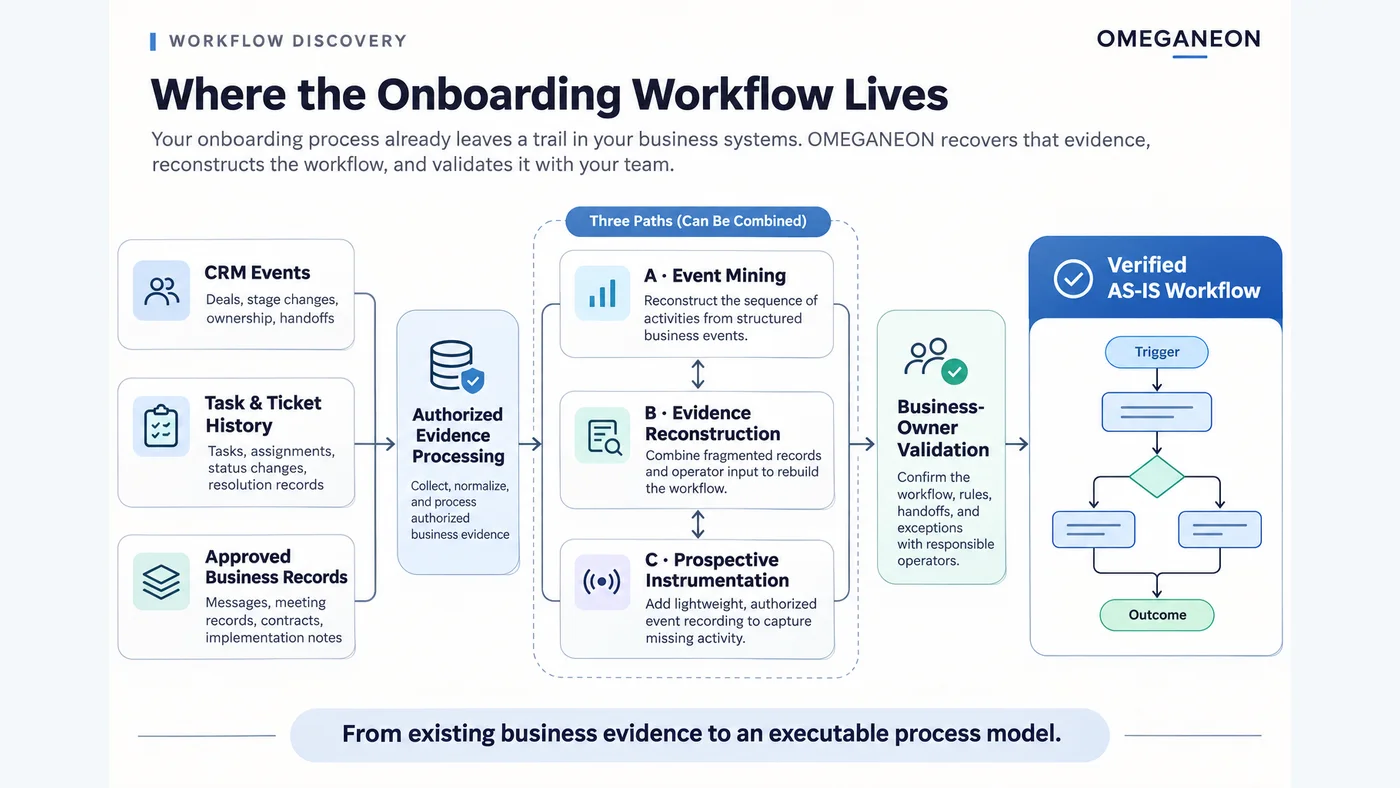
Recover onboarding workflows from existing business evidence, build self-advancing execution, and measure outcomes—without asking your team to write SOPs first.

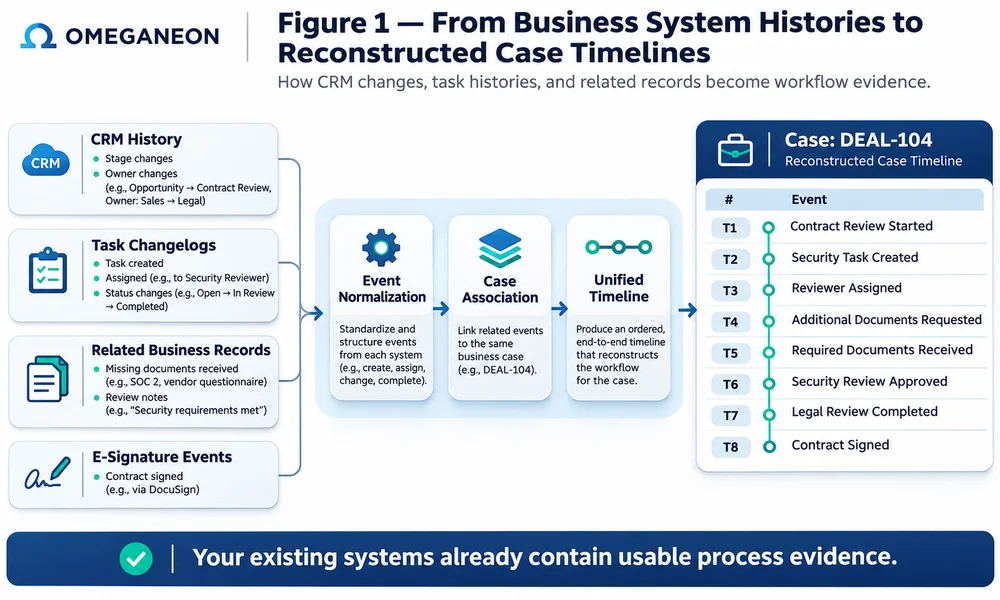
Turn CRM changes, task histories, and operational records into verified workflows—then implement the automation that removes recurring coordination work.

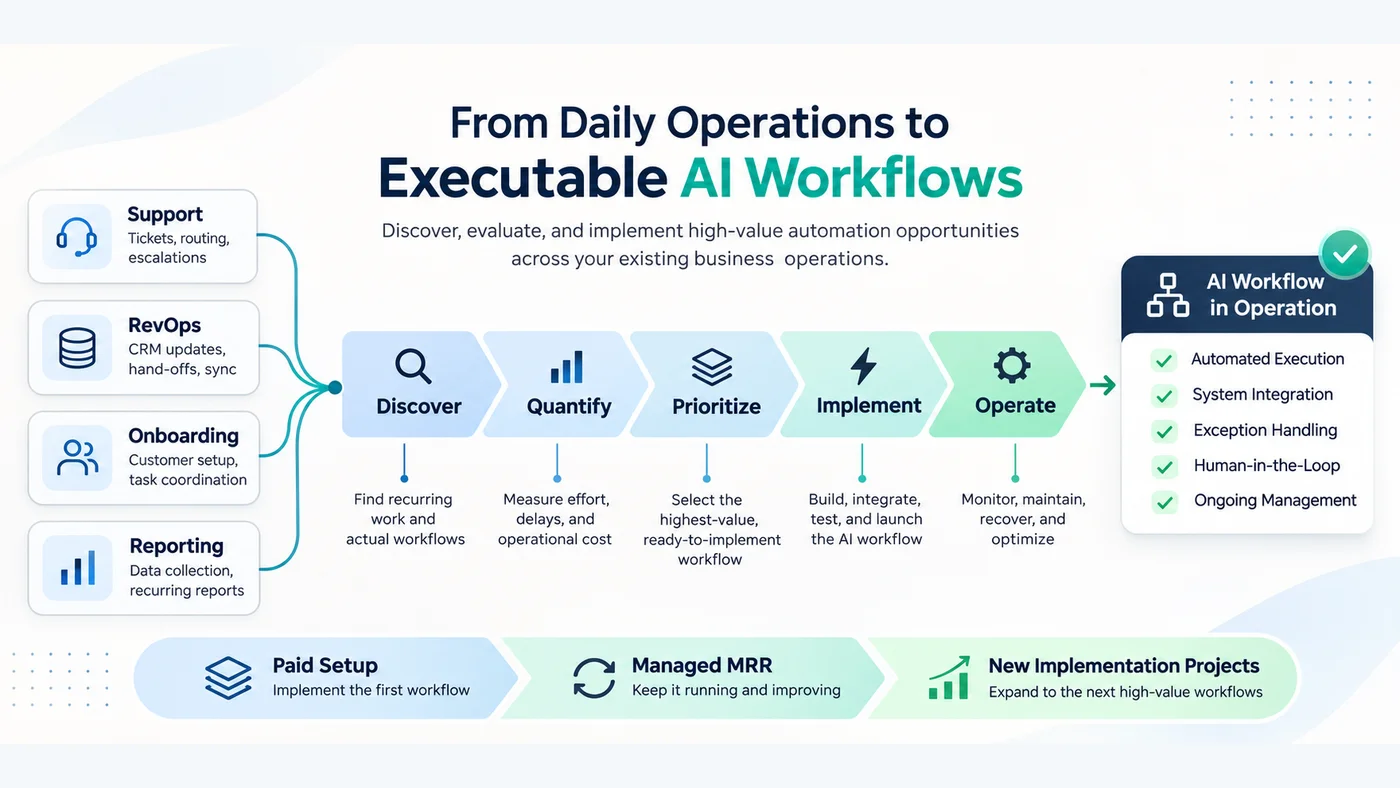
Identify high-value automation workflows, quantify the business case and define implementation, acceptance and ongoing operations.

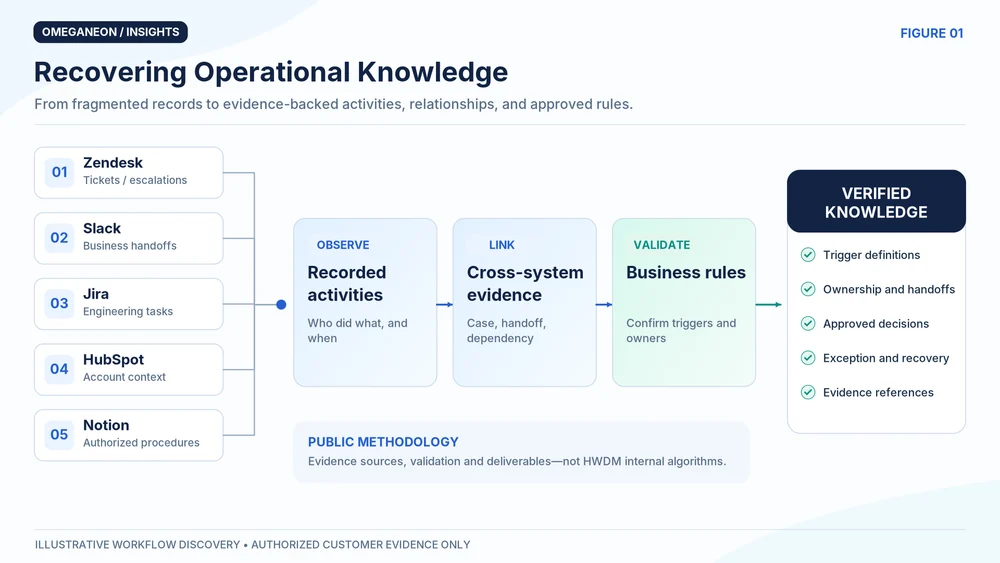
Recover operational knowledge from scattered business records, validate the rules, implement an executable AI workflow and keep it operating.

Compare hiring, cross-training, SOPs, and governed workflow automation to reduce key-person risk. Includes a 12-month capacity model and an absence-test playbook.

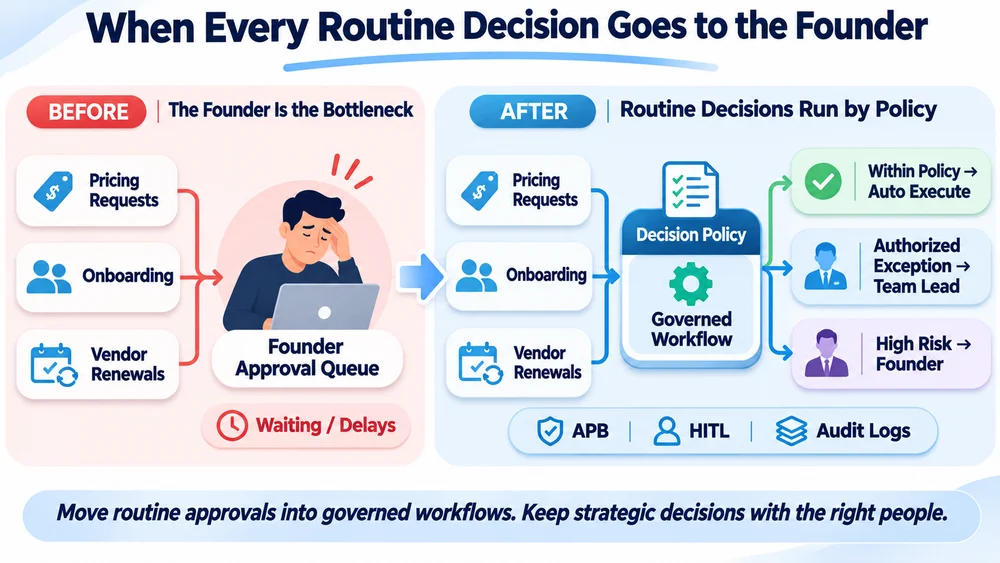
A practical founder-approval automation playbook for Series A/B startups: decision rights, delegated approvals, APB security boundaries, exception handling and measurable outcomes.

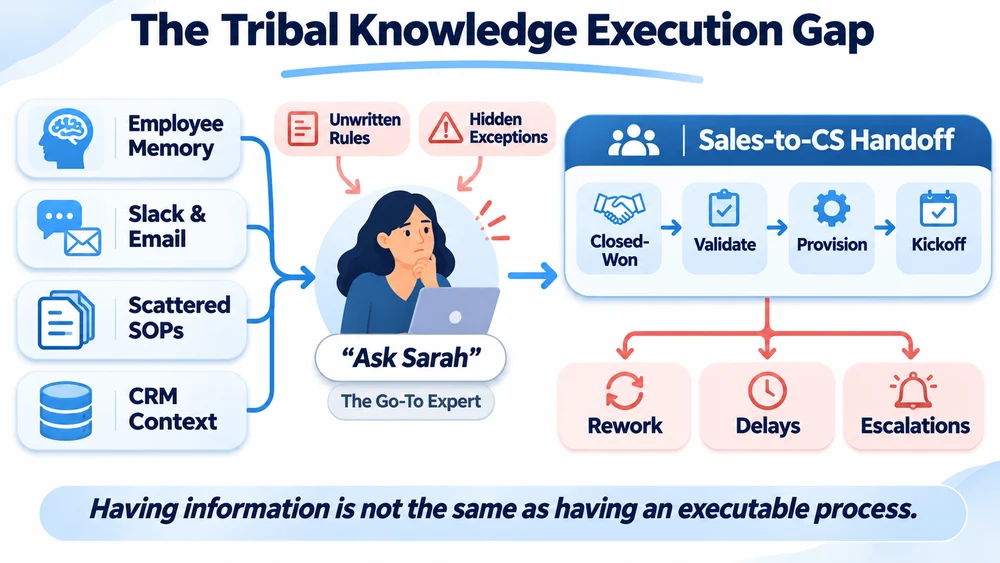
A practical guide for Series A/B startups to capture undocumented operational know-how, model decision rules, orchestrate AI and human work, and verify continuity.

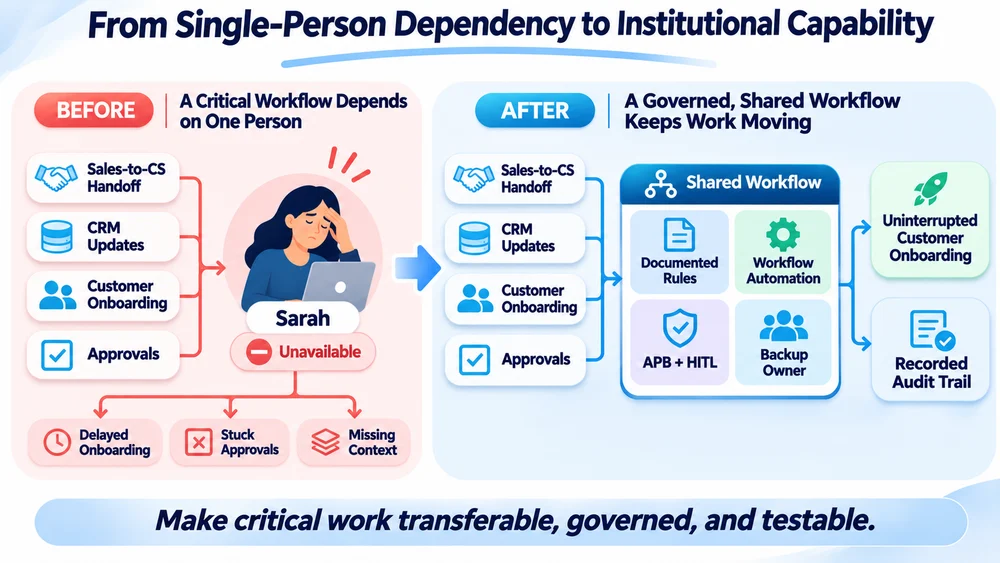
A practical framework for removing single-person dependencies from startup operations through knowledge capture, governed workflows, backup ownership, and continuity testing.

Discover how key-person risk disrupts startup operations and how institutionalized workflows preserve critical knowledge and business continuity.

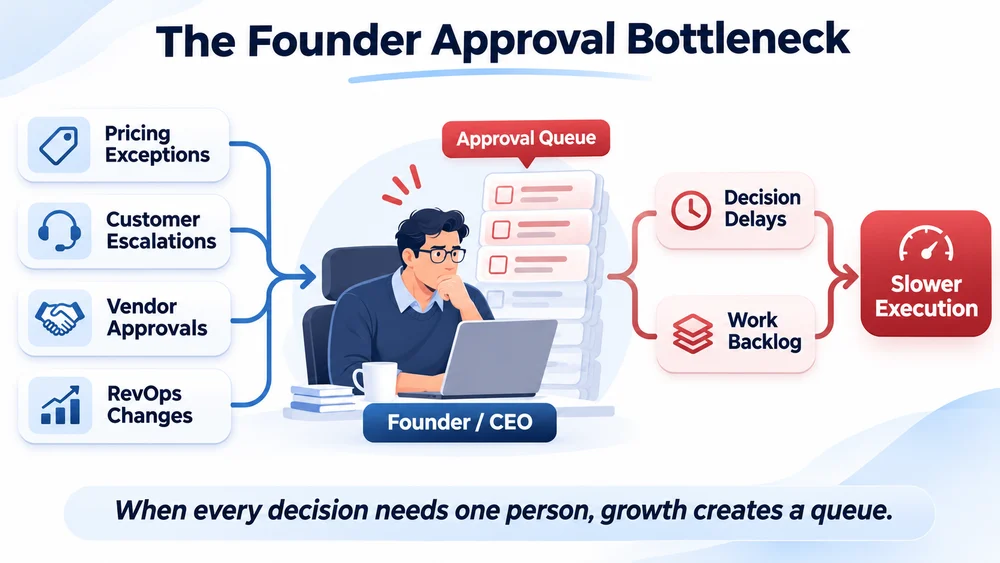
Founder dependency creates approval queues, stalled handoffs, and operational risk. Learn how growing startups can delegate routine decisions through governed workflows.

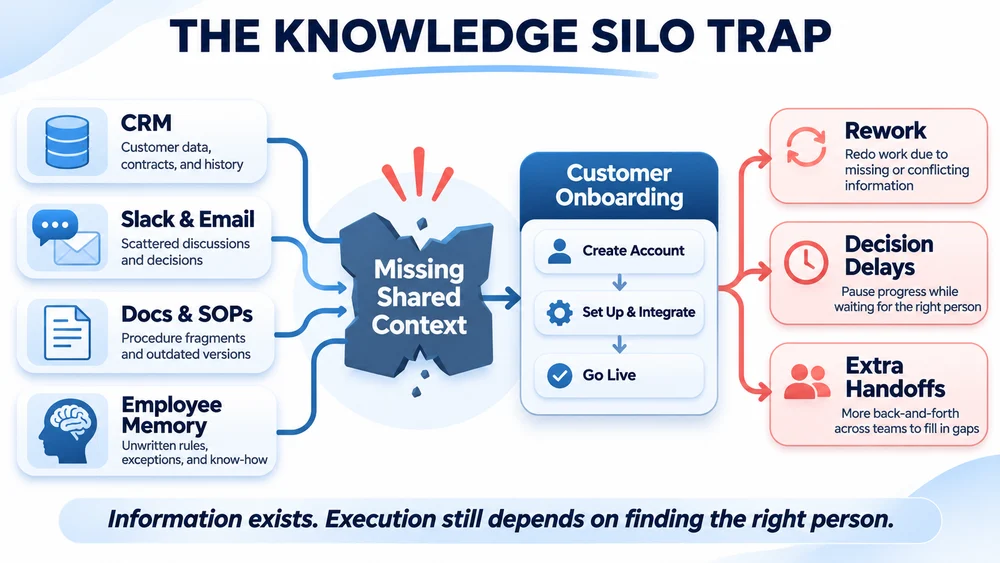
Knowledge silos slow onboarding, create rework, and concentrate critical know-how. Learn how to quantify the cost and turn fragmented knowledge into executable operations.

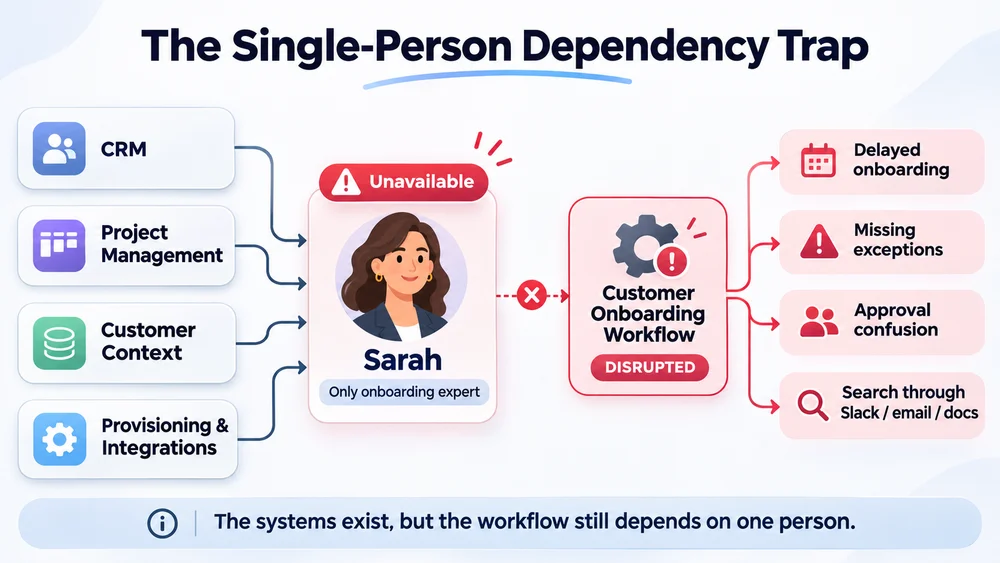
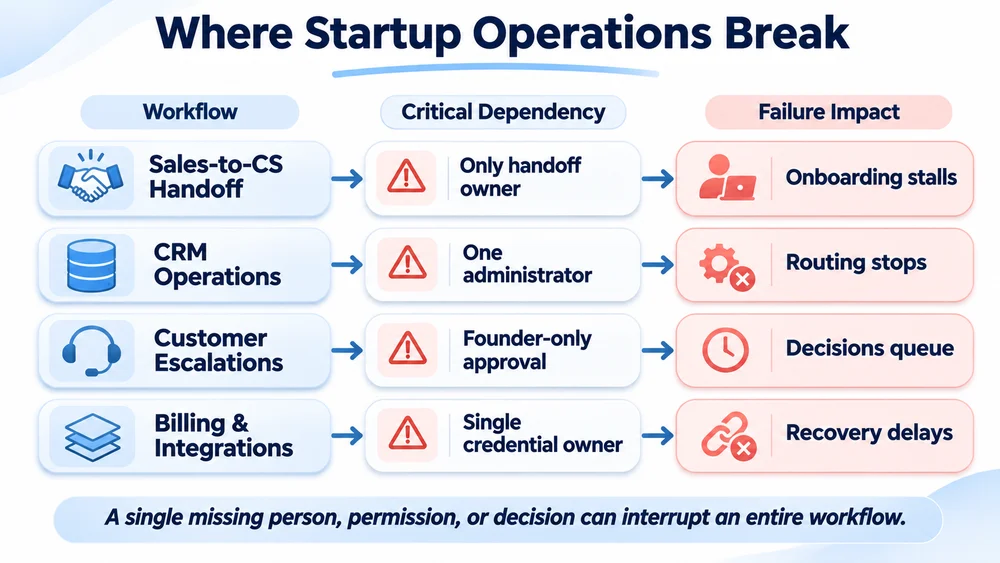
Find the people, permissions, hidden rules, and integrations that can halt critical startup operations. Use a workflow dependency map, risk matrix, and absence test.

A practical guide to securing startup AI agents with least privilege, six permission boundaries, human approvals, audit logs, and verifiable tests.

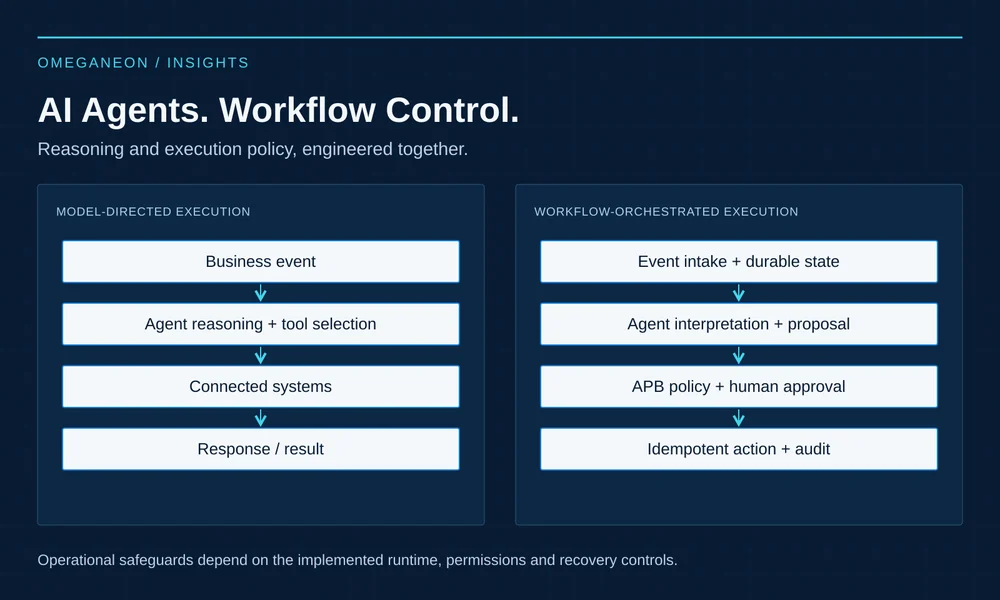
A production architecture comparison covering durable state, retries, approvals, agent permission boundaries, recovery, and executable failure-injection tests.

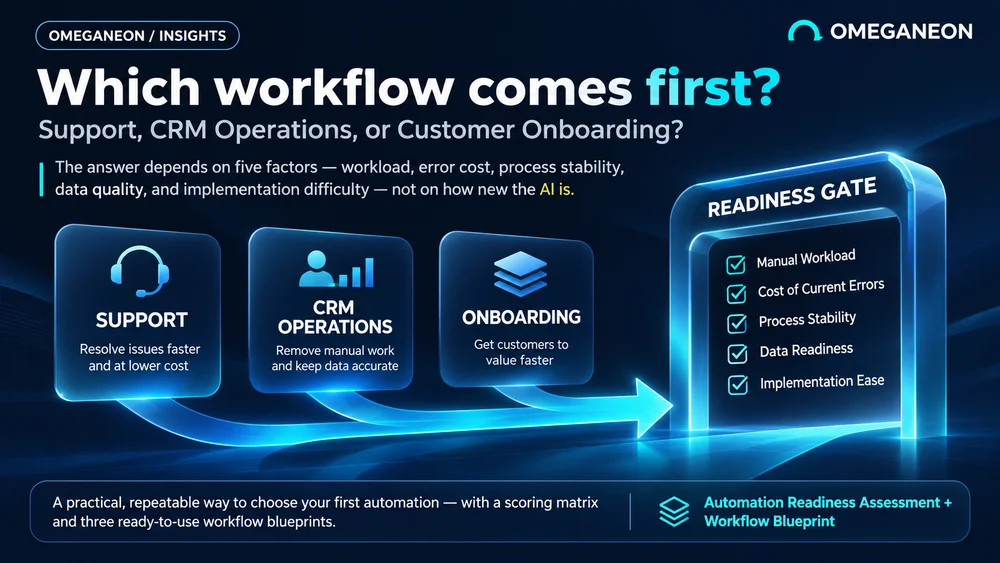
A five-factor automation readiness framework for startup operations, with support, CRM and onboarding workflow examples, weighted priorities and pilot acceptance gates.

A finance-ready model for AI workflow automation ROI, including realized savings, operating capacity, total cost of ownership, and sensitivity analysis.

A practical decision framework for Series A/B startups, comparing hiring, outsourcing and workflow automation with labor benchmarks, modeled costs and break-even analysis.

A practical, research-backed look at operating leverage for Series B startups, using SaaS benchmarks, public-company evidence, and a hypothetical onboarding case.

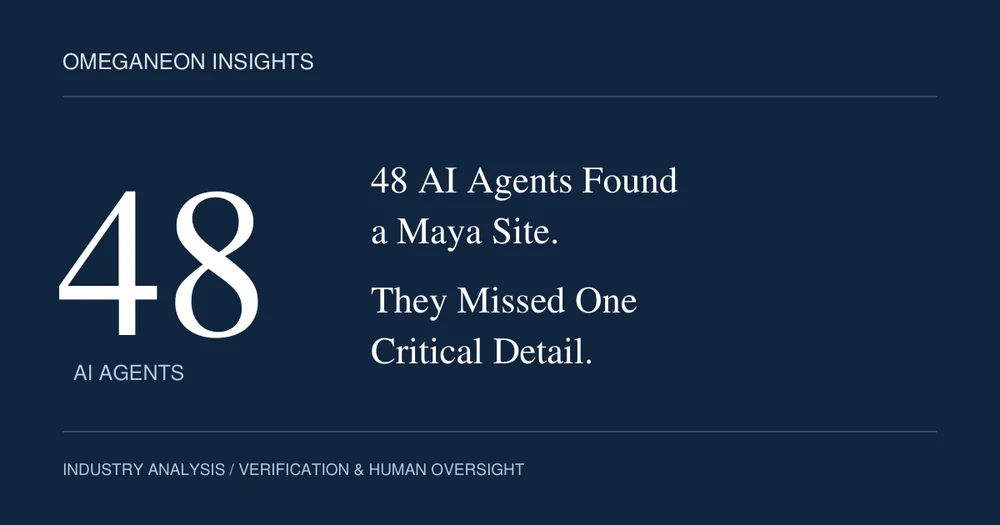
A Maya-site rediscovery shows why AI workflows need evidence verification, independent cross-checks and human review at consequential decisions.
We combine question-driven guides with analysis of AI industry events. Each article connects the evidence to a practical operating decision, with sources, independent analysis and clear limits.
Written for founders and operations leaders building the next stage of their business.
Explore our core whitepaper