In this article
The next unit of operating capacity has a price. Here is how to decide whether to buy it through another employee, an AI workflow, or both.

A Series A or Series B startup can double its customers without doubling every internal operation. But once support queues, CRM maintenance, order approvals, and reporting workloads begin growing, the same budget question surfaces: Should we hire another person—or change the way the work gets done?
The useful comparison is not employees versus AI in the abstract. It is the cost of delivering a defined amount of reliable work under two operating designs. Start with volume, quality requirements, exceptions, and the cash budget. Then select the lower-cost route that meets the operating target.
This article uses a transparent B2B SaaS support-operations scenario. The numbers are labeled hypothetical; the underlying labor and AI-productivity context comes from published research. The result is a purchase decision a COO and CFO can work through before authorizing another hire.
1. Start with the capacity gap, not the job description
An operations team is processing 1,800 customer requests per month. A new product launch increases its forecast to 2,400 requests. The existing two-person team has a practical, measured capacity of 1,000 requests per person per month, inclusive of its normal review and administration work.
The next period therefore begins with a gap between expected incoming demand and current capacity:
| Operating input | Monthly quantity |
|---|---|
| Current customer requests | 1,800 |
| Forecast customer requests | 2,400 |
| Existing team | 2 operations specialists |
| Human handling capacity | 1,000 requests per specialist |
| Existing total human capacity | 2,000 requests |
| Forecast capacity gap | 400 requests |
The 400-request gap is the capacity required just to keep up. The company also targets a maximum 90% human capacity utilization, preserving headroom for spikes and exceptions. At that utilization target, the existing team should process no more than 1,800 requests a month. The practical capacity requirement is therefore 600 requests.
That distinction changes the procurement decision. The team needs at least 600 requests of additional effective capacity—not necessarily one more employee.
2. Price the hire using fully loaded costs
Labor costs extend beyond base salary. They include benefits, payroll-related expenses, and the compensation package required to secure and retain the role.
The U.S. Bureau of Labor Statistics (BLS) reported that private-industry employers spent an average of $46.89 per hour worked in total compensation in June 2026: $32.82 in wages and salaries plus $14.07 in benefits. For the broader professional and technical services industry, the equivalent average was $75.98 per hour ($51.88 wages and $24.10 benefits). These are industry reference points, not a salary quote for the illustrative specialist below. [1][2]
For this scenario, the company budgets $108,000 per year in fully loaded incremental cash compensation for one additional operations specialist. This figure is a model assumption, including salary, employer costs, and benefits; it is not a BLS estimate for the role.
Before approving a requisition, the company should record its own complete cost: compensation, benefits, employer taxes, recruiting and onboarding cash, any role-specific tools, and the date at which the added employee reaches target throughput. Items that the existing team already pays for remain common costs unless the new approach changes them.
3. Price the workflow as an operating system, not a chatbot
A production AI workflow handles an explicit slice of the queue. For example:
- Capture and classify: ingest requests from the authorized support system; identify account and issue category.
- Retrieve verified context: read the approved knowledge base, customer entitlement, and applicable business rules.
- Execute bounded actions: complete routine status or policy-compliant requests within granted permissions.
- Escalate exceptions: hand complex, sensitive, and policy-exception cases to a named human owner.
- Log and monitor: record inputs, decisions, actions, errors, handoffs, and service outcomes for review.
The distinction matters operationally. A response draft is helpful; an authorized, monitored workflow with a measurable resolution outcome is a purchasable unit of operating capacity.
There is relevant real-world evidence for improving support productivity. In The Quarterly Journal of Economics (2025), Brynjolfsson, Li, and Raymond studied 5,172 customer-support agents and found that access to a generative AI assistant increased issues resolved per hour by 15% on average. That is an observed assistant-productivity result. [3]
The workflow economics below use a separate hypothetical 60% resolution rate among eligible routine cases. It is a scenario input, not a result attributed to that study or a performance claim about OMEGANEON.
Test the assumptions against the whitepaper’s financial sensitivity and break-even analysis.
4. A purchase decision: one more employee or one managed workflow?
Option A — Hire one more specialist
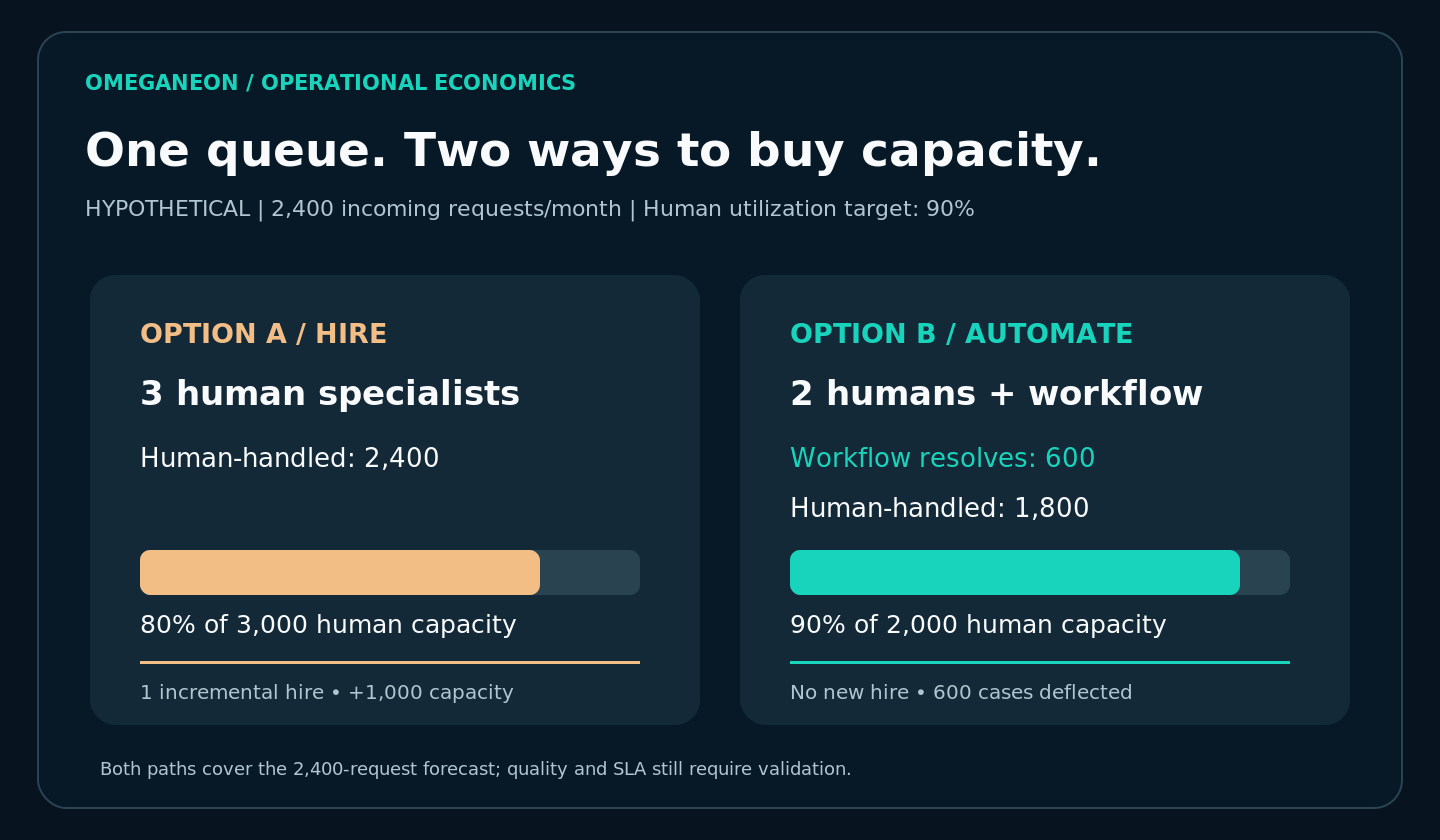
The current two-person team grows to three people. At 1,000 requests of capacity per specialist, the team can process 3,000 requests a month against the 2,400-request forecast: 80% utilization.
- Added annual fully loaded personnel cost: $108,000 (hypothetical).
- Additional capacity purchased: 1,000 human-handled requests/month.
- Human review of routine and exceptional requests remains part of normal staffing.
Option B — Implement and manage one bounded workflow
Suppose 1,000 of the 2,400 monthly requests meet the pre-agreed rules for routine automated processing. If the workflow resolves 600 of these 1,000 eligible requests to the required quality standard, the human queue falls to 1,800. The existing two specialists can meet that volume at 90% utilization.
- Routine requests successfully completed by the workflow: 600/month (hypothetical).
- Remaining human requests: 1,800/month.
- Existing human staffing: two specialists, with no new hire.
- Service-level and quality requirements: must pass production acceptance, including response time, reopen rate, exception escalation, and accuracy.
This is an avoided-hiring scenario. The two existing employees remain employed. The financial benefit is the approved third-person budget that the company no longer needs to spend after the workflow has proved sufficient.
First-year incremental cash budget
| Cost item | Hire one specialist | Implement and manage workflow |
|---|---|---|
| Incremental loaded personnel cost | $108,000 | $0 |
| One-time workflow implementation | $0 | $12,000 |
| Managed workflow operations | $0 | $48,000 |
| AI usage, hosting, and integrations | $0 | $7,200 |
| First 12 months, after production start | $108,000 | $67,200 |
| Annual difference | — | $40,800 |
All costs in this table are illustrative assumptions. Managed operations are modeled at $4,000/month and incremental API/hosting/integrations at $600/month. The $12,000 implementation figure is a modeling input, not an official OMEGANEON price quote. The comparison holds existing staff, base systems, and business volume constant. It begins at production start; pre-production parallel staffing, pilot costs, recruitment timing, and implementation ramp are not included.
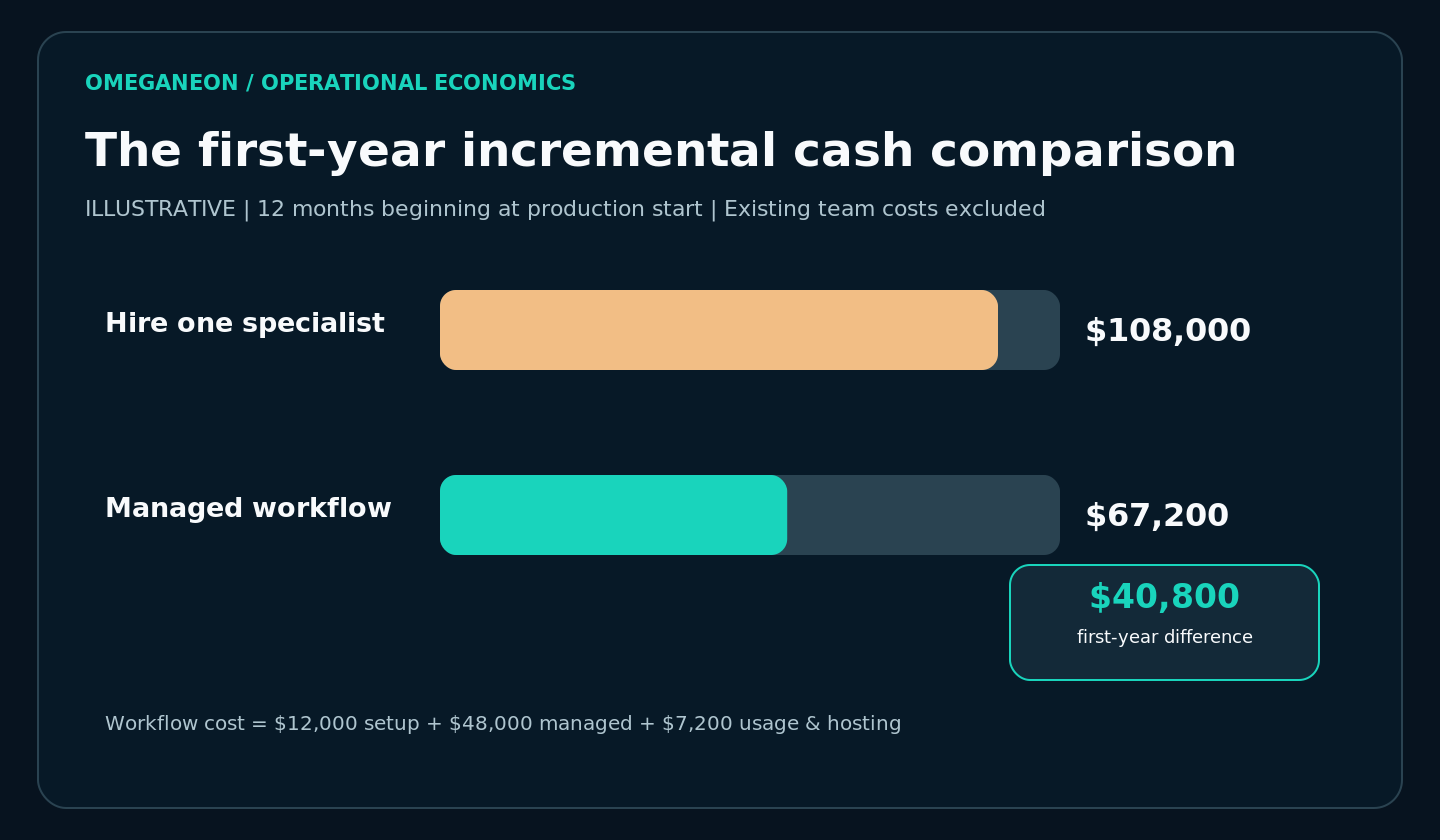
The decision: if both options meet the required service levels, the modeled workflow uses $40,800 less cash in the first 12 months, a 37.8% reduction in incremental spend. In a steady-state subsequent year without a new implementation fee, the difference rises to $52,800 under the same pricing and demand assumptions.
The first-year cost break-even is simple:
Hire cost = Implementation + 12 × (Managed operations + Usage & infrastructure)
In this scenario, a proposed workflow costing less than $108,000 in its first year beats the loaded cost of the new hire on incremental cash. Given the $12,000 implementation and $600 monthly infrastructure assumptions, the maximum break-even managed fee is $7,400/month.
5. Two thresholds, not one: cash and service capacity
The model has a financial threshold and an operational threshold. Passing only one is insufficient.
Financial threshold: $67,200 in year-one workflow spending compared with $108,000 for the additional employee.
Operational threshold: at least 600 routine requests/month must be fully and correctly resolved by the workflow, leaving no more than 1,800 for the existing two-person team.
| Verified resolution of 1,000 eligible cases | Resolved by workflow | Remaining human queue | Human utilization | Passes ≤90% target? |
|---|---|---|---|---|
| 30% | 300 | 2,100 | 105% | No |
| 40% | 400 | 2,000 | 100% | No |
| 50% | 500 | 1,900 | 95% | No |
| 60% | 600 | 1,800 | 90% | Yes |
| 70% | 700 | 1,700 | 85% | Yes |
The operational break-even in this case is 600 correctly closed requests per month. If the workflow delivers 400 instead, buying automation alone does not meet the 90% staffing-load target. The operating plan must change: narrow the automation scope and add capacity, or make the hire.
This is why a cost chart belongs next to a capacity chart. A cheaper system that fails the required service standard is not the winning option.
6. Read the payback clock correctly
With the production workflow operating, the monthly spending difference is:
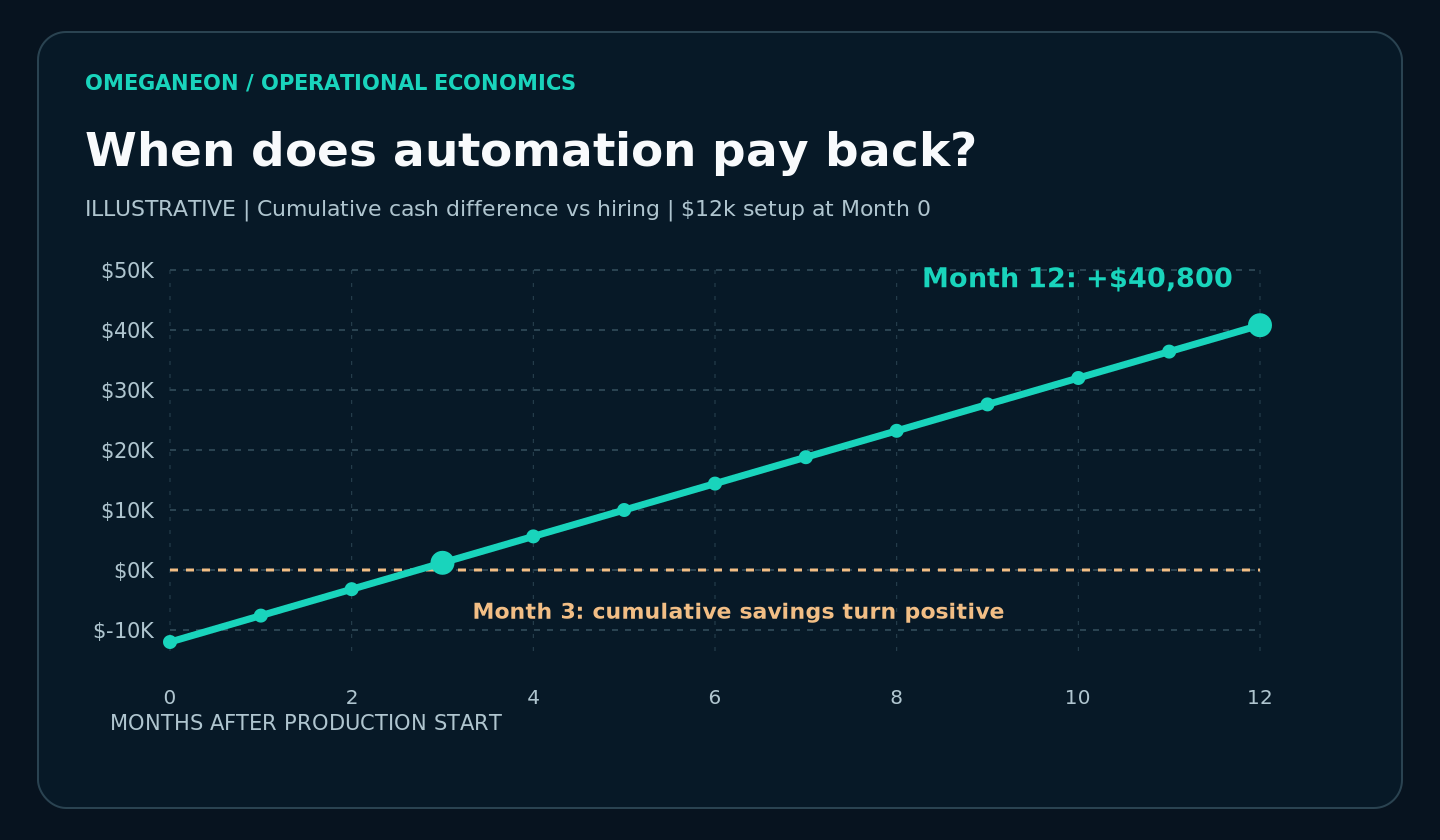
$9,000 hiring cost – ($4,000 managed + $600 usage) = $4,400/month.
An illustrative $12,000 upfront implementation cost is recovered after 2.73 months of production operation when compared with funding the additional hire from the same start date. Monthly cash snapshots cross above zero in month 3. By month 12, cumulative savings reach $40,800.
The start date is part of the model. If the company pays a pilot fee, runs both options in parallel, hires an interim contractor, or retains a new employee through a notice period, those cash flows must be added to the actual procurement model. Do not treat released staff hours as payroll dollars when the employees stay on the payroll; measure those hours as recovered capacity instead.
Explore the workforce transition economics in Scale Operations. Not Overhead. for the complete investment framework behind this analysis.
7. When to hire, when to automate, and when to do both
| Choose | Conditions that support the decision | Operating priority |
|---|---|---|
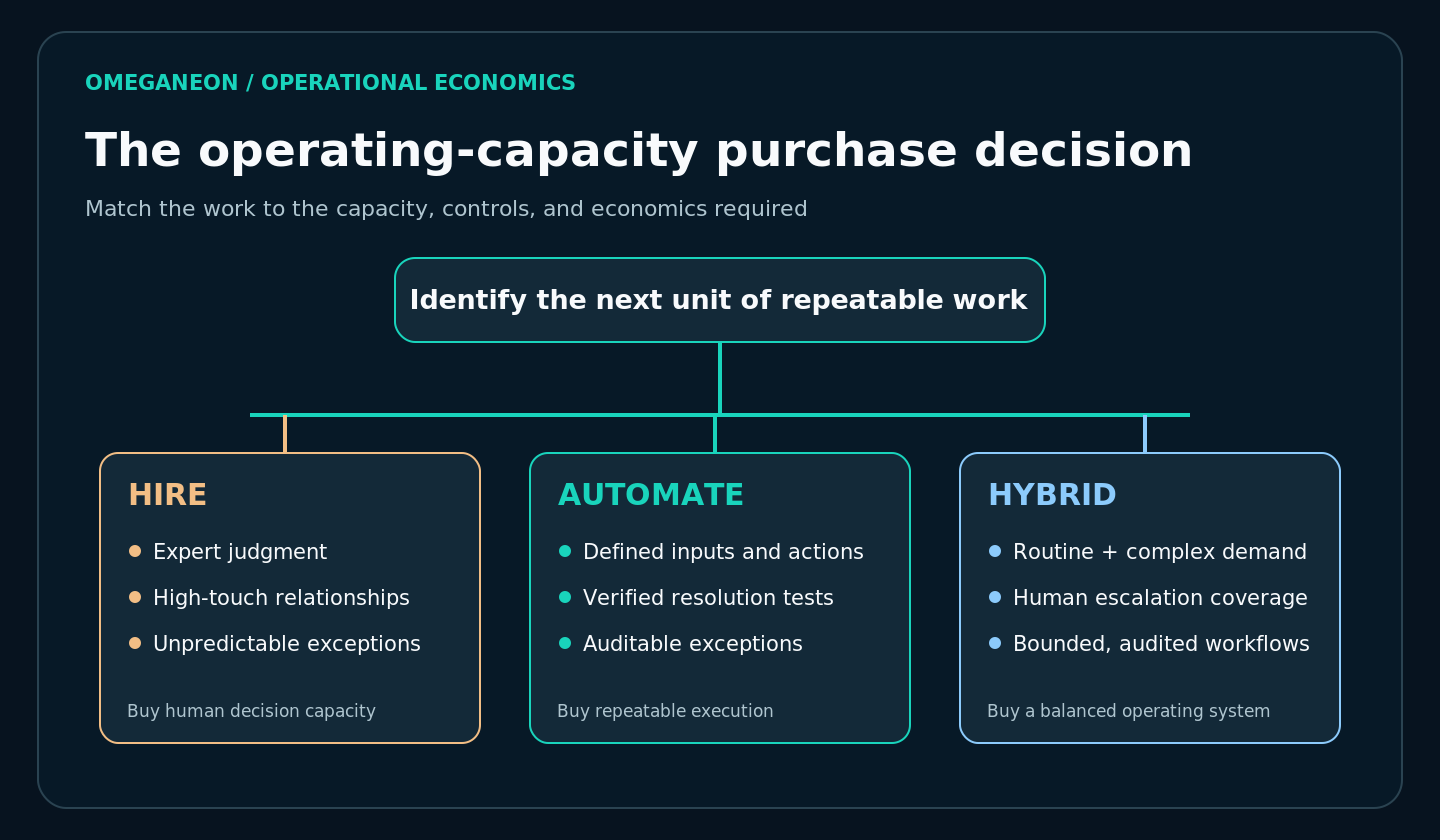
| Hire | Work requires continual judgment, relationship management, sensitive resolution, or unpredictable complex exceptions | Increase trained human capacity |
| Automate | High-volume tasks have defined inputs, authorized actions, testable completion, and manageable exceptions | Increase repeatable throughput at controlled cost |
| Hybrid | Routine traffic can be automated but growth also increases complex human cases | Separate routine execution from expert decision-making |
This framework converts a debate about AI into a specific capacity purchase. For a support team, the answer can be different for account-status checks, refund exceptions, contract disputes, and enterprise escalations—even when all four arrive in the same queue.
8. What OMEGANEON would verify before production
A workflow implementation should produce an acceptance record, not just a demonstration video. For this scenario, the operating owner should be able to inspect the following deliverables:
| Deliverable | Evidence or decision required |
|---|---|
| Workflow boundary | Eligible request categories, exclusions, approved integrations, and action limits |
| Baseline measurement | Incoming volume, human capacity, first-response time, resolution time, reopen rate |
| Controlled test set | Realistic routine cases, difficult edge cases, unauthorized-action tests |
| Capacity proof | At least 600 verified completed routine requests/month equivalent at the planned demand mix |
| Quality and safeguards | Agreed accuracy, SLA, escalation, audit logs, and human-approval checkpoints |
| Financial result | Complete incremental cash costs plus quantified staffing capacity gained |
| Production approval | Signed SOW, appropriate security and data terms, authorized production access, acceptance sign-off |
| Managed operations | Ongoing monitoring, error recovery, exception queues, change control, and performance reporting |
OMEGANEON's standard $4,000 / 4-week Paid Pilot is an entry route for evaluating a defined workflow in an authorized sandbox, with scope and acceptance criteria set by the signed SOW. The Paid Pilot is not automatic production deployment. Formal production implementation and Managed Operations require their own contractual scope, approvals, and acceptance. The $4,000 pilot fee is not included in the hypothetical $67,200 production-year comparison above; applicable credits and transition terms depend on the signed agreement.
The commercial test is straightforward: can the proposed workflow reliably absorb the specific capacity gap at a lower incremental total cost than hiring? The answer belongs in the acceptance results, the budget model, and the subsequent operating reports.
The next capacity decision
Hiring adds people. Automation adds repeatable execution. A hybrid design assigns each to the work it handles best.
At Series A/B, the most valuable question is therefore not "Can AI replace this role?" It is "Which part of the next 600 units of work should we buy as software-governed execution—and which part demands more human capacity?"
Define the workload. Compare incremental cash. Test the service threshold. Then fund the operating design that scales the business with the least unnecessary overhead.
OMEGANEON — AI Workflow Implementation & Managed Operations
Find the workflow. Prove the economics. Put it into operation.
CTA: Start a Chat · Explore a $4,000 / 4-week Paid Pilot
Research sources and model disclosure
Published empirical data
- U.S. Bureau of Labor Statistics, Employer Costs for Employee Compensation — June 2026 (published September 9, 2026). Private-industry average: $46.89/hour total compensation, with $32.82 wages and $14.07 benefits. https://www.bls.gov/news.release/ecec.nr0.htm
- U.S. Bureau of Labor Statistics, Employer Costs per Hour Worked, by Industry — June 2026. Professional and technical services: $51.88/hour wages and $24.10/hour benefits; total $75.98/hour. https://www.bls.gov/charts/employer-costs-for-employee-compensation/costs-by-industry.htm
- Erik Brynjolfsson, Danielle Li, and Lindsey Raymond, “Generative AI at Work,” The Quarterly Journal of Economics, Volume 140, Issue 2 (2025), pp. 889–942. Observed study: 5,172 customer-support agents; 15% average increase in issues resolved per hour after AI-assistant access. https://doi.org/10.1093/qje/qjae044
Hypothetical scenario inputs
Monthly requests (1,800 rising to 2,400), staff capacity (1,000 requests/person/month), routine eligible volume (1,000/month), workflow resolution rate (60% of eligible), 90% human-utilization threshold, one incremental hire ($108,000/year fully loaded), setup ($12,000), managed operations ($4,000/month), and incremental AI/infrastructure ($600/month) are modeling assumptions, not OMEGANEON client outcomes or vendor quotes. See calculation notes in the publishing package for the formulas and gates. Actual economics require validated baseline data, negotiated contract terms, operational acceptance, and the customer's real spending dates.
Put One Workflow Into Operation
Start a Paid Pilot — $4,000 · 4 weeks · One workflow.
Get a Workflow Assessment to define the implementation scope, acceptance criteria and Managed Operations plan.
Fund operating capacity with a clear investment case.
Compare full operating costs, multi-workflow economics, workforce transition paths and financial sensitivity—then set the evidence gates for implementation.
Build better operations.
Keep learning.
Practical research on AI workflows, operating costs, and scaling startup operations. Delivered by email.
The subscription form loads as you reach this section.
See the framework. Explore the work.
Agent Permission Boundaries, Human Approval & Audit Logs
Review the six APB permission primitives, human oversight and auditability used to bound business-system access.
Read the frameworkWHITEPAPERScaling, Just Like Drag-and-Drop.
Connect operating economics with implemented workflows and verifiable engineering evidence.
Read the frameworkRELATED CASE STUDY / START HEREERP Document Operations: From Manual Documentation to Managed AI Workflows
Review measured document execution, deterministic QA and human approval evidence.
Explore the case studyRELATED CASE STUDYScaling Creator Monetization Without Scaling Operational Work
Explore implemented customer lifecycle and revenue operations workflows.
Explore the case studyRELATED CASE STUDYAI-Powered Government Contract Opportunity Discovery & Qualification
See source-linked research, qualification rules and controlled review workflows.
Explore the case study