In this article
Increase operational capacity without increasing operating overhead in lockstep.

For a growing B2B startup, the next wave of customers should create more revenue—not an automatic requirement for another layer of operational headcount.
The problem emerges when every new account introduces more manual coordination: onboarding forms, internal handoffs, provisioning requests, status updates, reporting, and follow-ups. Revenue grows, but so does the amount of work required to deliver it. Hiring can solve the immediate capacity constraint. It also increases recurring burn.
There is another investment decision: automate the repeatable operating work, preserve human ownership of the judgment-intensive work, and measure the difference in cash.
This is a way to extend runway while continuing to invest in customer acquisition and delivery. The starting point is the next operational bottleneck—not an arbitrary company-wide cost-cutting target.
The runway pressure behind the next hiring plan
In Pilot's August 2026 analysis of roughly 1,000 cash-burning, venture-backed technology startups, 47% had less than 12 months of runway in June 2026, compared with 41% in June 2024. The figures come from Pilot's customer-based dataset. [1]
At the same time, growing companies are operating with different staffing patterns. Carta reported that average headcount among companies at Series B on its platform fell from 53 at its 2023 peak to 45 in 2025. [2]
The immediate question for a CEO or COO is therefore concrete:
When customer volume rises next quarter, which activities require more people—and which can be executed by a governed workflow?
A workflow is worth funding when it protects or increases the capacity that customers pay for while reducing the next increment of recurring expense.
Find the work behind the next hire
Start with the operating event that is driving the request for another employee. Then separate the work that needs a person from the work that needs reliable execution.
| Growth trigger | Repeatable work to automate | Work that stays human | Business result to measure |
|---|---|---|---|
| More new customers | Intake checks, provisioning tasks, status updates, handoff reminders | Exceptions, customer-specific decisions, escalations | Completed onboardings per month; time to value |
| More qualified inbound leads | Data enrichment, routing, CRM updates, bounded follow-ups | Discovery, relationship building, negotiation | Qualified opportunities handled per seller |
| Higher support volume | Classification, knowledge retrieval, ticket routing, approved responses | Sensitive cases, judgment calls, complex resolutions | Resolved cases per hour; response quality |
There is real evidence for task-level productivity improvements. A peer-reviewed study of 5,172 customer-support agents, published in The Quarterly Journal of Economics in 2025, found that access to generative-AI assistance increased issues resolved per hour by 15% on average. [3]
That research measures assisted support work. For an individual startup, the commercial decision still runs through its own workflow volume, staffing plan, service outcomes, and automation operating cost.
Explore the multi-workflow financial modeling in Scale Operations. Not Overhead. for the complete investment framework behind this analysis.
A worked example: 80 to 140 customer onboardings
Consider a hypothetical Series A/B B2B software company with a growing customer pipeline. Its existing team completes 80 customer onboardings per month. The company is budgeting for 140 per month in the next expansion phase.
The operations team has two options. The first is to add two onboarding specialists. The second is to automate the repeated onboarding coordination—while existing staff continue to own approvals, edge cases, and customer relationships.
Assumptions used in both scenarios
| Input | Modeled amount |
|---|---|
| Unrestricted starting cash | $3,600,000 |
| Existing monthly net cash burn, before new capacity | $250,000 |
| Current monthly onboarding throughput | 80 |
| Target monthly onboarding throughput | 140 |
| Additional employees in hiring scenario | 2 |
| Fully loaded cost per new employee | $132,000/year (assumption) |
| Workflow implementation | $10,000 one-time (assumption) |
| Workflow managed operations | $5,000/month (assumption) |
| AI/API/hosting costs | $1,000/month (assumption) |
| Revenue, quality, and target capacity | Held equal between scenarios (model assumption) |
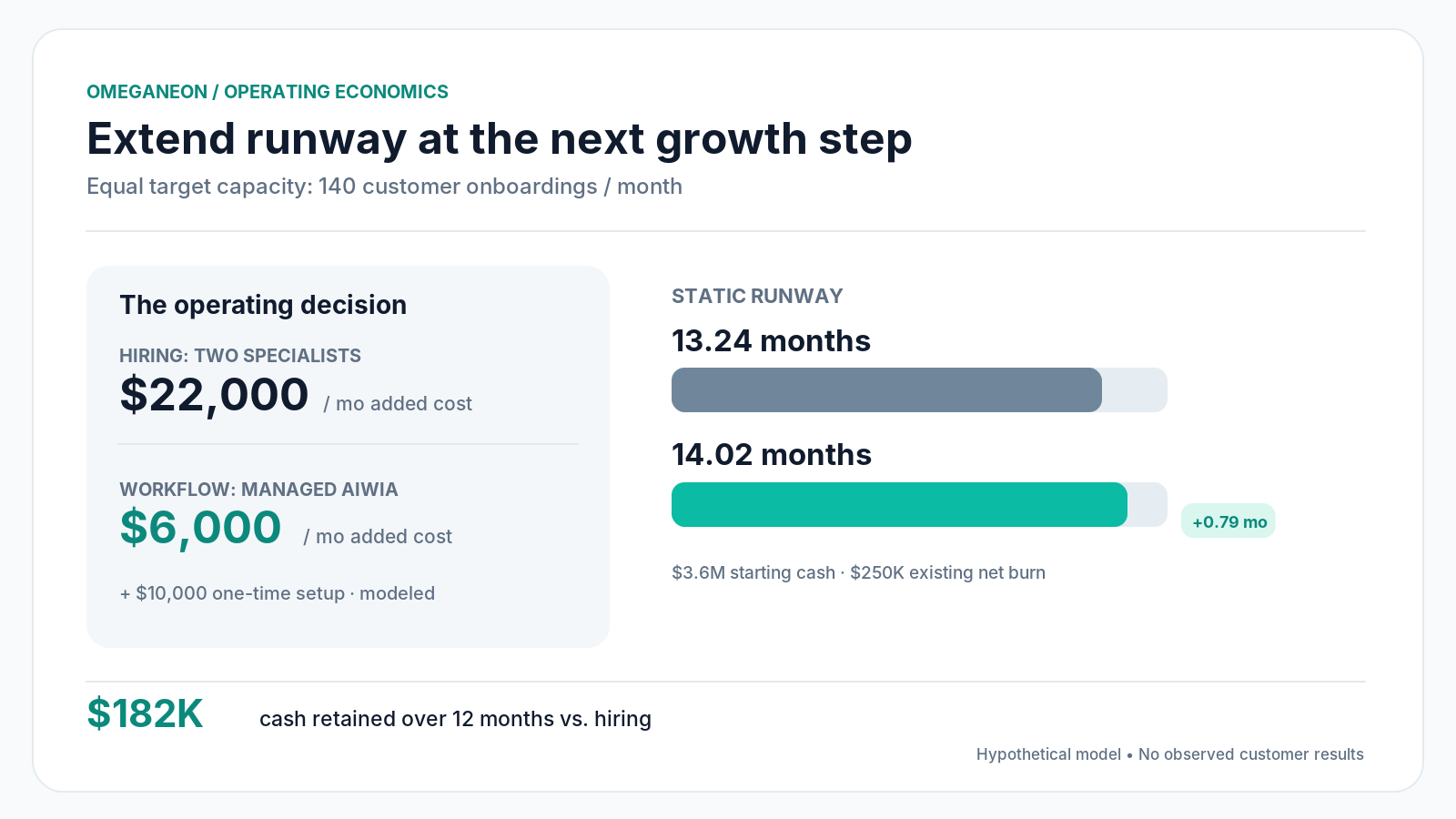
The hiring scenario adds $22,000 per month. The automated-workflow scenario adds $6,000 per month after a $10,000 one-time implementation expense. Both must meet the same 140-onboarding target and quality requirements before the financial comparison is useful.
| Metric | Add two hires | Implement managed workflow |
|---|---|---|
| Monthly incremental operating expense | $22,000 | $6,000 |
| Monthly total net burn | $272,000 | $256,000 |
| Initial implementation cash outlay | $0 | $10,000 |
| Static runway at modeled burn | 13.24 months | 14.02 months |
| Incremental runway | — | +0.79 months |
| Cash retained after 12 months vs. hiring plan | — | $182,000 |
The operating result: the company can budget for the same customer-delivery capacity with $16,000 less recurring monthly expense. After the illustrative one-time $10,000 implementation outlay, the twelve-month difference is $182,000 in cash retained.
The runway calculation is deliberately simple:
- Hiring: $3,600,000 ÷ ($250,000 + $22,000) = 13.24 months.
- Workflow: ($3,600,000 − $10,000) ÷ ($250,000 + $6,000) = 14.02 months.
This is a hypothetical, static-burn comparison, not an observed OMEGANEON client result or a month-by-month revenue forecast. The example assumes production readiness and equal throughput from the modeled start. The $10,000 implementation figure is a scenario input, not a published OMEGANEON rate.
Why this still preserves growth
The company is not reducing the target from 140 to 80 onboardings. It is changing how the additional 60 are delivered. The operating goal remains a higher number of live customers, with delivery quality and human escalation measured alongside it.
Growth funding can remain pointed at demand generation, product improvements, and customer success while the workflow carries a larger share of operational repetition.
What the workflow actually takes over
A useful onboarding workflow is more than a bot that writes a welcome email. It coordinates the work from an authorized trigger to a verified result.
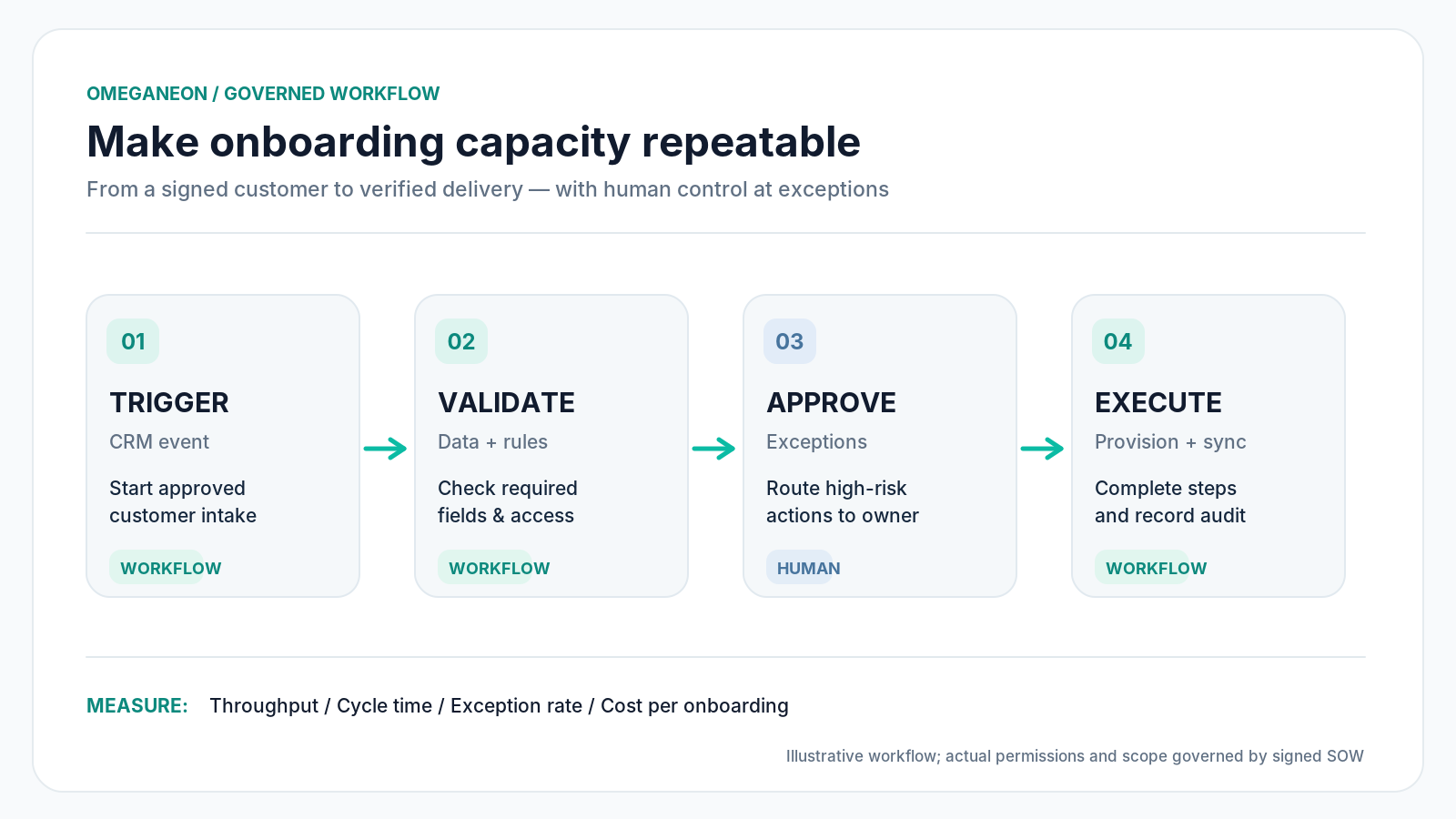
A production-ready design includes the following operating behavior:
- Trigger and intake. A signed customer or approved CRM stage starts the workflow. Customer records and required documents are collected.
- Validation. The workflow checks required fields, permissions, duplicate records, and defined handoff rules.
- Human-in-the-loop. High-impact decisions, unclear entitlements, and exceptional cases are routed to an authorized owner for approval.
- Execution and recovery. Approved steps provision services, update the CRM, notify relevant teams, and retry or escalate failed actions.
- Audit and measurement. The system records status, approvals, exceptions, outcomes, and the version of the workflow that ran.
The customer receives a reliable onboarding process; the operations team spends its attention on work that needs customer context or human judgment.
Test the assumptions against the whitepaper’s financial sensitivity and break-even analysis.
Make the decision with a 4-week proof plan
Start with one measurable workflow, not an organization-wide transformation program.
| Stage | Business decision | Evidence to produce |
|---|---|---|
| 01 — Baseline | Identify the next capacity bottleneck and approved hiring plan | Monthly volume, touch time, error/rework rate, full labor cost, service-level targets |
| 02 — Design | Define the exact work assigned to automation | Workflow blueprint, rules, integrations, permissions, exceptions, owner approvals |
| 03 — Paid Pilot | Test the workflow against predefined acceptance criteria | Sandbox test runs, failure cases, measured throughput, human-review load, cost model |
| 04 — Production decision | Approve production use only after security and operating acceptance | Signed SOW/authorization, production tests, responsibility matrix, monitoring plan |
| 05 — Managed operations | Compare ongoing performance with the hiring alternative | Monthly burn impact, output, quality, exception volume, uptime, maintenance spend |
OMEGANEON's standard Paid Pilot is $4,000 for 4 weeks for a contract-scoped workflow in an authorized sandbox. Production deployment and ongoing Managed Operations belong to a separate signed engagement and acceptance process. The contracted scope and verification criteria govern the work.
What the CFO and COO should review together
A concise monthly scorecard should carry six numbers: throughput, cycle time, cost per completed workflow, exception rate, committed hiring avoided or deferred, and net monthly cash impact.
The cash line is especially straightforward:
Net monthly cash impact = avoided or reduced cash operating expense − managed workflow costs − additional infrastructure costs.
Track the one-time implementation outlay separately. For existing employees who remain on payroll, use recovered capacity as an operational metric; record a cash saving when an actual expense disappears or a budgeted hire is deferred.
For a hiring request that has already been budgeted, the workflow is a direct capital-allocation alternative. For an existing team, it can be an expansion lever: handle additional volume first, then decide where a new specialist will create the most value.
Scale customer delivery, not the coordination burden
Longer runway and faster growth do not have to compete for the same dollars. The decisive move is to fund the capacity a business needs, then choose an operating design that delivers it with the lowest sustainable cash requirement.
For a Series A/B company preparing its next hiring plan, that can start with a single question: Which recurring workflow is forcing the next operational hire?
OMEGANEON implements and manages AI-powered workflows that turn that answer into a governed, measurable operating system.
Next step: Start a Chat. Review one high-volume workflow, quantify the cost of the next capacity increase, and define the evidence needed for a paid implementation decision.
Research and source notes
- Pilot (August 25, 2026). H1 2026 VC Market Update: The 5 Trends Defining Startup Fundraising. Analysis of approximately 1,000 cash-burning venture-backed technology startups in the Pilot customer dataset. https://pilot.com/blog/h1-2026-vc-market-startup-fundraising-trends
- Carta (May 4, 2026). State of Startup Compensation: H2 2025. Series B average headcount declined from 53 at its 2023 peak to 45 in 2025. https://carta.com/data/startup-compensation-h2-2025/
- Brynjolfsson, Li, and Raymond (2025). Generative AI at Work. The Quarterly Journal of Economics, 140(2), 889–942. 5,172 support agents; 15% average improvement in issues resolved per hour. https://doi.org/10.1093/qje/qjae044
- U.S. Bureau of Labor Statistics (September 9, 2026). Employer Costs for Employee Compensation — June 2026. Private-industry average hourly employer compensation: $46.89, comprising $32.82 wages and salaries and $14.07 benefits. Included as employer-cost context; the worked-example salaries are separately assumed amounts. https://www.bls.gov/news.release/ecec.nr0.htm
Editorial disclosure: All business, hiring, price, conversion, throughput, and runway figures in the worked example are hypothetical modeling inputs or outputs. The cited external studies are independently identified above. No customer outcome is represented as an OMEGANEON case study.
Put One Workflow Into Operation
Start a Paid Pilot — $4,000 · 4 weeks · One workflow.
Get a Workflow Assessment to define the implementation scope, acceptance criteria and Managed Operations plan.
Fund operating capacity with a clear investment case.
Compare full operating costs, multi-workflow economics, workforce transition paths and financial sensitivity—then set the evidence gates for implementation.
Build better operations.
Keep learning.
Practical research on AI workflows, operating costs, and scaling startup operations. Delivered by email.
The subscription form loads as you reach this section.
See the framework. Explore the work.
Agent Permission Boundaries, Human Approval & Audit Logs
Review the six APB permission primitives, human oversight and auditability used to bound business-system access.
Read the frameworkWHITEPAPERScaling, Just Like Drag-and-Drop.
Connect operating economics with implemented workflows and verifiable engineering evidence.
Read the frameworkRELATED CASE STUDY / START HEREERP Document Operations: From Manual Documentation to Managed AI Workflows
Review measured document execution, deterministic QA and human approval evidence.
Explore the case studyRELATED CASE STUDYScaling Creator Monetization Without Scaling Operational Work
Explore implemented customer lifecycle and revenue operations workflows.
Explore the case studyRELATED CASE STUDYAI-Powered Government Contract Opportunity Discovery & Qualification
See source-linked research, qualification rules and controlled review workflows.
Explore the case study