06 — Measured Outcomes
From procurement data to faster pursuit decisions
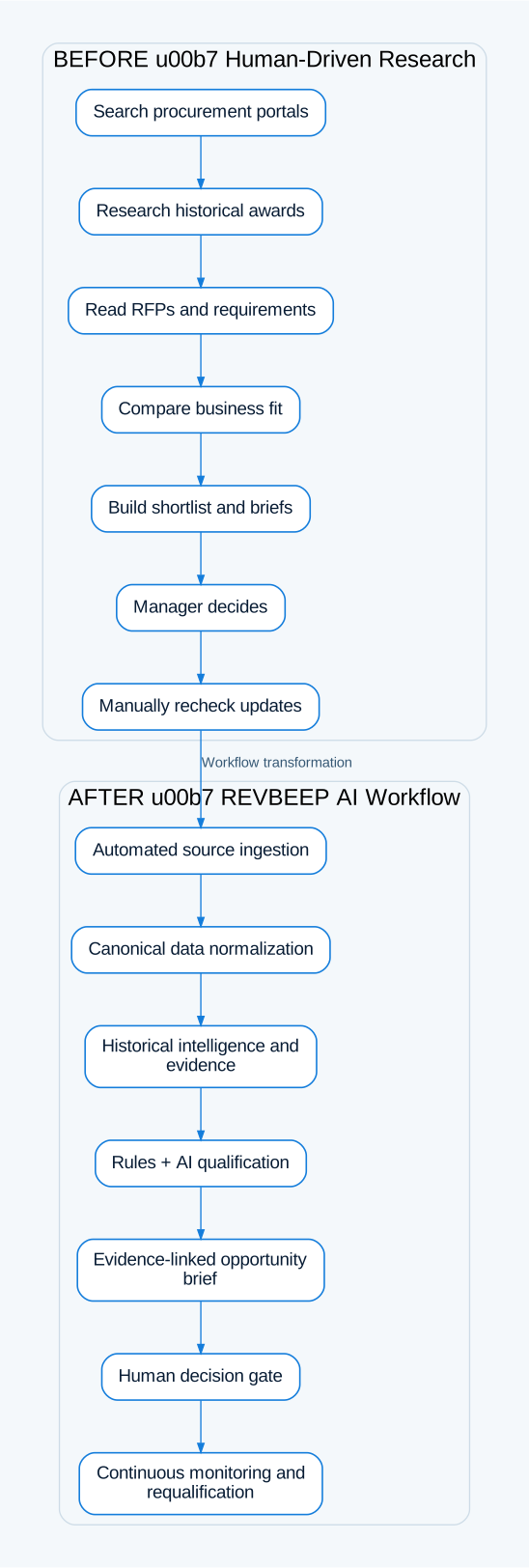
REVBEEP automates routine procurement ingestion and first-pass triage, prepares evidence-linked qualifications, and leaves pursuit authorization with human reviewers. The actual REVBEEP review benchmark is 10–15 minutes per target RFP; routine automated triage requires 0 human hours. Machine execution, escalated exceptions, and formal proposal preparation are separate from that human review measure.
Outcome Dashboard — Four Business Outcomes
REVBEEP's results are presented through four connected business dimensions: Human Hours Saved, Qualification Throughput, Cost per Qualified Opportunity, and Operational Transferability. These measures connect operational efficiency to processing capacity, unit economics, and expansion potential.
01 · Human Hours Saved — Remove repetitive work from the decision cycle
In the modeled two-RFP weekly workload, manual portal research requires 459–958 active human minutes, an AI-enabled commercial aggregator requires 193–462 minutes, and REVBEEP requires 20–30 minutes of routine human review.
Derived savings: REVBEEP removes 429–938 human minutes per week compared with manual portals and 163–442 minutes per week compared with the modeled AI-enabled aggregator workflow. These are scenario-derived differences; the task-level calculation appears below.
The underlying REVBEEP operational benchmarks remain 0 human hours for routine weekly triage and 10–15 minutes of human review per target RFP. Escalated exceptions are recorded separately.
02 · Qualification Throughput — Measure completed decisions, not search results
The comparison workload moves through a defined qualification funnel:
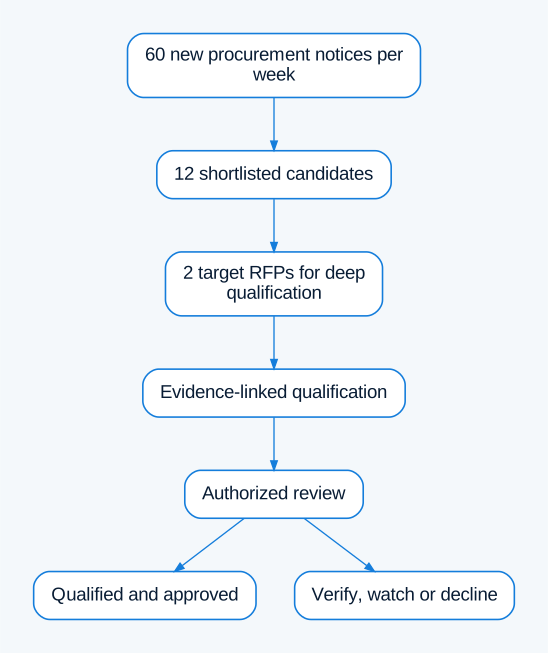
Open full workflow diagram
Production throughput is counted from completed QualificationRuns and their reviewed outcomes, reported with the measurement period, evidence version, and exception status. Source notices, shortlisted candidates, completed reviews, and verified qualified opportunities are distinct counts.
Operational question answered: How many qualified pursuit decisions can the same team complete within a given period?
03 · Cost per Qualified Opportunity — Connect automation to unit economics
Cost is calculated using one consistent period and one consistent definition of qualified: an opportunity with a completed, evidence-backed positive qualification confirmed under the applicable business decision process.
Cost per Qualified Opportunity =
  (Human review labor
   + Human exception-handling labor
   + AI / compute / runtime costs
   + Procurement-source and platform costs
   + Allocated managed-operations fees)
  / Number of verified qualified opportunities
All three workflows use equivalent inclusion rules. Manual and aggregator comparisons include the cost of human research time and any relevant subscriptions; REVBEEP includes managed operations and runtime costs. If a reporting window contains no verified qualified opportunities, the metric is reported as N/A, not $0.
Operational question answered: What does it cost to deliver one useful, verified pursuit opportunity—not merely to surface one more notice?
04 · Operational Transferability — Reuse the operating system beyond GovCon
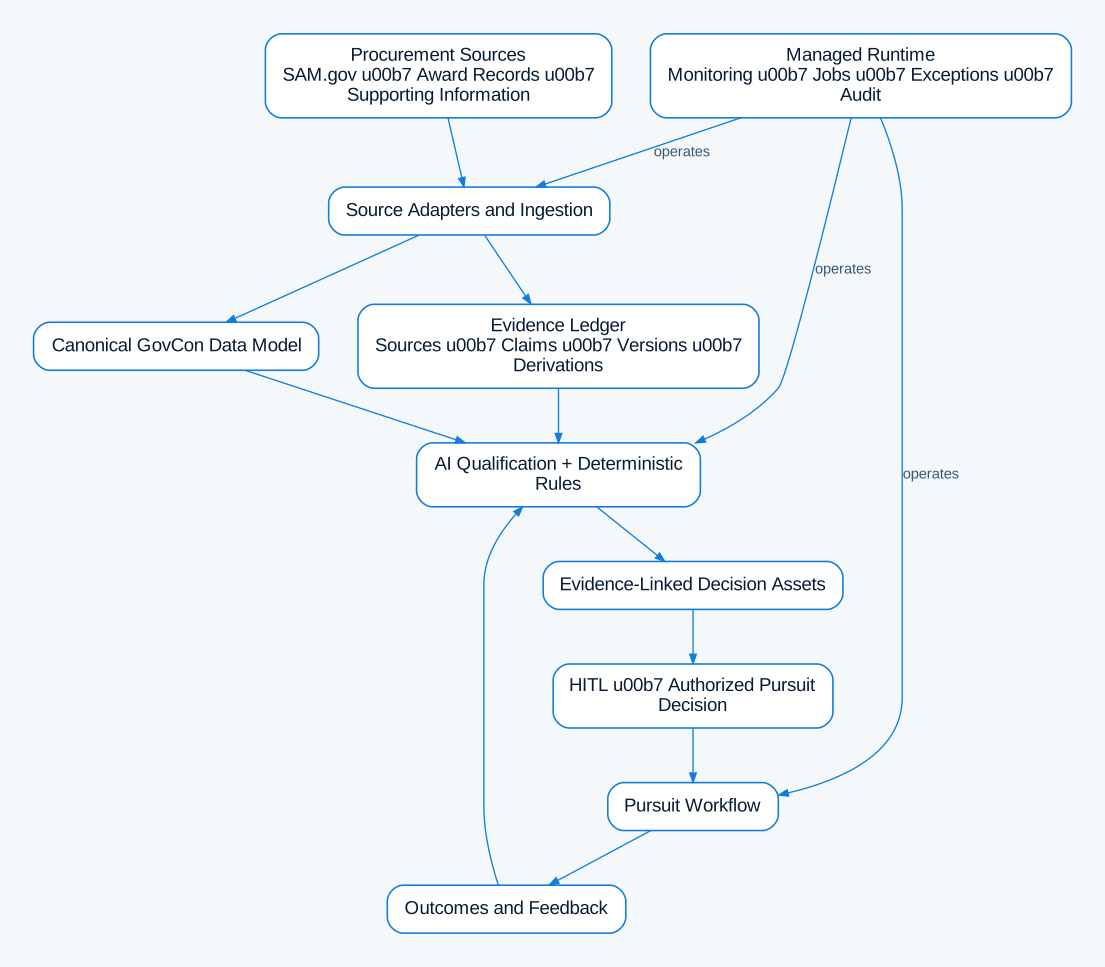
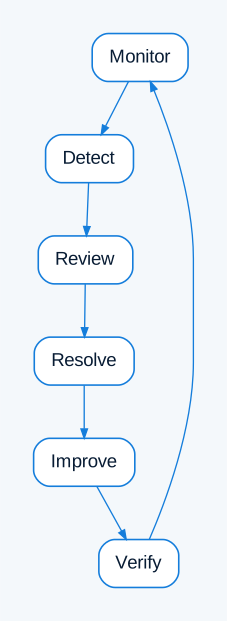
REVBEEP's reusable value extends beyond government procurement data. The business source adapters, taxonomies and qualification criteria change by industry, while core execution patterns can be applied to other evidence-heavy workflows.
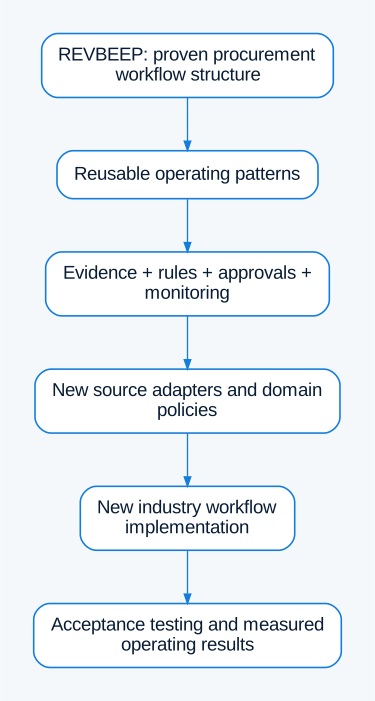
Open full workflow diagram
The transferability scorecard is designed to record percentage of core workflow components reused, time to deploy and validate an adapted workflow, and new-domain acceptance results. It distinguishes reusable architecture from a separately verified second-domain deployment.
Operational question answered: Can a proven workflow implementation become the foundation for the next department, process, or industry use case?
This bottom-up model estimates each operator action before calculating the final totals. It does not distribute predetermined total hours across tasks. The manual and aggregator estimates are scenario-specific calculations, while REVBEEP's 10–15-minute review figure is the separately established operating benchmark.
Fixed comparison workload: 60 new procurement notices/week → 12 selected for basic eligibility review → 2 target RFPs/week for deeper qualification. One workweek is five business days. The target RFP is moderately complex, with a main solicitation and supporting material. The comparison counts human active working time, not unattended processing or formal proposal writing. Saved searches are allowed for manual portals; commercial platforms are modeled with saved searches and current AI-assisted features, rather than pretending they are purely manual.
A. Weekly opportunity triage — action-by-action estimate
REVBEEP: Routine first-pass ingestion, filtering, and candidate prioritization are automated (0 routine human minutes/week). Any exceptional manual intervention is recorded separately.
B. Deep-dive qualification — action-by-action estimate
Unit: One target RFP already selected from the weekly triage. The initial skim and basic eligibility check in Section A are not repeated here. This stage covers detailed qualification and a bid/no-bid brief, not writing or submitting the final proposal.
C. REVBEEP — human decision review
The machine prepares the underlying research and evidence-linked brief. The human review can be decomposed independently as follows:
The independent 9–16-minute estimate and the recorded 10–15-minute operating benchmark are two separate lines of evidence. Complex exceptions are handled as additional work rather than silently included in routine review.
D. Weekly capacity model
Let N be the number of target RFPs receiving deep-dive qualification in a week. With the fixed 60-notice screening scope, total human time is:
Manual portals:             [183 + 138N, 368 + 295N] minutes/week
AI-enabled aggregator:      [ 69 +  62N, 166 + 148N] minutes/week
REVBEEP (actual benchmark): [     10N,       15N] minutes/week
For N = 2 target RFPs per week:
Derived human-time differences, two-RFP scenario: REVBEEP leaves 7h 09m–15h 38m less manual work than the modeled portal workflow and 2h 43m–7h 22m less than the modeled AI-enabled aggregator workflow. These differences are scenario calculations, not an additional production experiment.
Per-RFP reduction against this independent task model (using REVBEEP's actual 10–15 min benchmark):
- Versus manual portals: 89.1%–96.6% less human time.
- Versus AI-assisted commercial aggregator: 75.8%–93.2% less human time.
The percentages use conservative endpoints: 1 − 15/138 through 1 − 10/295, and 1 − 15/62 through 1 − 10/148. They are calculations from modeled competitor workflows and REVBEEP's reported human review time—not direct, matched real-world trials.
E. Previously established Industry Effort Benchmark (retained)
The separately provided real industry effort benchmarks remain intact. They are not the totals used to derive Sections A–D.
The older benchmark and the new bottom-up estimate describe different evidence categories and workload assumptions. Keeping both makes the comparison auditable without forcing task estimates to reproduce a known total. At higher notice volumes and more complex RFPs, working time increases; at lower volumes, it decreases.
F. Flow and measurement controls
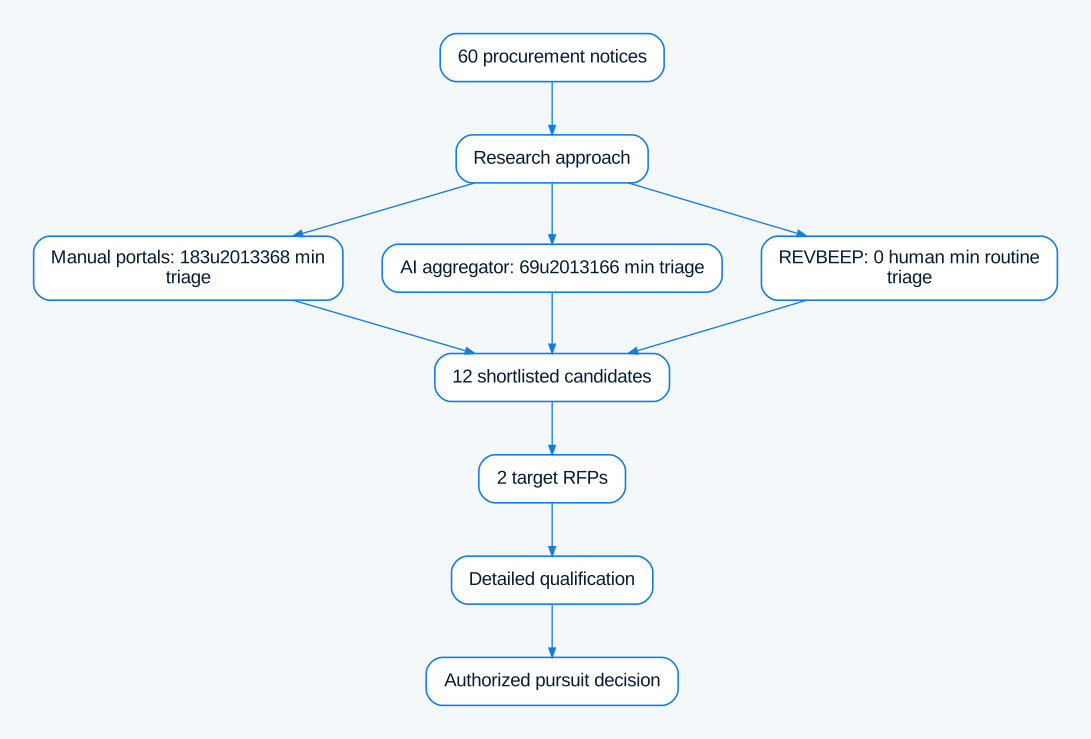
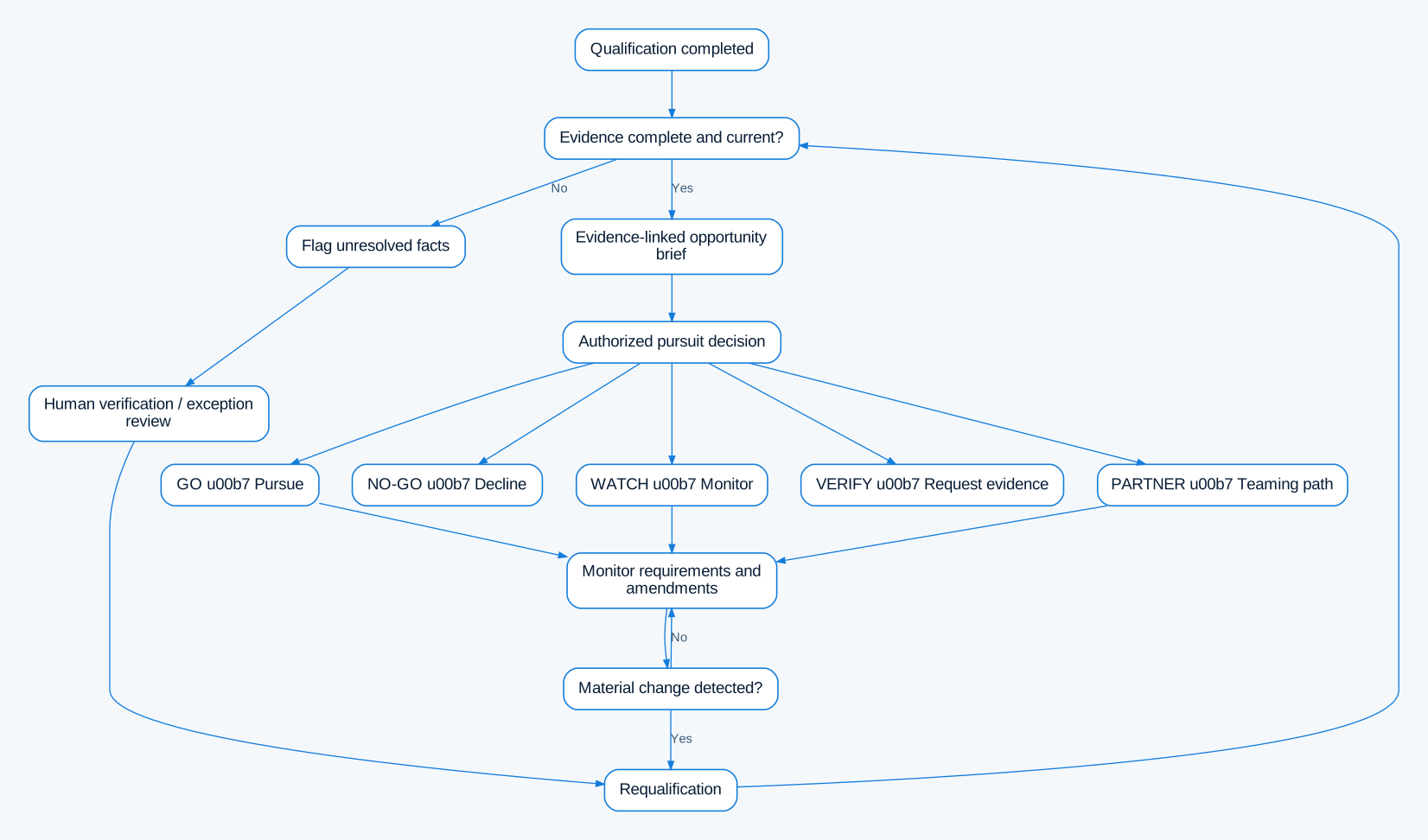
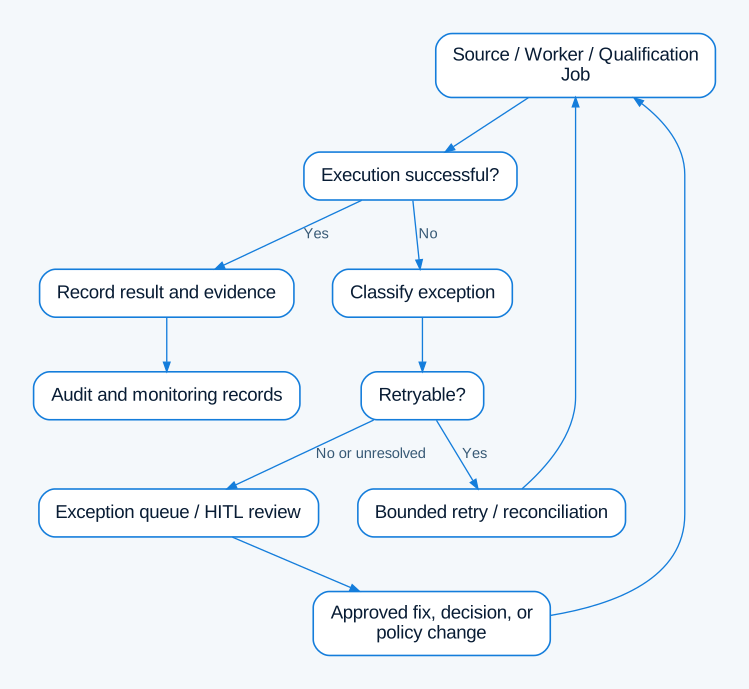
Open full workflow diagram
Internal measurement fields: week, source scope, raw notices, shortlisted notices, selected RFPs, document complexity, operator, action start/end times, workflow run ID, exception count and length, evidence version, approval result, and cloud operating cost. Use recorded stopwatch/task-timestamp evidence for subsequent observed cohorts.
Engineering and operating outcomes
REVBEEP's built system combines a canonical procurement model, evidence-linked qualification, version-aware decision records, background workflow execution, and continuing operating controls.
Business outcome: REVBEEP moves routine procurement research into automated workflow execution and concentrates human time on reviewing evidence-backed opportunities and making pursuit decisions.