06 — Measured Outcomes
Verified execution. Four dimensions of business value.
Verified delivery dashboard · November 2, 2026
What these results make possible
- One source of operational truth: revenue, work requiring attention, and activity are visible through one Creator management view.
- Consistent financial state: tests verified exact-unit projection behavior, agreement-specific revenue rules, immutable financial source history, and consistent calculation versions.
- Controlled action: tested Creator/Fan and cross-Creator boundaries reject unauthorized access.
- Resilient information presentation: the interface handles loading, empty, partial and stale information states, preserving relevant next actions.
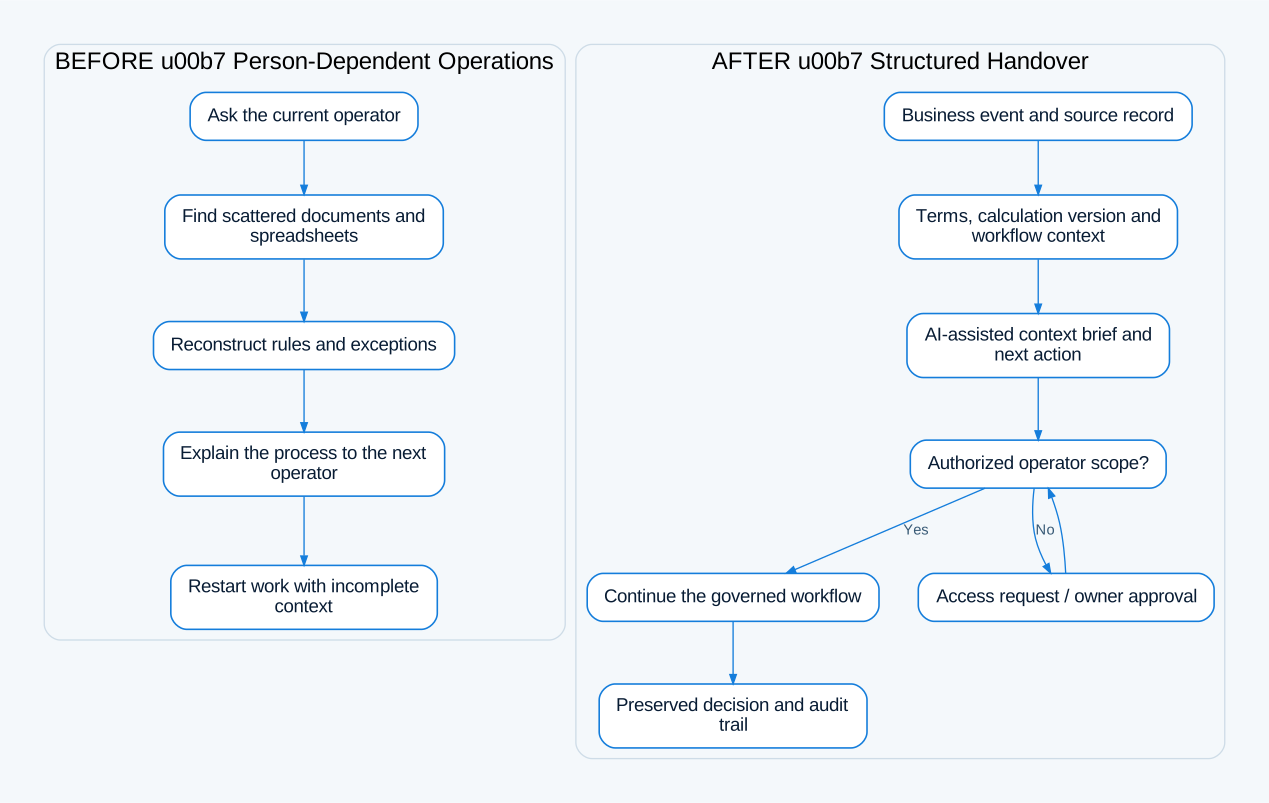
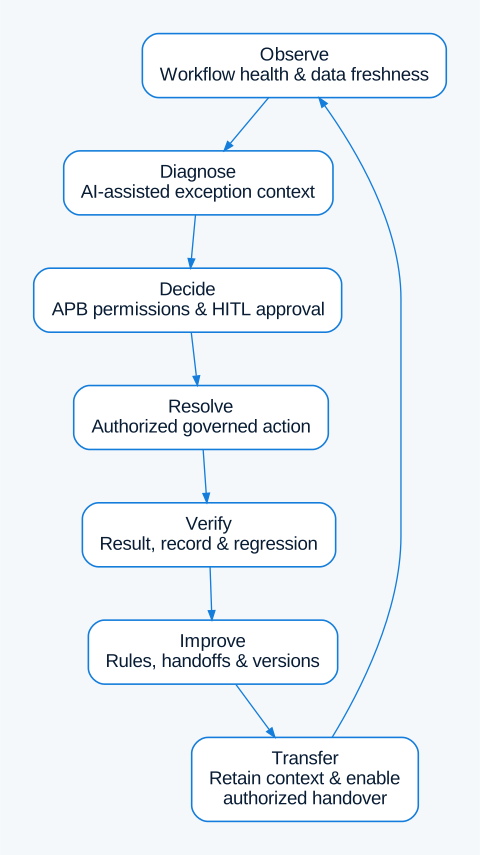
- Transferable operating foundation: versioned financial context, preserved source history, contextual actions, and verified tenant separation keep workflows understandable without depending on one person's private notes.
The operating economics
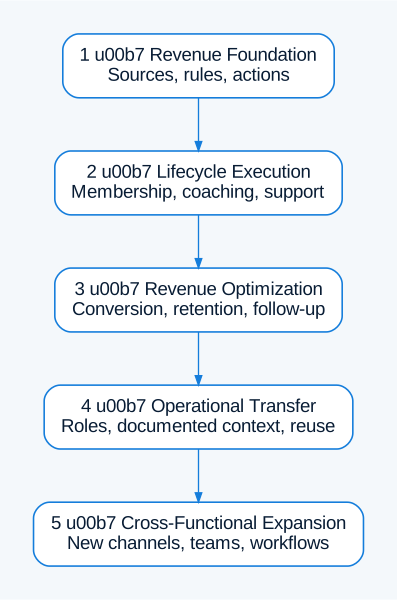
The commercial value of this system is organized around four outcomes. The first three address time and revenue performance; the fourth measures whether the operating method can be handed over and reused without rebuilding it.
Measurement scope: time savings are modeled; revenue uplift, conversion uplift and handover duration have not been measured.
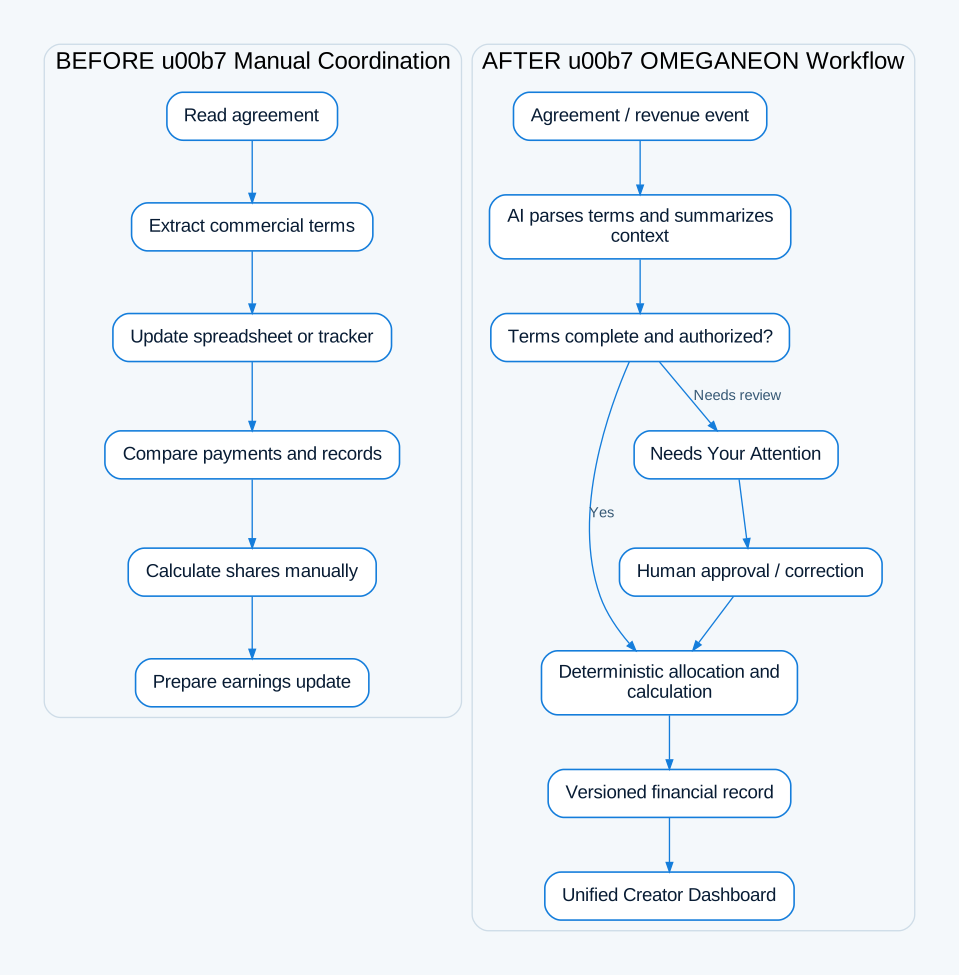
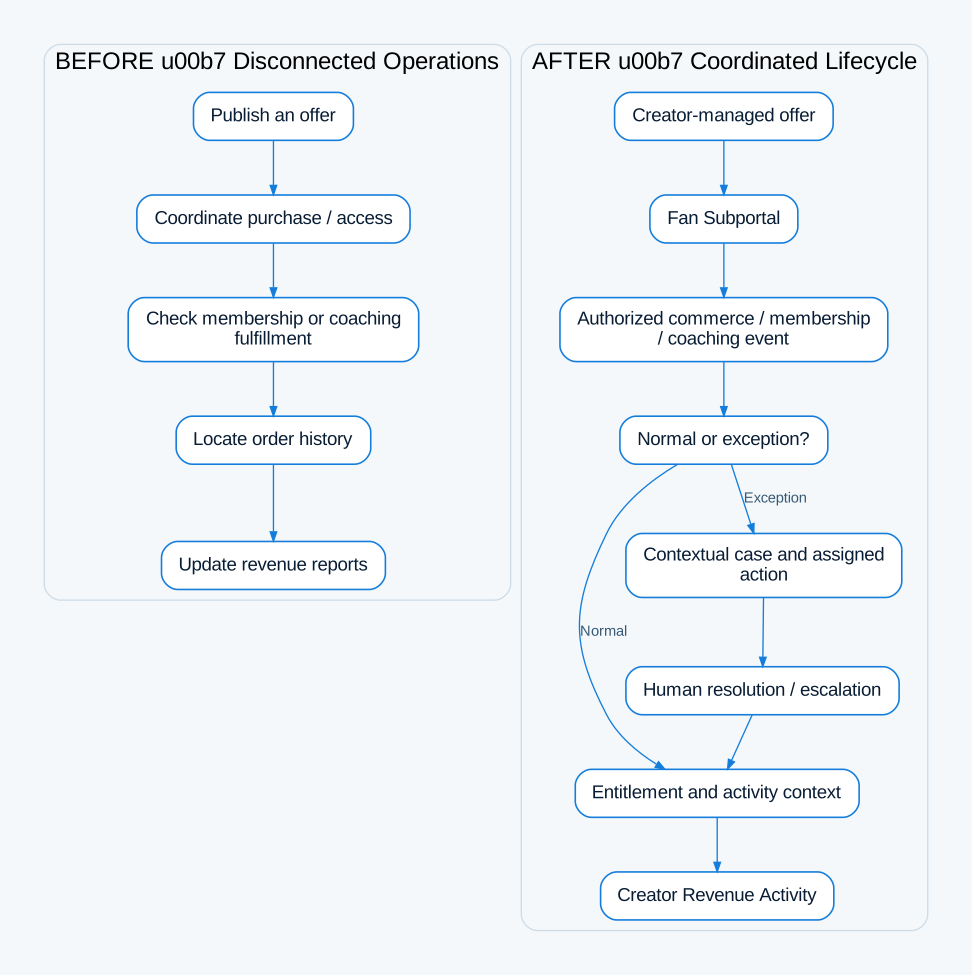
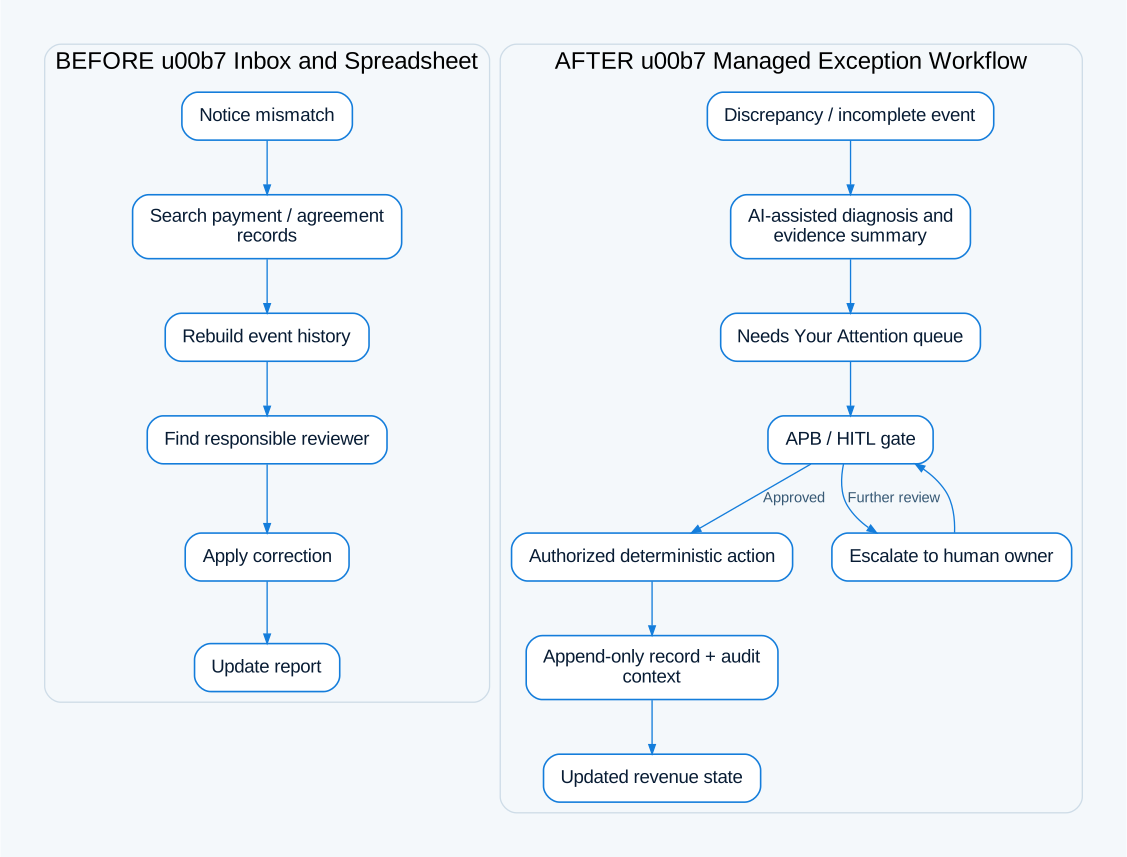
Estimated Manual Baseline — Step-by-Step Task Decomposition
Reference scenario: micro-creator with paid membership, digital offers, coaching and brand/affiliate income. Existing membership, payment and scheduling software already handles routine subscriptions, checkouts, and bookings. Only hands-on operating work is counted.
Where the reference month comes from
Each event time equals the sum of its documented micro-actions. For example, a routine member inquiry takes 2m to read, 2m to locate the account, 2m to check terms, 3m to reply and 2m to log the resolution: 11m per inquiry × 12 = 2h 12m/month. A weekly cross-source revenue reconciliation takes 45m × 4 = 3h/month using 7 documented micro-actions.
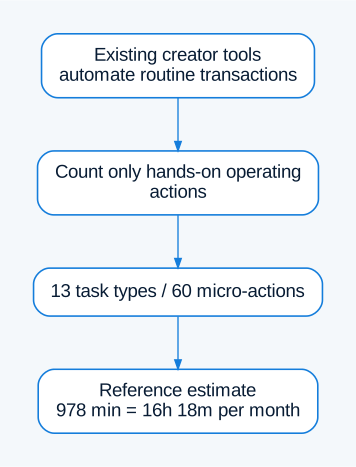
Open full workflow diagram
Opportunity, not a claim of achieved savings: 10h 38m of reference handling time is classified as automation-addressable; 5h 40m is retained human work. Under a separate 70% hypothetical reduction of the candidate steps, the modeled time released is 7h 27m/month. This percentage is an input assumption—not a measured system effect.
Reproduce the model: see Creator time-motion methodology for 60 itemized steps, monthly activity frequencies, low/high sensitivity cases, and counting rules.
The November 2, 2026 implementation test metrics above are separately verified and are not presented as evidence of an economic-hours outcome.
Measuring Operational Transferability
The transferability test is designed around a new authorized operator and a second Creator configuration, with business data and permissions kept separate.
Current verified foundation: immutable financial history, versioned projections, authorized contextual actions, and cross-Creator isolation. Handover duration and replication speed: to be measured through the above tasks.