In this article
Where operating budgets disappear between people, systems, and handoffs—and how to recover the capacity they consume.

A signed contract is supposed to mark progress. Inside a growing B2B software company, it can also start a chain of internal work: someone checks the CRM, someone verifies the terms, someone requests approval, someone creates a billing record, and someone else discovers that a field did not match the contract.
The customer sees one transaction. The company runs a small coordination project behind it.
For a Series A/B startup, that distinction has financial consequences. More customers, renewals, seat changes, and contract amendments generate more internal events. Each event uses labor, produces handoffs, and creates opportunities for errors. The operating budget grows even when no single person or tool appears unusually expensive.
The useful question is not “How much does this software cost?” It is “What does one completed, verified business event cost us—end to end?”
Where manual operating cost accumulates
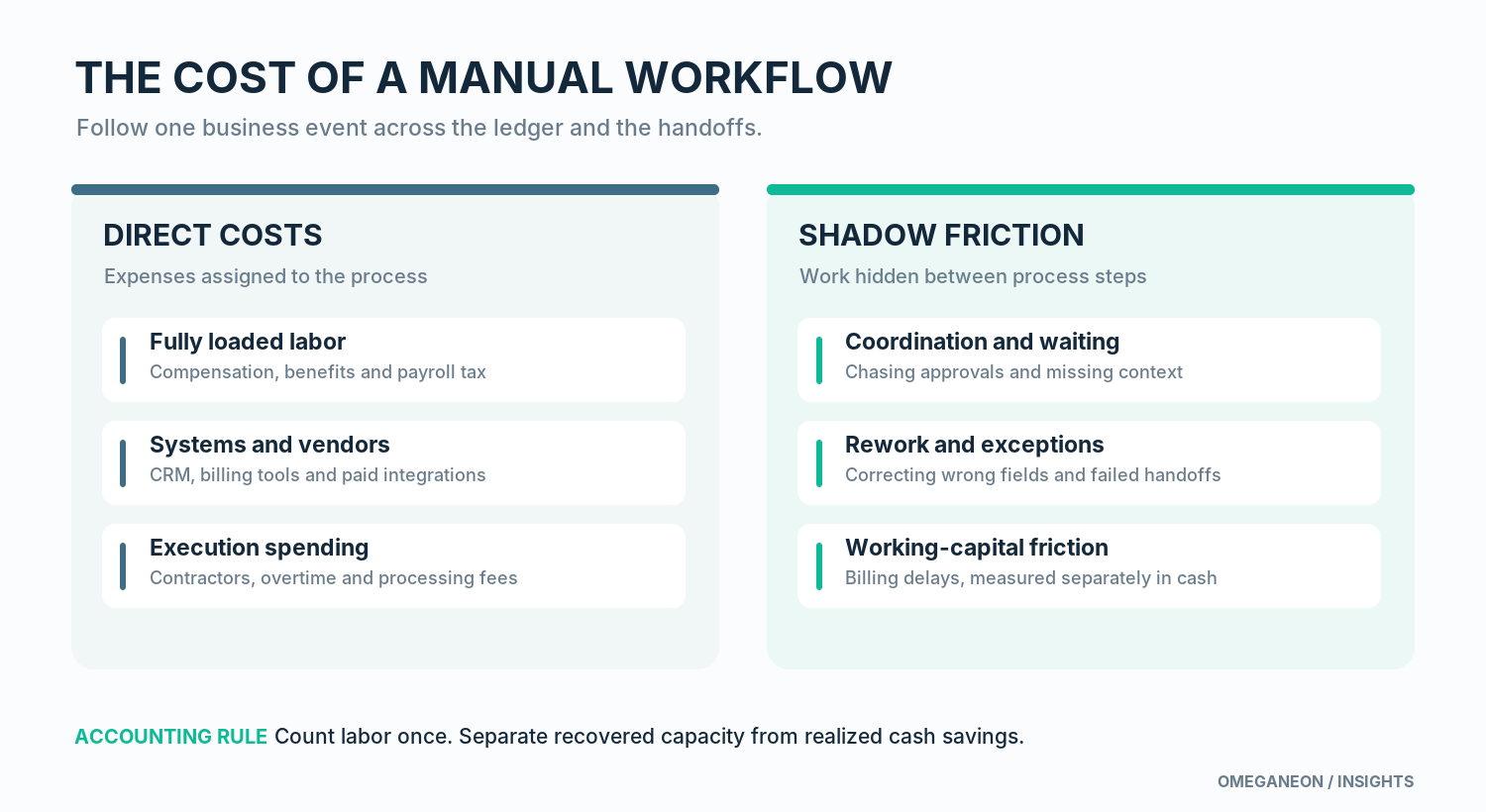
There are four practical places to look: the people doing the work, the movement between them, the corrections after an error, and the time that the unfinished process holds up a business outcome.
1. Fully loaded execution labor
Count the employee time that actually touches the process: collecting information, copying records, validating fields, writing internal updates, routing requests, and checking completion. Multiply it by the fully loaded hourly rate rather than salary alone.
The U.S. Bureau of Labor Statistics reported that employer compensation costs in June 2026 averaged $46.89 per hour across private industry, including $32.82 in wages and $14.07 in benefits. The professional, scientific, and technical services industry averaged $75.97 per hour. These are economy-wide reference points for constructing a company-specific cost rate. [1]
For a workflow audit, finance should supply the startup’s actual loaded rates by role. Record operations time and managerial review time separately.
2. Coordination and handoff time
A process can cross four tools and three teams without anyone owning the entire clock. The work includes chasing missing data, clarifying approvals, locating the current version of a contract, and reconciling what changed in the CRM versus the billing system.
Salesforce’s State of Sales, seventh edition, reported that sales representatives spend 60% of an average workweek on nonselling activities, including quote creation and data entry. That is a sales-workforce research finding—not an input automatically applied to every function. [2]
The better measurement is event-level: how many handoffs occur, how long each one takes, and how long the event waits between them?
3. Rework, exceptions, and escalation
The cost of a correction includes locating the mismatch, confirming the approved source, changing the records, re-running the step, and notifying the next owner. Rework becomes especially expensive when it requires finance leadership or a customer-facing employee to intervene.
A useful operating-cost benchmark comes from APQC. In its October 2026 cross-industry analysis of 5,846 organizations, the median cost to process an accounts-payable invoice was $6.00, with personnel, systems, overhead, and external processing costs included. [3] It is an example of how to measure cost per completed process unit; an AP invoice is a different workflow from the contract-to-billing example below.
4. Delays that affect cash conversion
An approved deal waiting to become an accurate invoice delays the next financial step. Measure the elapsed time from commercial approval to invoice issuance, then from invoice to payment. Track financing fees, dispute credits, customer concessions, or collections effort as separate cash effects where records support them.
In Intuit QuickBooks’ 2026 survey of U.S. small businesses, 59% reported at least some invoices more than 30 days overdue, and those with unpaid invoices were owed an average of $17,700. These figures describe the surveyed small-business population, not a Series A/B startup benchmark. They make invoice-to-cash timing a useful variable to put on the operational scorecard. [4]
Explore the unified operational economics model in Scale Operations. Not Overhead. for the complete investment framework behind this analysis.
A useful cost equation
For a single workflow, measure one month of completed business events using this structure:
Monthly process cost = (execution hours × loaded labor rate) + (coordination and rework hours × loaded labor rate) + incremental exception expense + allocated systems and vendor costs.
Then divide that amount by successfully completed, accepted events to obtain cost per completed event.
The important accounting treatment is straightforward: an employee who spends 20 minutes correcting a record has already consumed 20 minutes of paid labor. Count it under rework, not again under labor saved. Delayed collections belong in cash-cycle metrics; do not automatically book the entire delayed invoice value as a loss.
A modeled Series B example: 500 contract-to-billing events per month
Consider a hypothetical B2B SaaS company processing 500 commercial changes every month: new contracts, renewals, upgrades, amendments, and seat expansions. These are 500 billing handoff events, not 500 newly acquired customers.
The process currently crosses the CRM, signed contract, approval owner, billing system, and finance team. The company wants to maintain the same monthly volume and approved financial controls while changing the repeated execution work.
Starting assumptions
| Model input | Manual process | Managed AI workflow |
|---|---|---|
| Commercial events per month | 500 | 500 |
| Loaded operations rate | $72/hour | $72/hour |
| Loaded finance lead rate | $95/hour | $95/hour |
| Contract and CRM validation | 16 min/event | 3 min/event for review |
| Approval routing and follow-through | 9 min/event | 4 min/event |
| Billing record creation and sync | 12 min/event | 2 min/event for review |
| Events requiring rework | 12%; 25 min/event | 3%; 20 min/event |
| Finance escalations | 30 × 20 min | 15 × 15 min |
| Existing shared tools | $800/month | $800/month |
| Workflow Managed Operations | — | $5,000/month |
| Additional AI and hosting | — | $450/month |
| One-time production implementation | — | $12,000 |
All workflow volume, rework rates, labor rates, time reductions, and prices in this table are scenario assumptions. The AI workflow outcomes are targets for testing, not OMEGANEON client results. Workflow Managed Operations and production implementation figures are illustrative contract prices, not universal published pricing.
The complete monthly operating cost
| Cost component | Manual operations | AI workflow + human review |
|---|---|---|
| Contract / CRM reconciliation | $9,600.00 | $1,800.00 |
| Approval routing and chasing | $5,400.00 | $2,400.00 |
| Billing updates and synchronization | $7,200.00 | $1,200.00 |
| Rework and corrections | $1,800.00 | $360.00 |
| Finance escalations | $950.00 | $356.25 |
| Existing shared tools | $800.00 | $800.00 |
| OMEGANEON Managed Operations | $0.00 | $5,000.00 |
| AI and hosting | $0.00 | $450.00 |
| Total monthly process cost | $25,750.00 | $12,366.25 |
| Cost per completed event | $51.50 | $24.73 |
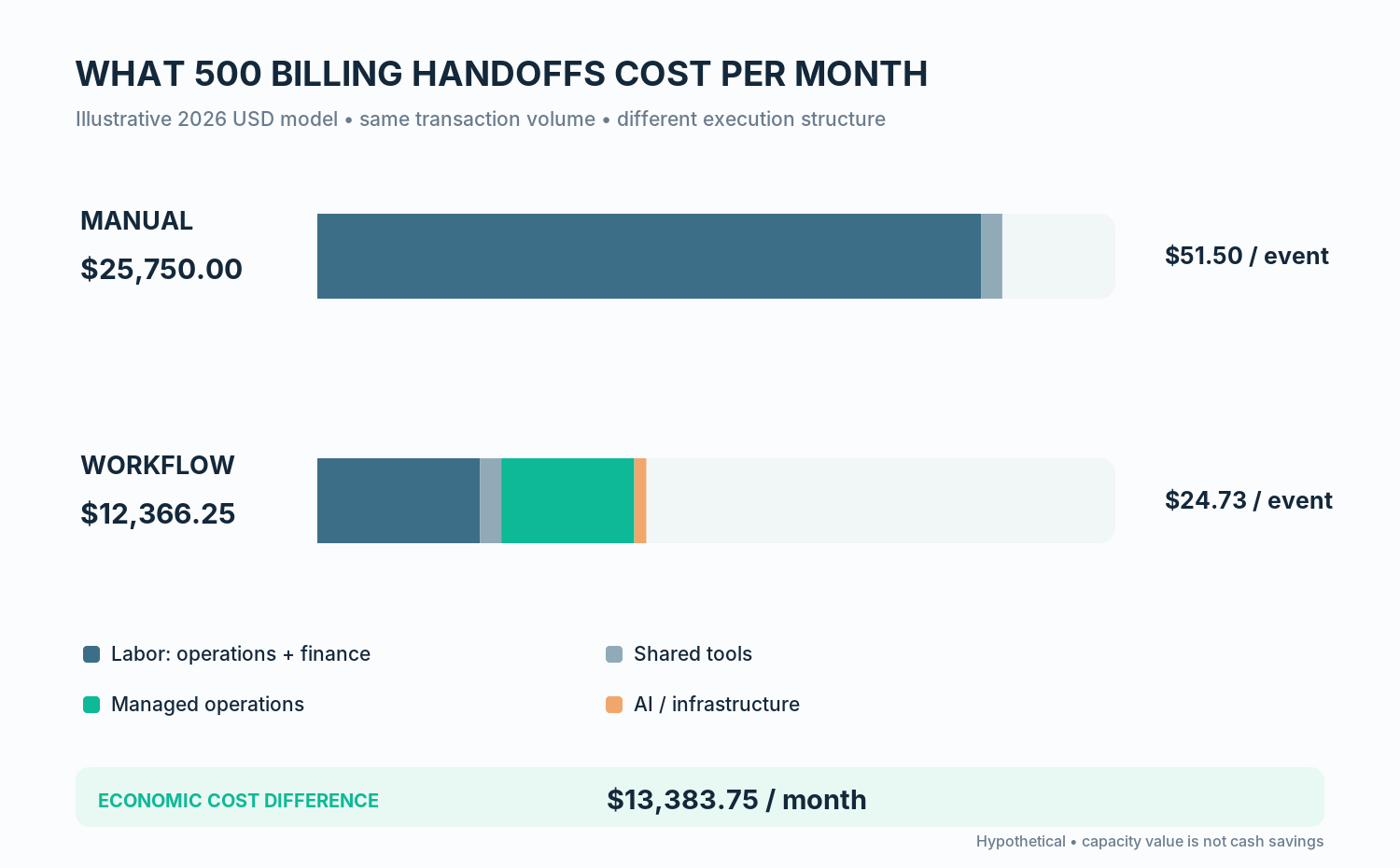
Economic operating-cost difference: $13,383.75 per month. At identical event volume, the modeled unit cost falls from $51.50 to $24.73. That result comes from reducing operational touch time and exceptions while adding a paid, managed workflow.
The time ledger is just as important. The manual process consumes 343.33 staff and finance hours per month. The redesigned process uses 83.75 hours, leaving 259.58 hours of operating capacity available for other work.
The operating model produces that capacity value under its assumptions. The cash outcome depends on what the company does with the released hours.
What actually changes in cash
A startup can use capacity in three different ways, each with a different financial outcome:
| Decision | What changes | Cash interpretation |
|---|---|---|
| Keep the same employees and redeploy their time | Teams handle more customers or higher-value work | Recovered capacity; existing payroll stays in place |
| Avoid a documented, approved incremental hire | A budgeted future payroll expense is no longer required | Avoided operating cash expense |
| Reduce existing contractor or overtime expense | An actual external invoice or payroll outlay ends | Realized operating cash reduction |
One budget-backed hiring scenario
Assume the company has approved one additional operations hire, costing 160 hours × $72 = $11,520 per month fully loaded. The measured 259.58 hours of released capacity are enough to absorb that one-role workload if the required skills and service levels match.
The managed workflow adds $5,450 per month in service and infrastructure spending. The approved-hire comparison is therefore:
| Financial line | Amount |
|---|---|
| Approved incremental hire avoided | $11,520/month |
| New managed workflow and infrastructure | −$5,450/month |
| Monthly avoided cash spending, net | $6,070 |
| One-time implementation expense | −$12,000 |
| Net first 12 months after production go-live | $60,840 |
| Implementation recovery at this cash benefit | 1.98 months |
This is a separate avoided-hiring cash scenario, not an extra $60,840 to add on top of the modeled $13,383.75 monthly capacity benefit. Both describe the value of reorganizing the same work from different accounting perspectives.
For a company retaining all existing employees with no planned hiring and no contractor or overtime reduction, the immediate incremental cash expense is $5,450 per month plus implementation. It buys operating capacity. The CFO should then value that capacity through actual growth, service-level, or hiring-plan decisions.
The workflow that replaces repeated handoffs
The target system needs to execute governed business rules, not merely summarize a contract into a chat response.
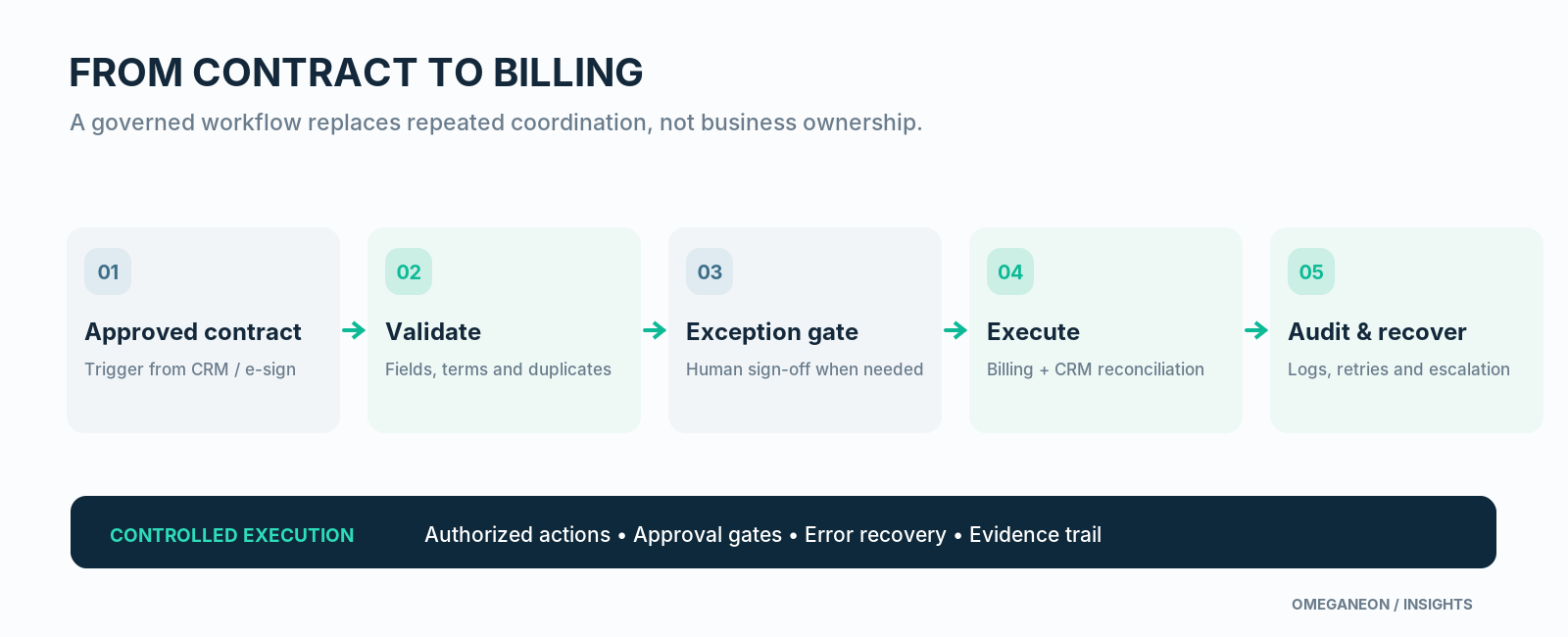
- Detect an approved commercial event. An authorized CRM or signed-contract trigger starts the workflow with the transaction ID and immutable reference to the agreement.
- Validate the source data. The workflow checks account identity, pricing, billing dates, entitlements, tax fields, and duplicate events against configured rules.
- Route exceptions for authorization. An ambiguous term, unusual discount, high-risk change, or failed data check goes to the appropriate human approver.
- Execute bounded actions. Approved actions create or update billing records, sync the CRM, and issue internal confirmations under scoped permissions.
- Recover and retain evidence. Idempotency, retry policies, escalation, versioned rules, and an audit trail support reliable ongoing operation.
Every action has a known owner, a permitted scope, and a recorded result. The team retains authority over commercial exceptions and customer decisions.
A 14-day audit before committing the budget
This is a short, concrete operating exercise rather than a company-wide process inventory.
| Window | What the company collects | What the decision-maker receives |
|---|---|---|
| Days 1–3 | Choose one workflow; define event ID, trigger, end state and responsible owner | A precisely bounded unit of work |
| Days 4–7 | Sample completed and failed events; collect timestamps, human touches and rework | Baseline minutes/event, exception rate, elapsed time |
| Days 8–10 | Apply loaded hourly rates, vendor invoices and current tool costs | Monthly economic-cost and cash-spend ledger |
| Days 11–12 | Define the authorized actions, approval gates and rollback paths | Draft workflow scope and controlled execution design |
| Days 13–14 | Agree acceptance criteria and the cash-realization decision | A fundable pilot proposal with measurable outcomes |
The decision pack should state the baseline, expected target, owner, acceptable failure rate, implementation budget, managed cost, and exactly what financial outcome will be counted. It should also name any existing hiring or contractor line whose expense is expected to stop.
From a cost ledger to a working system
OMEGANEON implements and manages AI-powered workflows built around validated rules, human approval where required, exception handling, recovery, and measurable operating performance.
The standard entry point is a $4,000 / 4-week Paid Pilot, with the workflow scope, access, test environment, and acceptance criteria defined in the signed SOW. A pilot tests the solution in an authorized sandbox; it does not itself constitute production deployment. Production implementation and ongoing Managed Operations are established through a separate signed engagement and production acceptance.
If a team is already considering another operations hire, the better next step is to quantify the work behind that headcount request.
Find the workflow. Measure its full cost. Put a verified alternative in front of the budget owner.
Start a 15-minute workflow conversation with OMEGANEON, or scope a 4-week Paid Pilot.
Research sources
- U.S. Bureau of Labor Statistics, Employer Costs for Employee Compensation — June 2026, released September 9, 2026. https://www.bls.gov/news.release/ecec.htm
- Salesforce, State of Sales, 7th Edition (2026), summarized in “How agentic AI sales software gives reps the room to win.” https://www.salesforce.com/au/sales/ai-sales-software-vs-traditional-sales-tools/
- APQC, What Is the Average Cost to Process an Invoice?, October 2026. https://www.apqc.org/What-Is-the-Average-Cost-to-Process-an-Invoice
- Intuit QuickBooks, 2026 Small Business Late Payments Report, July 2026. https://quickbooks.intuit.com/r/small-business-data/small-business-late-payments-report-2026/
Methodology: All modeled company conditions, transaction volumes, labor rates, staffing decisions, automation results, implementation costs and managed fees are expressly hypothetical; actual OMEGANEON client outcomes are not claimed. The APQC metric concerns accounts-payable invoices and is not used as a direct numerical benchmark for contract-to-billing handoffs. All money in USD.
Put One Workflow Into Operation
Start a Paid Pilot — $4,000 · 4 weeks · One workflow.
Get a Workflow Assessment to define the implementation scope, acceptance criteria and Managed Operations plan.
Fund operating capacity with a clear investment case.
Compare full operating costs, multi-workflow economics, workforce transition paths and financial sensitivity—then set the evidence gates for implementation.
Build better operations.
Keep learning.
Practical research on AI workflows, operating costs, and scaling startup operations. Delivered by email.
The subscription form loads as you reach this section.
See the framework. Explore the work.
Agent Permission Boundaries, Human Approval & Audit Logs
Review the six APB permission primitives, human oversight and auditability used to bound business-system access.
Read the frameworkWHITEPAPERScaling, Just Like Drag-and-Drop.
Connect operating economics with implemented workflows and verifiable engineering evidence.
Read the frameworkRELATED CASE STUDY / START HEREERP Document Operations: From Manual Documentation to Managed AI Workflows
Review measured document execution, deterministic QA and human approval evidence.
Explore the case studyRELATED CASE STUDYScaling Creator Monetization Without Scaling Operational Work
Explore implemented customer lifecycle and revenue operations workflows.
Explore the case studyRELATED CASE STUDYAI-Powered Government Contract Opportunity Discovery & Qualification
See source-linked research, qualification rules and controlled review workflows.
Explore the case study