In this article

Illustrative photo by Blake Wisz / Unsplash. Bob is a fictional character.
Hiring adds capacity. Automation changes how capacity scales. Here's how to make the decision with real data.
Your startup just raised a Series A or Series B round.
Customers are coming in faster. Onboarding takes longer. Your operations team is spending more time updating records, coordinating handoffs, and chasing information.
Your Head of Customer Success asks for another operations hire.
Sounds reasonable.
But there's a question worth asking before approving that headcount:
Are we running out of people, or are we running out of efficient ways to get work done?
Let's examine the economics of hiring, outsourcing, and workflow automation—and walk through the decision from the perspective of a startup COO.
1. Hiring Costs More Than a Salary

Photo: Creatopy / Unsplash.
According to the U.S. Bureau of Labor Statistics (BLS), private-industry employer compensation averaged $46.89 per hour worked in June 2026.
That includes $32.82 in wages and salaries and $14.07 in benefits.
The BLS also provides compensation data by establishment size:
| Establishment size | Employer cost per hour |
|---|---|
| 1–49 employees | $37.64 |
| 50–99 employees | $41.03 |
| 100–499 employees | $47.96 |
Source: BLS, Employer Costs for Employee Compensation, June 2026, Table 6.
Recruiting adds another expense.
The Society for Human Resource Management (SHRM) reported an average nonexecutive cost-per-hire of $5,475 in its 2025 benchmarking research.
Its 2026 recruiting benchmark reported a 39-calendar-day median time-to-fill for nonexecutive positions.
For a growing startup, every new position is an investment in additional operating capacity.
The question is what that capacity will actually accomplish.
2. Research Shows How AI Changes Workplace Productivity
Two major academic studies provide useful evidence.
Customer Support: 15% More Issues Resolved per Hour
A 2025 study published in The Quarterly Journal of Economics, Generative AI at Work, examined 5,172 customer support agents.
Researchers found that AI assistance increased productivity by 15% on average, measured by customer issues resolved per hour.
Less experienced and lower-skilled employees experienced substantial improvements in speed and quality.
Knowledge Work: Two Fewer Hours on Email Per Week
The 2025 NBER study Shifting Work Patterns with Generative AI examined 7,137 knowledge workers across 66 companies.
In the second half of its six-month experiment, the 80% of AI-enabled workers who used the tool spent approximately two fewer hours per week on email.
These studies document two measurable productivity improvements: greater throughput and reduced time spent on existing tasks.
Now consider what those economics mean for an operating decision.
3. Hypothetical Case: I'm Bob, COO of a Series B Startup

Illustrative photo: Bluestonex / Unsplash.
The following is a fictional business scenario. The operating figures and vendor quotations are hypothetical; the cited BLS and SHRM benchmarks are real.
Monday: "Bob, We Need Another Hire."
I'm Bob, the COO of a 70-person B2B SaaS startup.
We recently closed our Series B. Our sales pipeline is growing, and our Customer Success team is getting overwhelmed.
On Monday morning, my Head of Customer Success walks into my office.
"We need another operations person. Onboarding is getting out of control."
My first instinct is to approve the request.
We've just raised capital. We have customers to support. Hiring another person seems like the fastest answer.
But before opening the position, I ask one question:
"What exactly is taking up everyone's time?"
We review the onboarding process.
Every time a customer signs a contract, someone has to collect information from our CRM, prepare onboarding records, assign tasks, update internal systems, and notify the relevant teams.
It's the same coordination process, repeated hundreds of times.
Tuesday: I Count the Work
I ask the team to quantify the workload.
Here's what we find:
| Metric | My startup |
|---|---|
| Employees | 70 |
| Monthly onboarding handoffs | 800 |
| Average manual time per handoff | 12 minutes |
| Total monthly manual workload | 160 hours |
That's nearly a full-time workload devoted to recurring coordination.
I open the BLS compensation data.
For private-industry establishments with 50–99 employees, the average employer compensation cost is $41.03 per hour.
Using that benchmark:
160 hours × $41.03 = $6,564.80 per month.
Annualized, that's $78,777.60 in labor capacity.
SHRM's average nonexecutive recruiting cost adds another $5,475.
My first-year hiring benchmark becomes:
$84,252.60.
Now I have a number to compare against other approaches.
Wednesday: I Price Three Options
I prepare a financial comparison using the same 800 monthly handoffs.
Option A: Hire
Add enough employee capacity to complete the recurring workload manually.
First-year modeled cost: $84,253, including the SHRM recruiting benchmark.
Option B: Outsource
In my hypothetical vendor proposal, an outsourcing provider charges $7.50 per handoff.
My internal team would also spend $400 monthly on quality oversight.
Monthly cost:
800 × $7.50 + $400 = $6,400.
First-year cost: $76,800.
Option C: Automate the Workflow
My hypothetical automation proposal includes:
- $25,000 one-time implementation
- $2,200 monthly infrastructure and managed operations
- 24 hours of human review each month, valued at $41.03 per hour
First-year cost:
$25,000 + 12 × ($2,200 + 24 × $41.03)
= $63,216.64.
I put the numbers side by side.
| Option | First-year modeled cost |
|---|---|
| Hire | $84,253 |
| Outsource | $76,800 |
| Automate + human review | $63,217 |
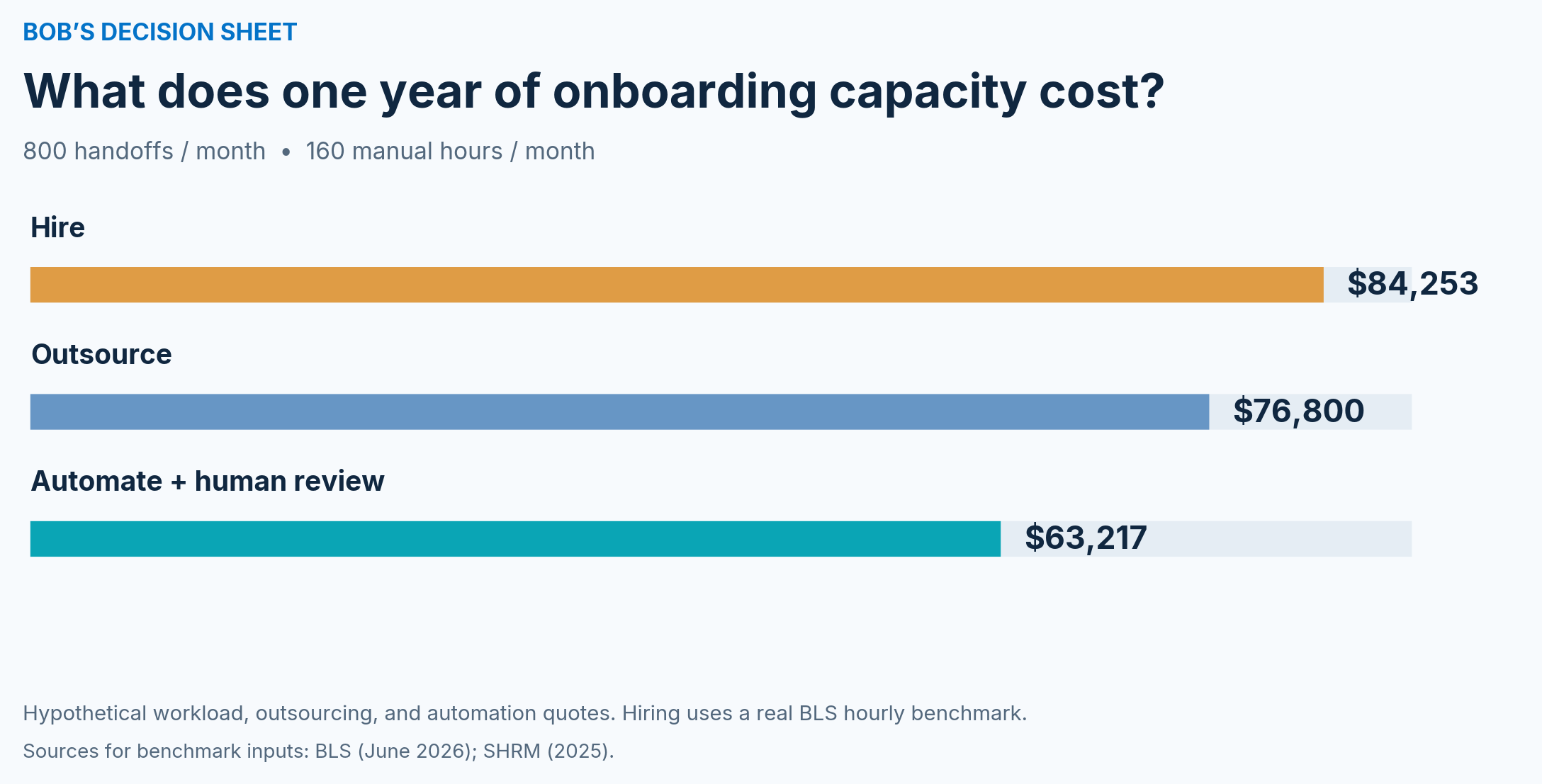
Figure 1. Scenario assumptions and BLS/SHRM benchmarks; modeled costs, not customer results.
Automation comes out $21,036 below hiring and $13,583 below outsourcing in this scenario.
But I don't approve the proposal yet.
I ask our team to calculate how the economics change if customer onboarding volume falls.
At 400 handoffs per month, outsourcing costs $40,800 annually under the same pricing model.
Automation costs $57,308 in the first year, with human review hours scaling down proportionally.
At 800 handoffs, automation wins. At 400, outsourcing wins.
The break-even point against outsourcing is approximately 620 handoffs per month under these assumptions.
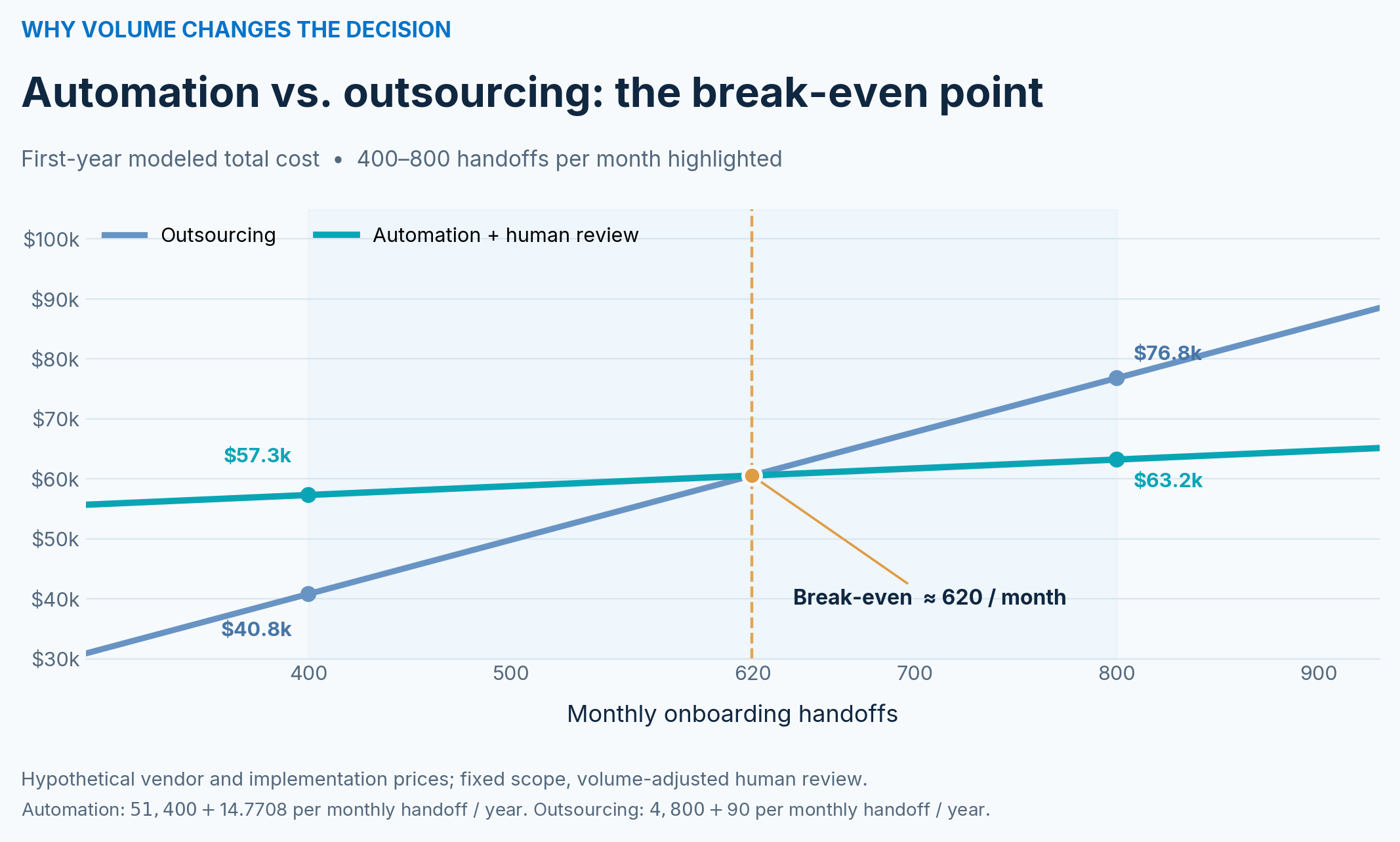
Figure 2. First-year modeled cost; break-even at approximately 620 monthly handoffs.
The decision depends on volume.
Thursday: I Look Beyond the Spreadsheet
I review the actual onboarding workflow with our team.
Several steps are deterministic: detect a signed contract, retrieve customer information, create onboarding tasks, and update records.
Other steps require human judgment.
An enterprise customer might have an unusual implementation requirement. A contract might contain special terms. Customer information might be incomplete.
I want those exceptions routed to a person.
So I define the proposed operating model:
Workflow automation handles routine coordination. AI handles authorized interpretation. Humans review exceptions and consequential decisions.
I also want every important system action recorded, permissions restricted, and failures monitored.
That's consistent with the operational monitoring and human oversight practices described in the NIST AI Risk Management Framework.
Friday: I Make the Decision
I don't open the operations position.
Instead, I authorize a phased automation project, with acceptance criteria for processing accuracy, exceptions, system reliability, and human review.
I keep our Customer Success team focused on customer relationships.
And I establish a specific budget test: the workflow must meet our operating requirements while staying below the cost of buying the same capacity through hiring or outsourcing.
My decision isn't to eliminate people.
It's to stop treating every increase in repetitive work as a reason to add another person.
End of hypothetical case.
4. The Five Variables Behind Bob's Decision
Bob's decision follows a framework any growing startup can apply.
| Variable | What to measure |
|---|---|
| Workflow volume | Monthly transactions and expected growth |
| Repeatability | Standardized steps, rules, and required inputs |
| Exception frequency | Cases requiring judgment or escalation |
| Human execution cost | Compensation, recruiting, supervision, external labor |
| Automation cost | Implementation, infrastructure, maintenance, human review |
The goal is to compare the total cost of delivering the same business outcome.
A high-volume workflow with predictable execution requirements creates a different economic decision from a low-volume process requiring extensive judgment.
And the answer changes as the business grows.
5. When Should You Hire, Outsource, or Automate?
Hire for Judgment, Ownership, and Relationships
Hire when the workload requires strategic thinking, specialized expertise, customer trust, negotiations, or direct accountability.
A Customer Success Manager responsible for retaining enterprise customers creates value through decisions and relationships.
Outsource for External Operating Capacity
Outsource when a qualified provider can execute the work at an attractive total cost and meet the required service standards.
Compare vendor charges, internal oversight, contractual obligations, and service reliability.
Automate Repeatable Execution
Automate when standardized tasks create sufficient recurring volume to justify implementation and ongoing operations.
High-value candidates include CRM updates, onboarding coordination, recurring reports, information routing, and cross-system data synchronization.
Combine Them
The strongest operating model can include all three.
Employees own relationships and judgment.
External providers handle selected services.
Automated workflows execute standardized operational steps.
The goal is an operating structure that scales with demand.
Evaluate the workflow through revenue efficiency and operating leverage, alongside the responsibilities people retain.
6. AI Assistance and Workflow Automation Are Different Investments
The academic productivity studies discussed earlier focus on AI assistance in existing jobs.
A production workflow system addresses the execution of an entire business process.
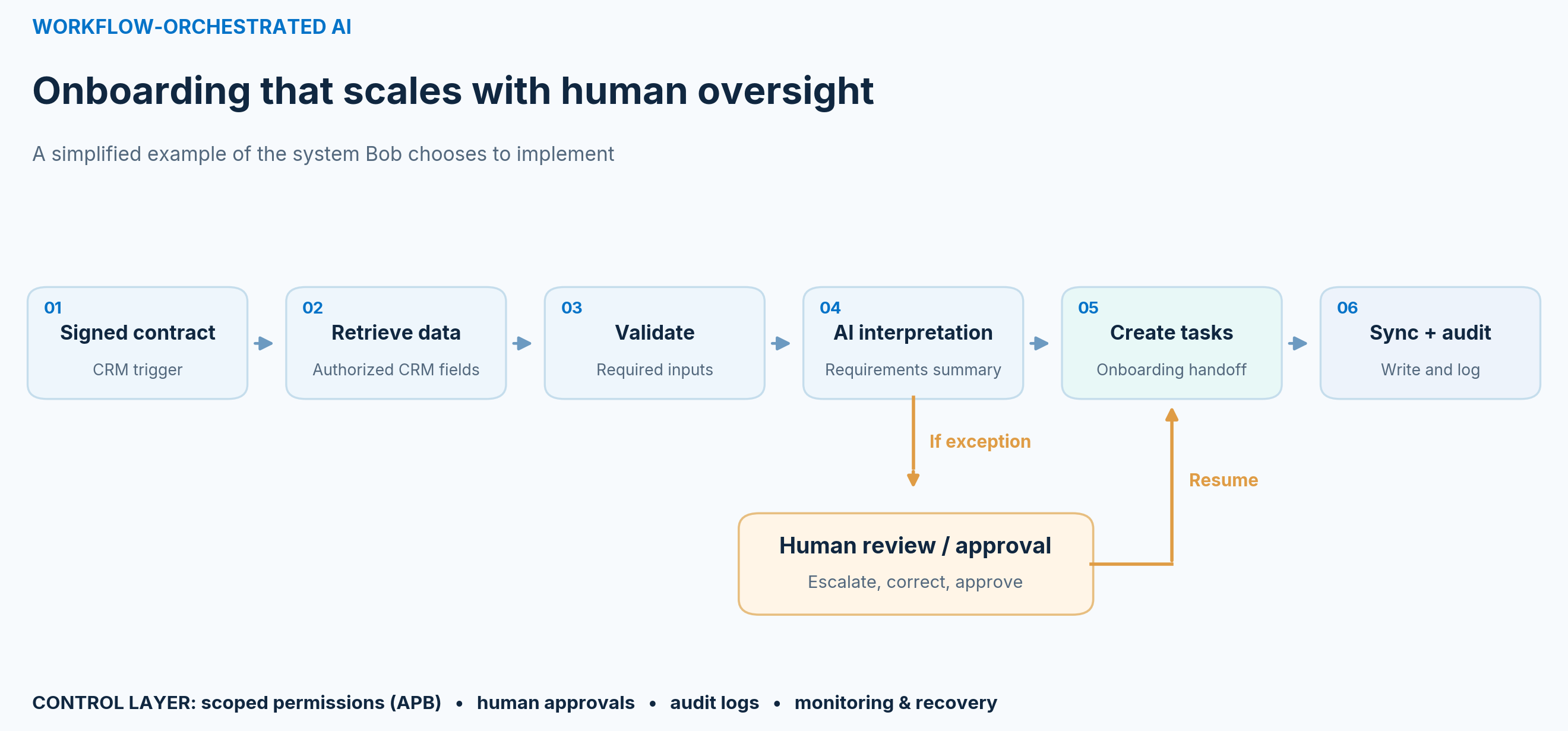
Figure 3. Simplified conceptual architecture for a controlled onboarding workflow.
Consider Bob's onboarding operation.
An AI assistant can help an employee prepare an onboarding summary.
A workflow-orchestrated AI system can coordinate a broader process:
Signed Contract → CRM Data Retrieval → Validation → AI Interpretation → Task Creation → Human Approval When Required → System Updates → Audit Record
The workflow defines when execution starts, which systems can be accessed, which actions are authorized, and how exceptions are handled.
AI agents contribute to interpretation, reasoning, and generation.
This makes workflow structure and operational governance central to the investment.
According to the NIST AI Risk Management Framework, deployed AI systems require ongoing attention to monitoring, oversight, incident response, recovery, and change management.
Those responsibilities belong in the operating budget.
7. Calculate Financial Value Correctly
A workflow assessment should distinguish between four measurable outcomes.
Avoided hiring: Additional workloads are handled without incurring planned recruiting and employment expenses.
Reduced expenditure: Contractor costs, overtime, or other operating expenses decrease.
Recovered capacity: Employees spend less time on routine tasks and more time on higher-value work.
Improved execution: Transaction throughput, turnaround time, accuracy, or service quality improves.
A financial model should also separate actual cash savings from the economic value of recovered employee time.
For Bob, the $78,777.60 annual labor benchmark measures the value of manual execution capacity in his hypothetical scenario.
Avoiding a planned incremental hire creates a different financial outcome from automating work already performed by employees who remain on payroll.
Both outcomes deserve measurement. They require different accounting.
8. Before Your Next Hire, Assess the Workflow
For a Series A or B startup, the objective is to scale operations without making every increase in demand require a proportional increase in manual effort.
The investment decision starts with the workflow.
At OMEGANEON, we approach that decision through three stages.
Workflow Assessment
Map the existing process, quantify recurring work, identify operational bottlenecks, and measure exception rates.
ROI Modeling
Compare hiring, outsourcing, and automation using workload measurements, authoritative labor benchmarks, actual vendor quotations, and implementation estimates.
Implementation & Managed Operations
When automation is justified, implement and operate a governed workflow with Agent Permission Boundaries (APB), human oversight, audit logs, monitoring, and ongoing maintenance.
The goal is repeatable execution with measurable business outcomes.
Before You Approve Another Operations Hire, Run the Numbers.
You know what additional headcount will cost.
Now find out what the workflow itself is costing your business.
OMEGANEON helps growing startups assess, implement, and manage AI-powered business workflows.
Request a Workflow Assessment.
References
U.S. Bureau of Labor Statistics (2026). Employer Costs for Employee Compensation — June 2026. Official Report | Establishment Size Data
Society for Human Resource Management (2025). SHRM Releases 2025 Benchmarking Reports. Official Research
Society for Human Resource Management (2026). Recruiting Executives Benchmarking: Attracting Critical Talent. Official Research
Brynjolfsson, E., Li, D., & Raymond, L. (2025). Generative AI at Work. The Quarterly Journal of Economics, 140(2), 889–942. DOI
Dillon, E. W., Jaffe, S., Immorlica, N., & Stanton, C. T. (2025). Shifting Work Patterns with Generative AI. NBER Working Paper No. 33795. Research Paper
National Institute of Standards and Technology. AI Risk Management Framework — Manage. Official Framework
Photography Credits & Licensing
All three editorial photos are sourced from individual pages marked “Free to use under the Unsplash License”. Unsplash permits commercial use and modification without requiring attribution; the original photo links above are retained as courtesy credits. The photos are illustrative and do not depict Bob or OMEGANEON clients.
Turn a recurring bottleneck into a managed workflow.
Explore how workflow-orchestrated AI connects business execution, human approvals and ongoing operations—and how to measure the result.
Build better operations.
Keep learning.
Practical research on AI workflows, operating costs, and scaling startup operations. Delivered by email.
The subscription form loads as you reach this section.
See the framework. Explore the work.
Scaling, Just Like Drag-and-Drop.
Examine how repeatable work can be redesigned while people retain judgment and ownership.
Read the frameworkRELATED CASE STUDY / START HEREERP Document Operations: From Manual Documentation to Managed AI Workflows
Review a concrete split between automated document preparation and human approval.
Explore the case studyRELATED CASE STUDYAI-Powered Government Contract Opportunity Discovery & Qualification
Compare manual screening effort with automated triage and authorized qualification.
Explore the case studyRELATED CASE STUDYScaling Creator Monetization Without Scaling Operational Work
Explore reusable revenue execution and the operating work that remains.
Explore the case study