In this article
The Deal Is Closed. Why Hasn't Onboarding Started?
Bob is the COO of a hypothetical Series A B2B SaaS company.
A new enterprise customer signs. The CRM shows Closed Won. Revenue is booked. Yet the next morning, the Customer Success lead is still asking the account executive for the implementation scope, contract commitments, technical contacts, and the integrations the customer expects.
The account executive is traveling. The kickoff hasn't been scheduled. The implementation team hasn't received its tasks. Everybody assumes somebody else owns the next step.
Bob doesn't have a written customer-onboarding SOP. He does have a CRM, Slack conversations, customer emails, project tickets, calendars, and people who have successfully onboarded customers before.
That is where the work begins.
The objective isn't to produce another document. It's to recover the operating sequence his company is already performing, verify it with the people responsible, and implement a workflow that moves each new account toward its first meaningful result.
The practical question is not, “Where is our SOP?” It's: “What actually happens between a signed deal and a customer receiving value—and why does each handoff need someone to chase it?”
01 — Define the Onboarding Journey Before Automating Tasks
Begin with one customer journey and an outcome that matters.
For a B2B SaaS implementation, the start could be Contract Executed rather than Closed Won if the contract is the real authorization trigger. The finish should be a customer-defined first-value event, not merely an internal box marked Onboarding Complete.
The path between them can include:
- Sales handoff and commitments verification.
- Customer and technical-contact confirmation.
- Requirements gathering and kickoff coordination.
- Account, workspace, and integration setup.
- Customer-side dependencies, training, and adoption tasks.
- First-value verification and handoff to ongoing Customer Success.
Set three boundaries before touching automation: which customer segments are in scope, which systems the workflow may use, and which actions require a person to approve them. A self-service SMB account and a security-intensive enterprise deployment may need different branches.
Then define success in operational terms: less human coordination per onboarding, shorter time to kickoff, faster time to first value, more complete handoffs, and a clear owner for exceptions.
Deliverable: an agreed onboarding scope, trigger, first-value definition, and measurement baseline.
02 — Recover the Process From Business Evidence
A missing SOP does not erase the activity that produced the last ten successful onboardings. Those activities can leave evidence in the tools the team already uses.
| Business system | Useful evidence | Question answered |
|---|---|---|
| CRM (HubSpot, Salesforce) | Deal stage changes, owner changes, handoff fields | When was the account ready, and who owned it? |
| Jira or Linear | Issue creation, assignments, state transitions | Which implementation tasks happened and in what order? |
| Zendesk or other support tools | Ticket events, escalations, changes | Where did onboarding get blocked? |
| Slack and email | Authorized handoff communications and decisions | What information was missing or clarified? |
| Calendar and product systems | Confirmed meetings and activation events | When did kickoff occur and when did first value happen? |
These are real types of product records. HubSpot exposes property history, Jira offers issue changelogs, Linear tracks issue activity, and Zendesk provides ticket audits. Data access, completeness, and retention are checked during discovery.
Three paths to a verified workflow
OMEGANEON's Hierarchical Workflow Digest Model (HWDM) uses the evidence available for the specific workflow:
A — Event Mining. Where suitable CRM, ticket, or task histories exist, reconstruct the order, frequency, handoffs, variants, and waiting periods of actual events. Standard event-based process mining relies on a case identifier, activity name, and timestamp; Microsoft documents these event-log requirements.
B — Evidence Reconstruction. Where history is fragmented, combine authorized business records, task descriptions, examples of completed onboardings, and demonstrations by the employees doing the work. Have a responsible operator verify the reconstructed steps and rules.
C — Prospective Instrumentation. Where the historical evidence is insufficient, add lightweight, approved event recording to the customer’s business systems so the next onboarding cycles produce the missing evidence.
These paths can be combined. The objective is a trustworthy AS-IS process model—not merely an AI-generated summary of Slack messages. The model needs identifiable triggers, activities, owners, decision points, dependencies, and exception paths. Each material conclusion is linked to evidence or an explicit business-owner confirmation.
Customer information is handled within an authorized scope, with customer-side processing and data minimization where required. The model focuses on business events, not covert employee surveillance.
.
Figure 1 — Where the real workflow lives
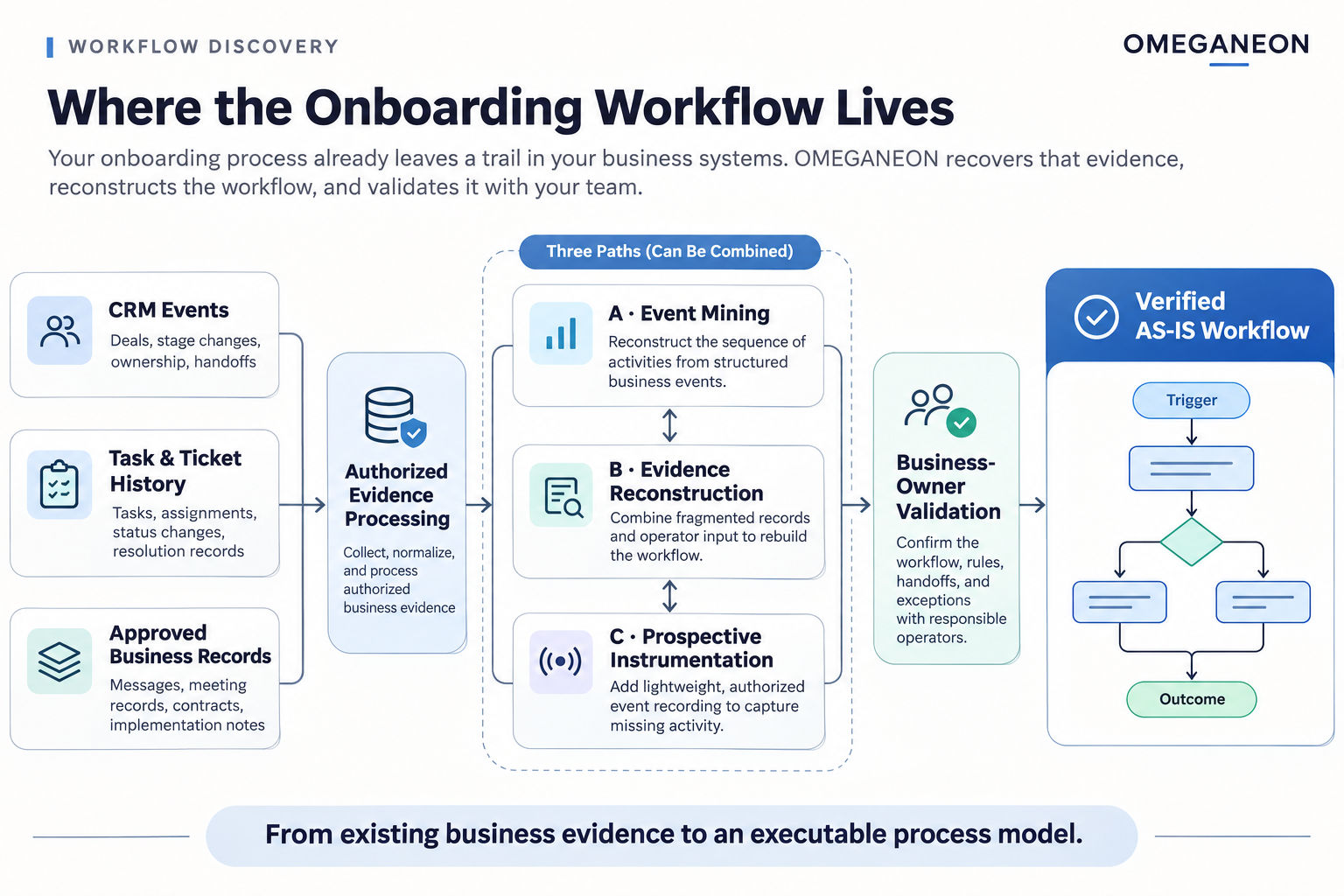
Business-system evidence is processed through HWDM discovery paths, validated by a business owner, and assembled into a verified AS-IS workflow.
Explore discovering existing workflows in No SOP Required. for the methodology behind this step.
03 — Model What Actually Happens, Including the Waiting
Return to Bob's company. The team selects a representative set of completed and delayed onboardings. It maps each case from contract execution to first value.
The reconstructed process shows that:
- The deal stage change does not consistently assign a Customer Success owner.
- The account executive knows the promised integrations, but those commitments do not always appear in the handoff fields.
- The CS lead creates implementation tasks manually after clarifying missing information.
- Kickoff scheduling depends on individual follow-ups.
- Setup blockers sit in tickets without a shared definition of when the onboarding can advance.
These observations belong to Bob's fictional example, not to a measured OMEGANEON customer case.
For every activity, record five operational facts:
| Field | Example |
|---|---|
| Trigger | Contract marked executed |
| Input | Account ID, package, commitments, technical contacts |
| Action and owner | CS reviews handoff; implementation creates workspace |
| Decision or dependency | Security review required? Customer credentials received? |
| Evidence of completion | Approved handoff, confirmed kickoff, successful activation event |
Then separate elapsed waiting time from actual human work time. Waiting three days for an email reply is not three days of labor. This distinction matters when diagnosing delays and calculating ROI.
The output is an AS-IS map that Bob can inspect, challenge, and approve. It also exposes the exact steps where execution can advance automatically.
04 — From Reconstructed Processes to Self-Advancing Customer Onboarding
Finding the workflow is the discovery. Making it execute is the transformation.
A diagram can tell Bob what happens after a deal closes. An implemented workflow can validate the handoff, create the work, assign the owner, follow dependencies, detect blocked states, and resume when the required conditions are met.
4.1 — Stop making people push each step forward
The previous operating model uses employees as its coordination engine. An account executive remembers to send a message. A CS lead remembers to check a spreadsheet. An implementation manager remembers to create tasks. A technical specialist remembers to report that provisioning succeeded.
Replace that with an event-driven execution model. The workflow holds the current state of each onboarding, the next authorized action, the relevant deadline, and the evidence needed to move forward.
This changes three things:
- Progression: a completed prerequisite can trigger the next step without a manual reminder.
- Ownership: every blocked case has a named owner and a defined resolution route.
- Visibility: the team sees each account's real execution state, not just scattered status messages.
The goal is not to remove judgment from customer relationships. It is to remove the avoidable coordination work that surrounds that judgment.
4.2 — Before and after: one customer, two operating models
BEFORE: human-coordinated execution
- A deal reaches Closed Won.
- Sales sends a Slack handoff when someone remembers.
- CS asks for missing contract and deployment details.
- A manager manually picks an owner.
- CS creates implementation tasks and schedules kickoff.
- Employees chase outstanding setup items and updates.
- Someone verifies activation and updates the CRM.
AFTER: workflow-orchestrated execution
- An approved contract-execution event starts one onboarding instance.
- The workflow checks required handoff fields and agreement references.
- Missing inputs generate routed requests; resolved requests resume execution.
- Validated customer type and implementation scope determine the approved onboarding route.
- The system assigns the responsible owner and creates linked tasks and milestones.
- Authorized integrations advance steps as dependencies complete; risky actions require human approval.
- Product or CS evidence confirms the customer's first-value milestone and updates the record.
Figure 2 — Before / after transformation
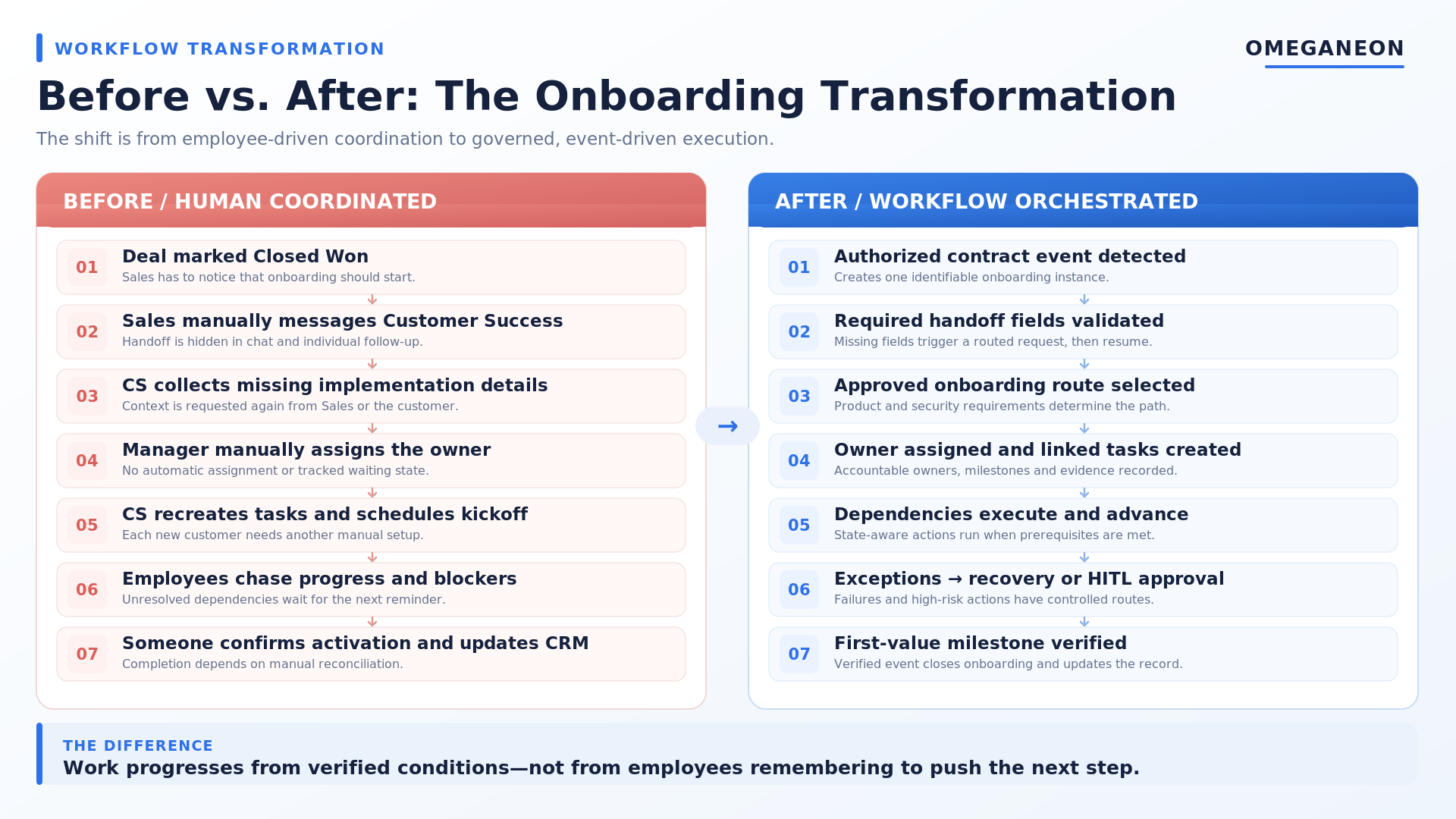
Human-coordinated onboarding versus event-driven, workflow-orchestrated onboarding with controlled exceptions and HITL.
This is a proposed operating design for Bob's hypothetical company. The actual branches and permissions come from the customer's validated workflow.
4.3 — What happens after the next contract is signed?
Consider a new customer purchasing a SaaS product that needs an SSO integration and a data import.
1. Detect the authorized trigger. The workflow receives the contract-executed event, resolves the CRM account and deal IDs, and checks whether an onboarding instance already exists. That prevents duplicate task trees when the CRM sends the event again.
2. Validate the sales handoff. It checks the product package, agreed implementation scope, contractual commitments, primary contacts, and security requirements. If the integration owner is missing, the system records the gap and routes a request to the responsible employee. The account remains in Waiting for Handoff Data instead of silently advancing with incomplete information.
3. Select the approved onboarding path. A standard package can follow a configured route. An enterprise contract requiring security review enters a separate branch. AI can interpret unstructured implementation notes and prepare summaries, while the workflow applies the customer's approved conditions and permissions.
4. Establish ownership and the work plan. With the handoff accepted, the workflow assigns a Customer Success owner, creates linked implementation tasks, attaches the approved requirements, and requests kickoff availability. It tracks meeting confirmation rather than equating a sent invitation with a completed kickoff.
5. Advance the setup by evidence. Workspace creation completes. The workflow marks that task done. Data import stays blocked until credentials are delivered. An integration test fails, producing an exception with an assigned owner. Once the issue is cleared, the relevant branch resumes. No one needs to reconstruct the entire case from scratch.
6. Confirm first value. Bob's company defines first value as the customer's first successful production data synchronization, acknowledged by the responsible team. A verified event—not an optimistic status label—closes the onboarding milestone. Customer Success receives an account-specific summary of completed work, open issues, and the next relationship actions.
This is what customers buy: an operating capability that executes the approved process and coordinates the handoffs, not another set of reminders or a static playbook.
4.4 — Give each part of the system the job it does best
| Layer | Operational responsibility |
|---|---|
| Workflow orchestration | Triggers, state, dependencies, routing, retries, deadlines, and recovery |
| AI agents | Interpretation of notes, requirement extraction, contextual summaries, and approved non-deterministic tasks |
| Business rules | Eligibility, routing, mandatory evidence, thresholds, and stop conditions |
| Human operators | Relationship decisions, unresolved conflicts, and high-risk approvals |
| Managed operations | Monitoring, maintenance, incident handling, permission management, and improvements |
The workflow provides execution structure. Agents handle tasks that require interpretation. Employees retain control over decisions that require business authorization.
Under OMEGANEON's Agent Permission Boundaries (APB), permissions are defined by System, Data, Action, Limit, Duration, and Identity. Human-in-the-Loop (HITL) checkpoints sit at the approved risk boundaries; execution is logged for operational review.
4.5 — Make exceptions part of the execution path
An onboarding plan that stops at the first missing field is still dependent on employee rescue. Build the recovery paths into the workflow:
- Missing information: create a request, assign ownership, retain state, and resume after validation.
- Conflicting terms: flag the conflict and require an authorized employee to resolve it before the affected action.
- Provisioning failure: classify the error, retry safe operations under defined limits, or escalate with full context.
- Duplicate CRM event: use case identity and idempotent actions to avoid duplicate work.
- Customer silence: track a bounded follow-up sequence and route persistent blockers to Customer Success.
The workflow should always know what is blocked, why it is blocked, who can resolve it, and what event permits safe continuation.
4.6 — Connect execution to economic outcomes
The financial case is built from a baseline and measured operating results:
- Human hours per onboarding: measured active work, not elapsed waiting.
- Time to kickoff: contractual trigger to the meeting actually held.
- Time to first value: agreed start event to verified customer-value milestone.
- Handoff completeness: percentage of in-scope handoffs passing the required evidence checks.
- Exception recovery time: issue detection to verified resolution.
- Onboarding throughput: completed customer journeys per defined reporting period.
Calculate the economic result using verified changes in labor cost and capacity, along with implementation and ongoing operating costs. If a team saves coordination time and uses the released capacity for additional onboardings, count the relevant economic benefit once rather than adding overlapping estimates.
4.7 — What OMEGANEON delivers
The implementation is not simply a workflow diagram or an AI demo. It has four deliverable layers:
- Workflow Discovery: a verified AS-IS model, confirmed handoffs, business rules, dependencies, and exception paths.
- Workflow Implementation: executable TO-BE processes, integrations, AI tasks, ownership routing, approval gates, and durable workflow state.
- Production Readiness: scenario testing, permission boundaries, auditability, monitoring configuration, and customer-approved acceptance criteria.
- Managed Operations: execution monitoring, incident recovery, integration upkeep, access governance, and workflow evolution as the company scales.
The deliverable is a running, managed onboarding operation.
.
Explore from knowledge to execution in No SOP Required. for the methodology behind this step.
05 — Design the Exception Paths Before Go-Live
A workflow has to deal with more than its ideal sequence. For onboarding, that means translating the business team's real exceptions into explicit rules and recovery conditions.
| Situation | Workflow response | Human involvement |
|---|---|---|
| Required implementation contact missing | Request data, hold affected branch, resume when validated | Account owner supplies or confirms contact |
| CRM scope conflicts with signed agreement | Flag discrepancy and stop affected provisioning | Authorized owner decides the controlling scope |
| Integration call times out | Check result, retry only when safe, otherwise escalate | Engineer receives actionable error context |
| Same contract event delivered twice | Detect existing onboarding case; prevent duplicate actions | Review only if records disagree |
| Customer misses a milestone | Trigger an approved follow-up and update due-state | CS decides relationship-sensitive next steps |
These controls are part of a real operating model. They are also why a workflow needs state management, authorization rules, audit logs, and human escalation—not just an AI prompt.
06 — Verify the Workflow Against Real Cases
Before production, test the process against representative historical and simulated cases. Include the normal route and every critical branch agreed during discovery.
A production acceptance suite for Bob's onboarding flow includes:
- Complete handoff and successful provisioning.
- Missing mandatory information and safe resumption.
- Contract-versus-CRM conflict requiring approval.
- Duplicate start event and duplicate external API response.
- Integration failure, bounded retry, and escalation.
- Revoked permission or expired authorization.
- Customer-side delay with correct ownership and status.
- Verified first-value milestone and final handoff.
For each test, retain the test case, expected result, observed execution, workflow version, and approval evidence. Confirm who can authorize changes and how failures are recovered. The customer-authorized owner signs off against agreed operational outcomes before go-live.
This is how the reconstructed workflow becomes a trustworthy production service instead of an attractive process diagram.
.
Explore security & verification in No SOP Required. for the methodology behind this step.
07 — Measure What Changed
The most useful onboarding dashboard is built around events and operational results, not vanity automation counts.
| KPI | Operational definition | Comparison |
|---|---|---|
| Time to Kickoff | Kickoff actually held − authorized start event | Median and distribution by customer segment |
| Time to First Value | Verified first-value event − authorized start event | Median and distribution by implementation type |
| Human Hours per Onboarding | Total measured human work minutes ÷ completed onboardings | Before versus after, same work scope |
| Handoff Completeness | Handoffs with all required evidence ÷ eligible handoffs | Percentage by period |
| Exception Recovery Time | Verified resolution − exception detected | By exception category |
| Onboarding Throughput | Verified completions per period | By cohort and team capacity |
| Cost per Completed Onboarding | Allocated labor + workflow operating cost ÷ completions | Before versus after with stated cost basis |
Figure 3 — Operational outcomes dashboard design
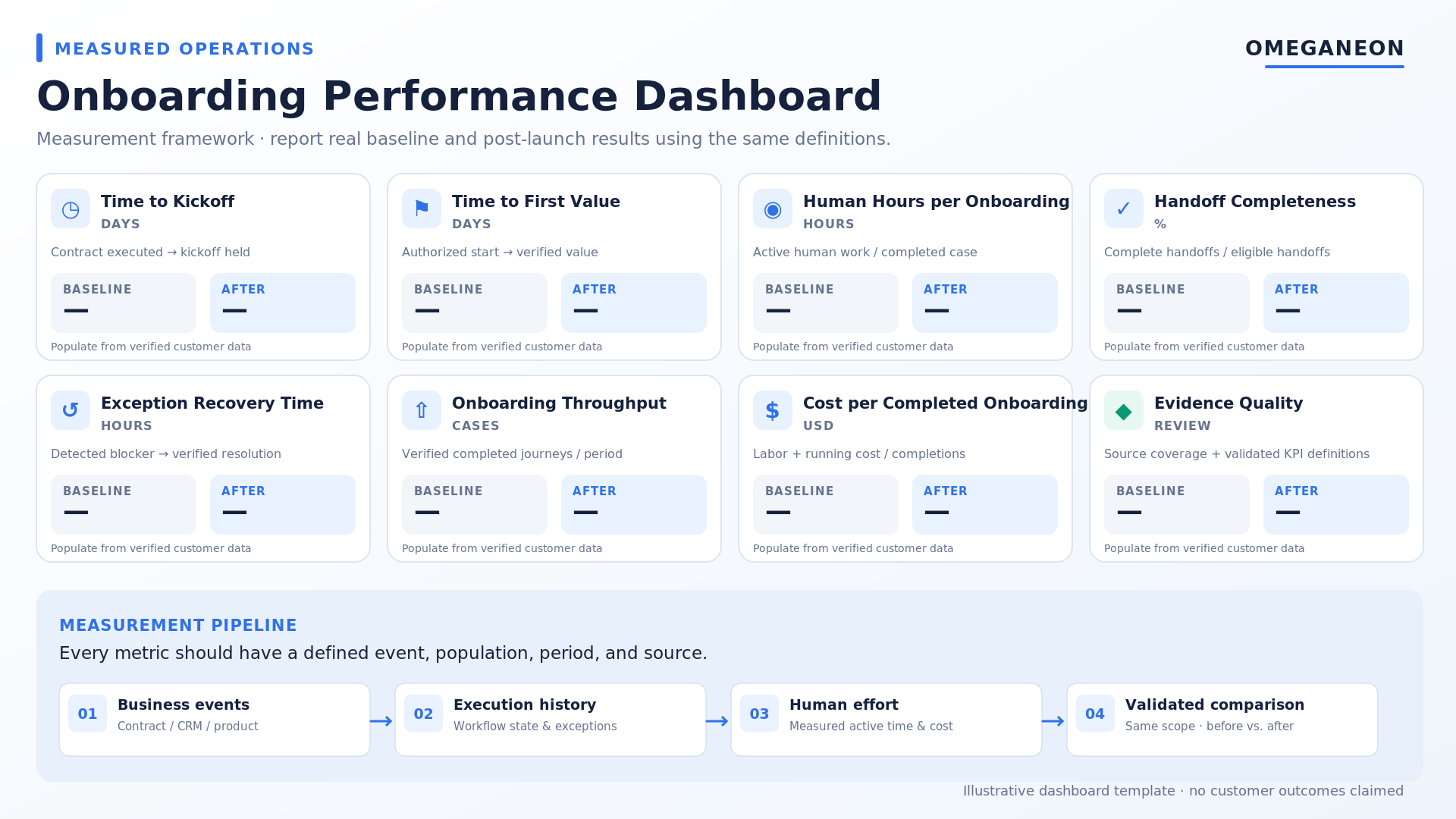
An illustrative measurement dashboard. Baseline and post-launch values must come from verified customer records; no performance claims are shown.
Track the baseline measurement period, eligible customer cohort, source event, and calculation rule for each KPI. The Bob example intentionally contains no invented performance figures. Actual outcomes belong in verified customer case studies and implementation reports.
08 — Keep the Workflow Running as the Company Grows
Onboarding changes. The company introduces new product packages, enterprise approvals, new integrations, new customer segments, and new teams. A workflow deployed once and ignored becomes stale.
Managed Operations keeps the system aligned with the business:
- Monitor executions, stalled cases, deadlines, and incident patterns.
- Maintain integrations and recover failed or interrupted work.
- Review APB permissions, approval routing, and operational access.
- Version workflows and validate upgrades before rollout.
- Compare actual execution with the approved model to detect process drift.
- Improve high-friction steps and expand automation to adjacent journeys.
The operating knowledge recovered during discovery now lives in a maintained, executable system rather than in a single employee's memory.
.
Explore operational continuity in No SOP Required. for the methodology behind this step.
09 — Start With One Onboarding Journey
There is no need to launch a company-wide documentation project first.
Choose one repeatable onboarding path. Identify its trigger and first-value outcome. Bring a few completed customer cases, access to the relevant business-system histories, and the person who owns the work. Map the current execution. Validate the exceptions. Implement the approved path. Measure the result.
This approach follows a practical insight from First Round Review's guide to building an early Customer Success function: onboarding is one of the foundational operating systems a startup needs as customer volume increases. The difference is that OMEGANEON can begin from the company's existing operational evidence and carry the model through implementation and ongoing operations.
For Bob, the important realization isn't, “We should finally write an SOP.” It is:
“We don't have written SOPs. But our business already produces enough activity to begin discovering what should be automated.”
And the next decision is concrete: “We can have OMEGANEON recover that workflow, build the execution system, and keep it operating.”
No SOP Required.
Your onboarding process already exists in the work your team performs. OMEGANEON helps recover it, automate it, and keep it running.
Explore how OMEGANEON discovers operational workflows, preserves business knowledge, and converts them into executable, managed AI operations.
Assess Your Customer Onboarding Workflow
Sources and further reading
- First Round Review — The Founder's Guide to Building a V1 of Customer Success
- Microsoft — Prepare processes and data for Process Mining
- HubSpot — Export property history
- Atlassian — Jira REST API: Issues and changelogs
- Linear — Issue assignment and activity history
- Zendesk — Ticket Audits API
Scenario note: Bob and his company are hypothetical.
From operating knowledge to a workflow that runs.
Recover operational evidence, validate business rules, implement a controlled AI workflow and keep it running through Managed Operations.
Build better operations.
Keep learning.
Practical research on AI workflows, operating costs, and scaling startup operations. Delivered by email.
The subscription form loads as you reach this section.
See the framework. Explore the work.
No SOP Required.
Recover operational knowledge, validate business rules and turn scattered records into executable, managed workflows.
Read the frameworkSECURITY FRAMEWORKAgent Permission Boundaries, Human Approval & Audit Logs
Review the six APB permission primitives, human oversight and auditability used to bound business-system access.
Read the frameworkRELATED CASE STUDY / START HEREERP Document Operations: From Manual Documentation to Managed AI Workflows
See document inputs translated into deterministic QA, approval gates and versioned delivery.
Explore the case studyRELATED CASE STUDYScaling Creator Monetization Without Scaling Operational Work
Explore reusable customer lifecycle and revenue operations workflows.
Explore the case studyRELATED CASE STUDYAI-Powered Government Contract Opportunity Discovery & Qualification
Follow source-linked evidence into qualification rules and authorized decisions.
Explore the case study