In this article
The difference is not intelligence versus automation. It is who controls the execution of real business operations.
An AI agent can interpret a customer request, decide what information matters, and propose its next action. A workflow can maintain execution state, enforce an approval boundary, and recover when a dependent system fails. A production system can combine both.
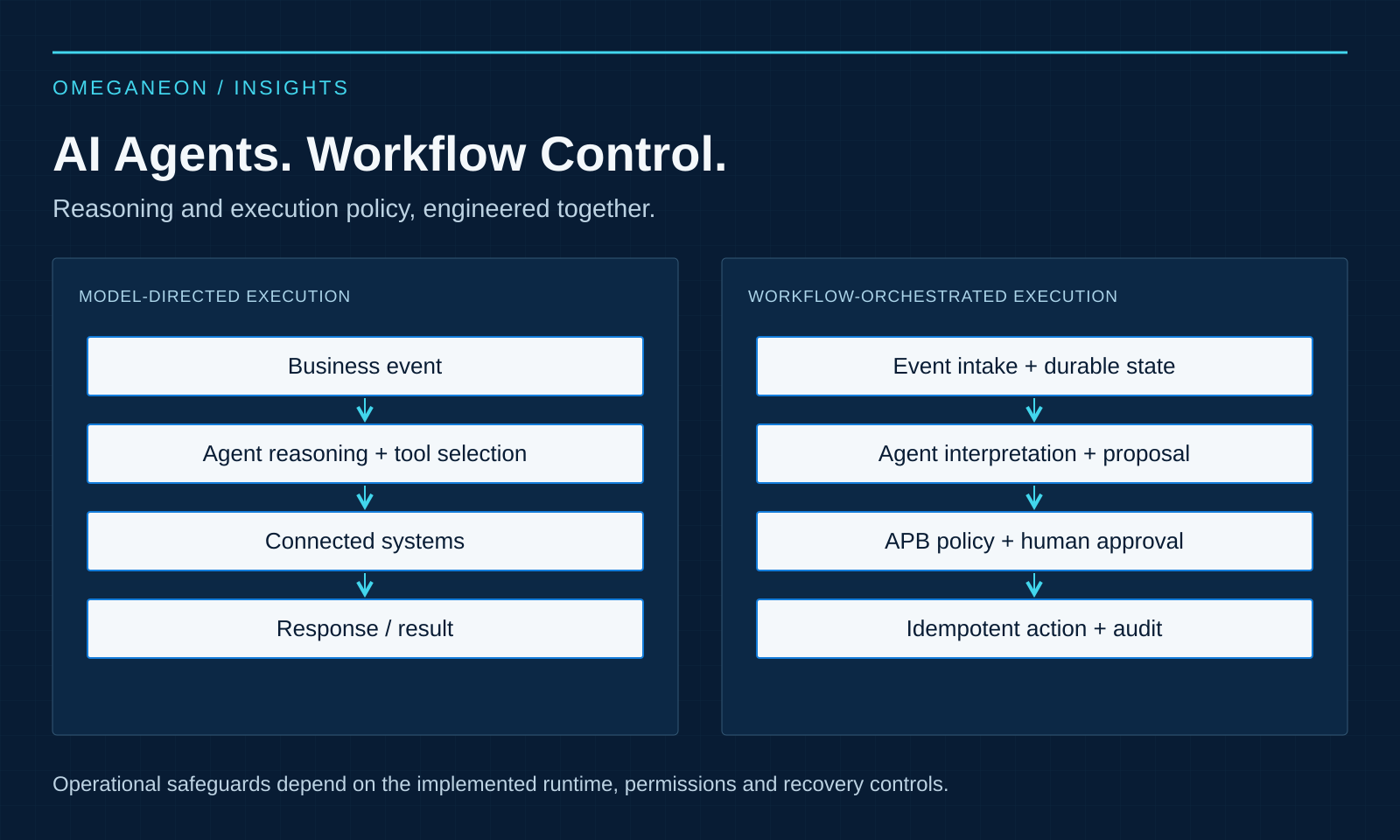
Figure 1. Editorial overview of two deployment designs. “Minimal agent loop” means an implementation without separately engineered operational controls; modern agent SDKs can add approvals, persistence, orchestration, and tracing.
The problem begins after the model makes a good decision
Consider a hypothetical Series B B2B SaaS company. A sales representative marks a deal Closed Won in the CRM. The company wants to automatically:
- Read the opportunity, discovery notes, and contractual handoff fields.
- Identify implementation commitments, customer risks, and missing information.
- Prepare a structured Customer Success handoff.
- Request approval when a sensitive or externally visible action is required.
- Create the handoff record, notify the account owner, and record what happened.
An agent is valuable in step 2: customer notes are inconsistent, context-heavy, and require interpretation. But the handoff is also an operational transaction. The system must know whether the task was completed, whether approval was granted, and what to do if the CRM accepts a write immediately before the worker crashes.
This is where workflow architecture changes the engineering problem.
What is an agent? What is a workflow?
Anthropic's engineering guide Building effective agents distinguishes between agents, in which a model dynamically directs its process and tool use, and workflows, in which models and tools are coordinated through defined execution paths.
The distinction describes control flow, not two incompatible product categories. The OpenAI Agents SDK explicitly supports model-driven orchestration and code-driven orchestration, including combinations. It also provides human approval controls and tracing.
In this article, we compare:
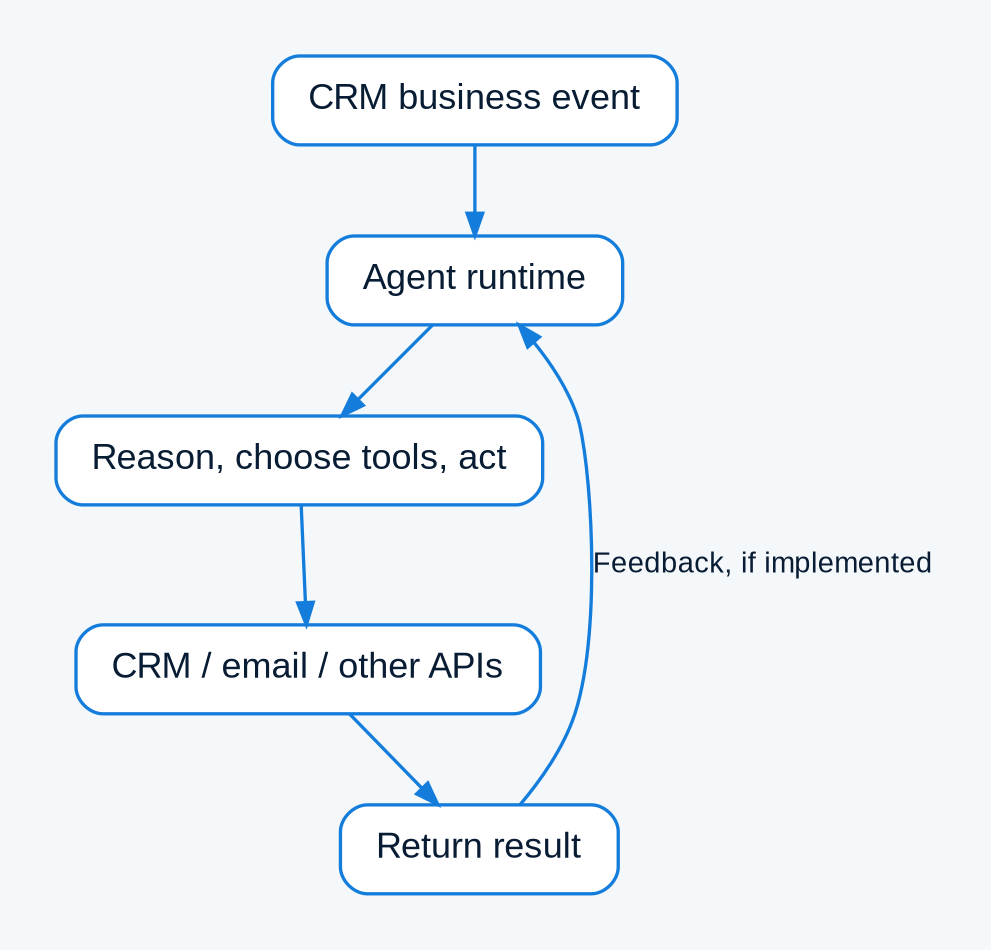
- Minimal standalone agent loop: A model receives a goal, reasons, invokes tools, and returns a result; operational controls are limited to what its host application has built.
- Workflow-orchestrated agent: A controller owns process state and execution policy, while one or more agents handle the steps that benefit from model reasoning.
Architecture A — minimal standalone agent loop
Open full-size diagram · Download Mermaid source
The model-driven loop offers flexibility: it can navigate unpredictable questions, select tools, and adapt its sequence of steps. The operational outcome depends on the runtime, persistence, authorization, and recovery mechanisms surrounding that loop.
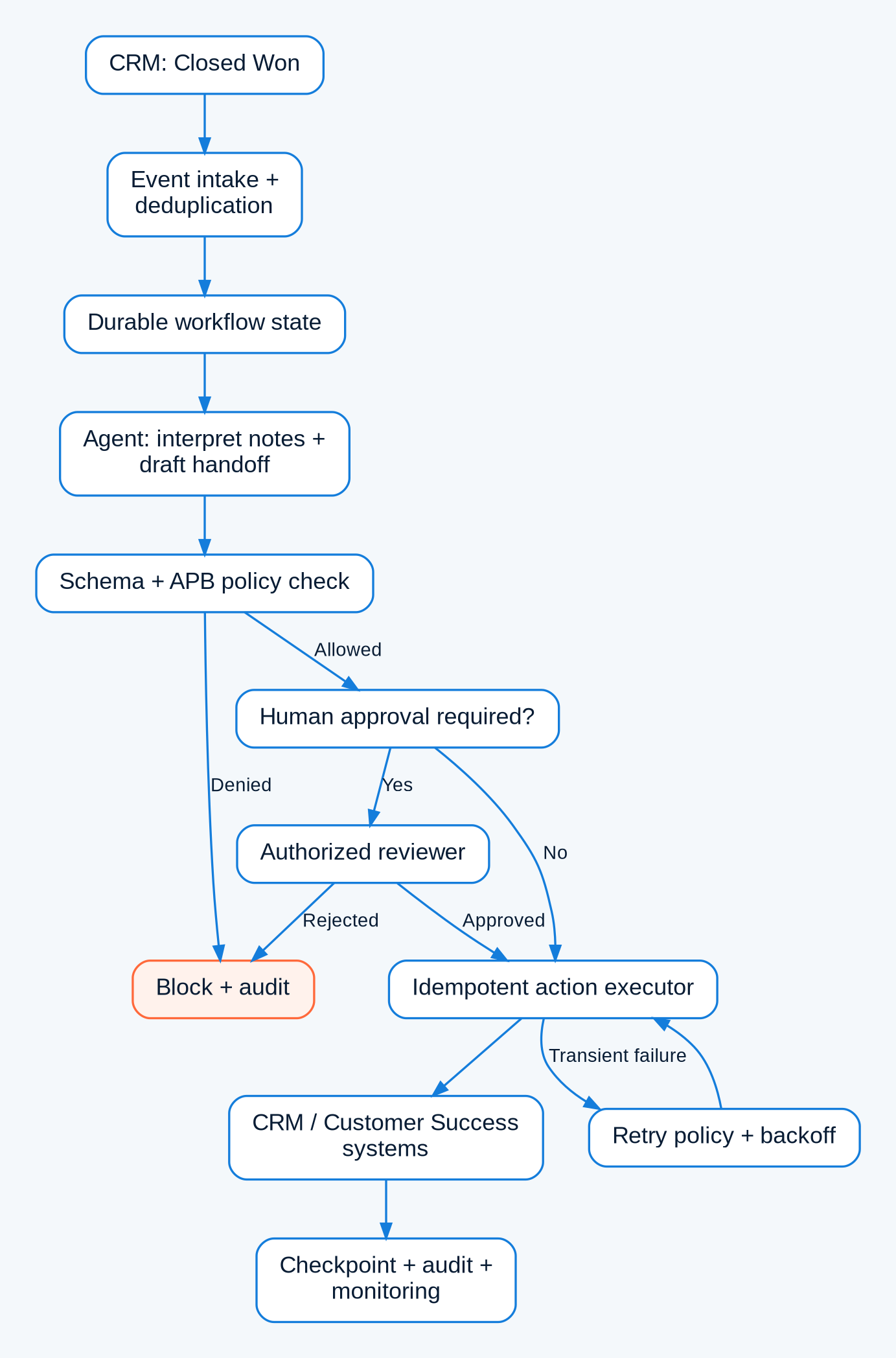
Architecture B — workflow-orchestrated AI agent
Open full-size diagram · Download Mermaid source
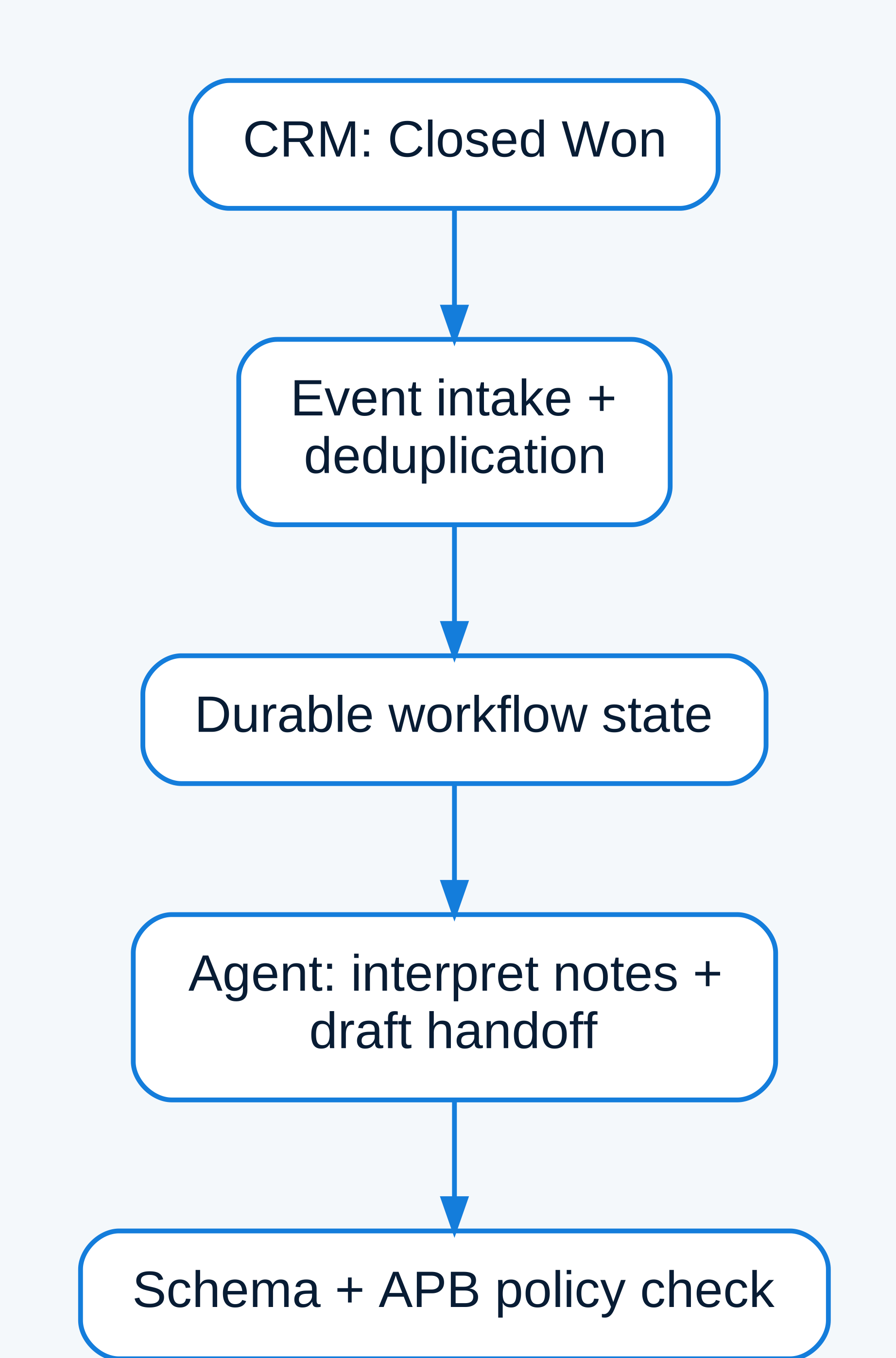
Figure 2. Reference architecture. The policy service—not the model—authorizes business actions. The executor uses operation-specific idempotency keys or reconciliation mechanisms.
The agent remains part of the architecture. It supplies interpretation and proposals. The workflow controller owns the transition from a proposal to an authorized business action.
What actually changes in production?
| Dimension | Minimal standalone agent loop | Workflow-orchestrated agent |
|---|---|---|
| Reasoning | Model decides how to proceed. | Model still handles ambiguous interpretation and decision support. |
| Control flow | Often follows model-directed tool calls. | Explicit steps, conditions, branches, and boundaries. |
| Execution state | Depends on application/SDK persistence. | Persisted process state tied to a business event or workflow ID. |
| Recovery | Must be implemented in the surrounding runtime. | Defined retry, resume, timeout, and failure paths. |
| Approval | Available in capable SDKs; scope depends on configuration. | Approval becomes an explicit, stateful transition tied to the requested action. |
| Authorization | Tool permissions require external enforcement. | Policy checked immediately before the side effect. |
| Evidence | Agent traces can show model/tool behavior. | End-to-end event, approval, action, outcome, and recovery records. |
| Engineering cost | Small initial surface area. | Additional state, infrastructure, operational, and testing responsibilities. |
A workflow does not make a model's interpretation correct. It creates places to validate that interpretation and control what happens next. An agent SDK can provide many of the same mechanisms; the deciding factor is the implemented system, not the label on the framework.
Compare the production architecture beyond standalone AI agents.
A production handoff, step by step
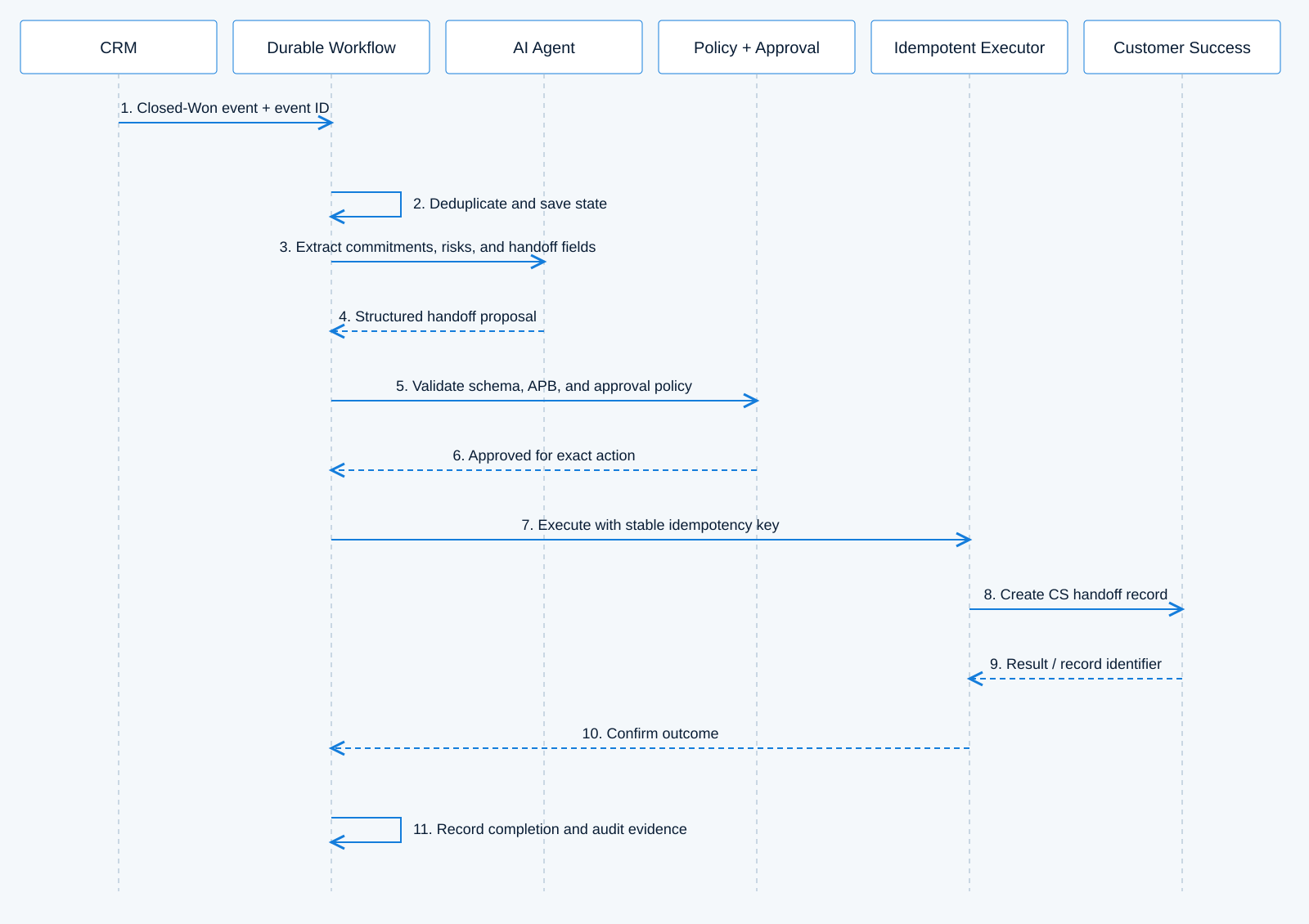
Open full-size diagram · Download Mermaid source
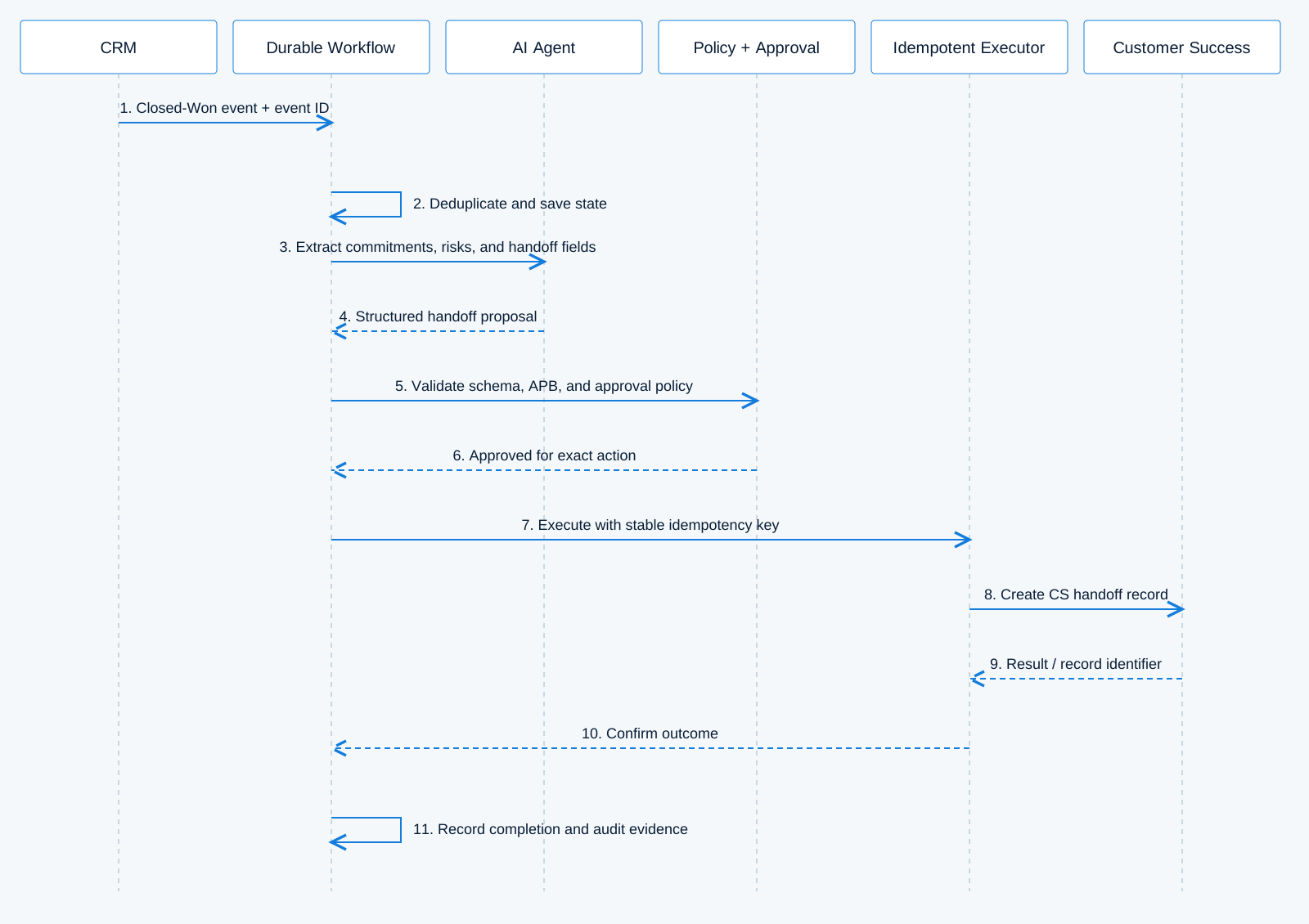
Figure 3. The approval is bound to the specific action and parameters. The workflow records the external system's result before marking the business operation complete.
The most important failure window occurs between the external API accepting an action and the workflow recording completion. If a worker crashes in that window, a resumed execution must first establish whether the external side effect already happened.
The OpenAI Agents SDK human-in-the-loop documentation describes this exact risk: approval and serialized run state do not themselves guarantee exactly-once tool execution. LangGraph's documentation likewise calls for idempotency keys or existing-result checks around side effects.
Seven failure-injection tests that matter
These are test specifications, not reported production outcomes. They can be run against a local simulator and then adapted to actual CRM, email, and approval integrations.
| Test | Injected condition | Required observable result |
|---|---|---|
| T01 — Happy path | A valid Closed-Won event with authorized approval | One completed workflow, one handoff action, completion audit event. |
| T02 — Crash after write | Stop the worker after the external system accepts a write, before saving completion | Resume succeeds; externally visible action count remains 1. |
| T03 — Duplicate webhook | Deliver the same business-event ID twice | One workflow instance and one external action. |
| T04 — Cross-tenant write | Agent proposes writing into a different tenant | Executor blocks the action; external action count 0. |
| T05 — Approval rejection | Unauthorized reviewer attempts approval; authorized reviewer rejects | No external write and no completion status. |
| T06 — External timeout | Dependent API times out before the side effect | Workflow remains recoverable; a later attempt completes once. |
| T07 — Payload mutation | Change action parameters after approval | Approval fingerprint mismatch blocks execution. |
Reproducible companion: workflow_failure_injection_tests.py
python -m unittest -v workflow_failure_injection_tests.py
The companion uses Python's standard library and SQLite. It simulates the agent's proposal and an external CRM endpoint that honors a stable idempotency key. Local execution result: 7/7 tests passed. Test scope: local architecture with simplified reviewer and tenant-policy fixtures. Production validation covers authentication, provider sandbox behavior, failure injection and webhook/API semantics.
Authorization is not a prompt
OMEGANEON's Agent Permission Boundaries (APB) model specifies six checks:
| Primitive | Production question |
|---|---|
| System | Which connected service can the action reach? |
| Data | Which records or data fields can it read or change? |
| Action | Is this a read, create, update, send, or delete? |
| Limit | What volume, rate, monetary, or scope threshold applies? |
| Duration | When does authorization expire? |
| Identity | Which tenant, human, and service principal is acting? |
These boundaries belong in the executor or an independently enforced policy layer. Approval records should identify the exact action, target, parameters, reviewer, and expiration. The OWASP AI Agent Security Cheat Sheet recommends least privilege, independent execution checks, action-bound approvals, audit evidence, and adversarial testing.
A model can recommend "send the onboarding summary." It does not decide whether it has permission to email that recipient or access another customer's records.
Which stack should engineering teams use?
No single vendor name decides production readiness. The implemented controls do.
| Building block | What the official documentation establishes | Design boundary |
|---|---|---|
| OpenAI Agents SDK | Model/code-driven orchestration, handoffs, HITL run-state serialization, tracing. Orchestration · HITL | Application must still authenticate approvers, enforce permissions, and reconcile external side effects after failure. |
| LangGraph | Persistent checkpoints and resumable interrupts. Persistence · Interrupts | An interrupted node restarts from its beginning on resume; pre-interrupt side effects must be safe to repeat. |
| Temporal | Event-history replay reconstructs workflow state after worker failure. Workflows · Retry policies | Workflow logic must be replay-deterministic; LLM calls and external I/O belong in Activities. |
| AWS Step Functions | Retry, Catch, and callback task tokens for external/human steps. Errors · Callbacks |
Product quotas matter: Standard executions can last up to one year; Express up to five minutes; state/task payloads have a 256 KiB limit. Quotas |
Microsoft's AI agent orchestration pattern guide also separates sequential, concurrent, group-chat, handoff, and dynamic manager patterns. Those choices affect routing, cost, latency, and failure behavior; adding agents is not automatically an architectural improvement.
Measure business execution, not agent activity
A production scorecard should track:
- Business completion rate: completed eligible workflows / started eligible workflows.
- Duplicate side effects: unintended repeated external actions per period or per business event.
- Approval-policy violations: actions performed without the required valid approval.
- Recovery time: time from detectable failure to successful completion or safe escalation.
- Latency: end-to-end event-to-outcome duration, including approval waiting time where relevant.
- Cost per completed workflow: model, infrastructure, API, and human-review costs divided by completed operations.
Agent traces explain reasoning and tool activity. Business execution records establish whether the customer's handoff happened correctly.
The architectural decision
For open-ended research, analysis, and interactive assistance, a well-designed agent with narrowly scoped tools can be sufficient. For high-volume, cross-system operations with explicit approval, recovery, and audit requirements, workflow orchestration creates a separate execution-control layer. Where both reasoning and operational control are needed, combine them.
Use an agent to interpret what should happen. Use a workflow to govern how an approved action actually happens.
OMEGANEON's Scaling, Just Like Drag-and-Drop. whitepaper develops this distinction as a broader approach to moving from manual SOPs to controllable AI operations. A Workflow Assessment starts with the business event, maps the human and system decisions, defines authorization boundaries, and tests recovery before deployment.
Official references
- Anthropic Engineering — Building effective agents (December 19, 2024).
- OpenAI — Agents SDK: Agent orchestration, Human-in-the-loop, Tracing.
- LangChain — LangGraph: Functional API and idempotency, Interrupts.
- Temporal — Workflows and event-history replay, Retry policies.
- AWS — Step Functions error handling, service integration callbacks, quotas.
- OWASP — AI Agent Security Cheat Sheet.
- Microsoft Azure Architecture Center — AI agent orchestration patterns.
Turn a recurring bottleneck into a managed workflow.
Explore how workflow-orchestrated AI connects business execution, human approvals and ongoing operations—and how to measure the result.
Build better operations.
Keep learning.
Practical research on AI workflows, operating costs, and scaling startup operations. Delivered by email.
The subscription form loads as you reach this section.
See the framework. Explore the work.
Agent Permission Boundaries, Human Approval & Audit Logs
Review the six APB permission primitives, human oversight and auditability used to bound business-system access.
Read the frameworkWHITEPAPERScaling, Just Like Drag-and-Drop.
Read the core argument for combining agent reasoning with workflow execution and governance.
Read the frameworkRELATED CASE STUDY / START HEREERP Document Operations: From Manual Documentation to Managed AI Workflows
Trace AI extraction and generation through deterministic QA, approval and delivery.
Explore the case studyRELATED CASE STUDYAI-Powered Government Contract Opportunity Discovery & Qualification
Follow research, evidence collection and qualification into a governed review process.
Explore the case studyRELATED CASE STUDYScaling Creator Monetization Without Scaling Operational Work
Explore connected events, AI-assisted decisions and ongoing revenue operations.
Explore the case study