In this article
A single point of failure isn't always a server outage. Sometimes it's the only person who knows the rule, the only account that can change a setting, or the approval everyone waits for.
Your startup can have modern infrastructure and still lose operational capacity when one employee, credential, or undocumented decision disappears from the workflow.
For a Series A or Series B company, the practical question is not “Do we have documentation?” It is “Which critical workflows cannot continue when one dependency becomes unavailable?”
This article provides an operational audit you can use to answer that question: map the work, identify the dependency, assess the disruption, then run a controlled continuity test.
1. The Friday CRM Incident
Hypothetical case. The company, people, and events below are fictional.
I'm Jordan, Head of Revenue Operations at a 67-person B2B SaaS startup.
On Friday, our only CRM administrator takes unexpected leave. The CRM itself remains online. Our sales team can log in, update opportunities, and view dashboards. From the outside, nothing looks broken.
Then a deal closes.
The usual routing automation doesn't create a customer onboarding record. The Customer Success team doesn't receive the expected handoff. Finance asks why a contracted billing exception hasn't appeared in the system.
Our team finds the automation, but nobody else understands its exception rules, credential ownership, or recovery sequence. One connector still relies on the administrator's personal access configuration. We also discover that the latest procedure was never added to the shared runbook.
The company has tools. It has talented employees. It even has a workflow.
What it lacks is an independently executable path around one critical dependency.
The failure is not limited to the CRM. It propagates into onboarding, billing, customer communication, and reporting.
That's what makes a single point of failure (SPOF) a business problem rather than merely an IT term.
2. Where Single Points of Failure Hide
A single point of failure is a dependency whose loss can interrupt a process because no functioning alternative is available when needed.
In startup operations, the dependency can take several forms:
| Dependency type | What is concentrated | Example failure | Business effect |
|---|---|---|---|
| Person | Execution ownership | One employee performs all sales-to-CS handoffs | Onboarding stalls |
| Knowledge | Rules, exceptions, history | Only one specialist understands CRM routing | Changes cannot be repaired safely |
| Access | Credentials or administrative authority | One account controls a production integration | Recovery is delayed |
| Decision | Approval authority | Founder must approve every exception | Decisions queue up |
| System / integration | Technical execution path | One unsupported connector handles critical data | Downstream workflows stop |
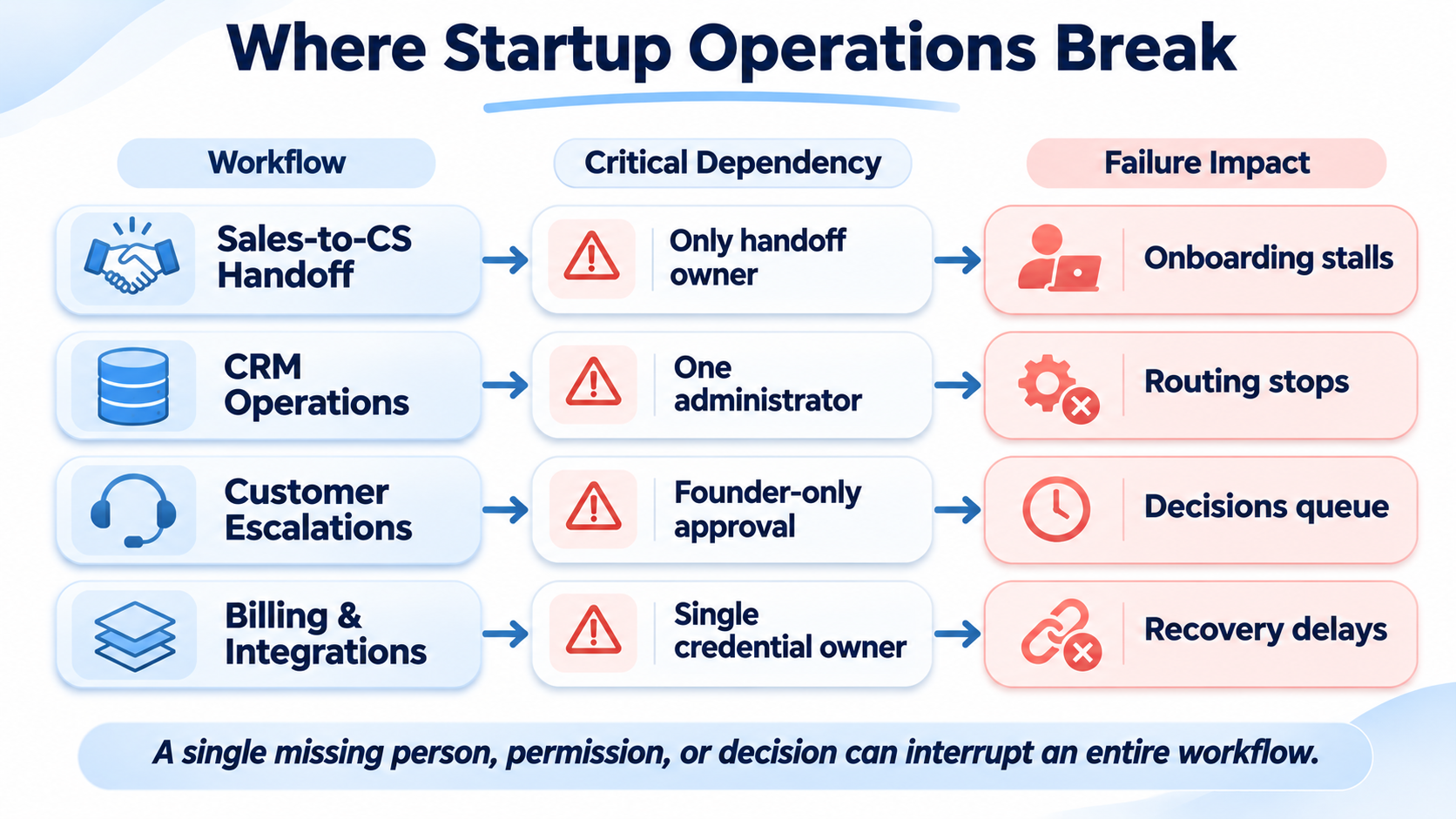
Figure 1. Where Startup Operations Break — four illustrative failure paths across Sales-to-CS, CRM, customer escalation, and billing integrations.
There is a useful technical analogy here. Software engineering teams use the Truck Factor, also called the Bus Factor, to discuss how much project knowledge is concentrated in a small number of developers.
In a 2016 peer-reviewed study, Avelino and coauthors analyzed 133 popular GitHub projects and estimated that 65% had a Truck Factor of two or fewer. The study examined software project contributor dependencies. Its operational lesson for a startup is to identify concentration explicitly and test how the work survives the loss of a critical contributor. Read the original research.
The first step is to move beyond the org chart. A job title names an owner; it doesn't show the hidden dependencies between an action and its successful completion.
3. Map the Workflows That Actually Matter
Start with business outcomes, not applications.
Select the workflows where interruptions affect cash collection, customer commitments, revenue growth, or a required operating control. For an enterprise SaaS startup, a useful initial set includes:
- Closed-won to customer onboarding: opportunity validation, handoff, provisioning, kickoff, exceptional terms.
- CRM and revenue operations: lead routing, pipeline rules, forecasting inputs, attribution and reporting.
- Customer escalations: triage, special approvals, response ownership, resolution tracking.
- Billing and renewals: invoicing inputs, payment exceptions, contract changes, renewal notices.
- Internal automation and integrations: connector credentials, workflow configuration, error handling and rollback.
For each workflow, build a dependency record. The goal is to make the invisible execution path visible.
A one-page dependency record
| Field | What to capture |
|---|---|
| Business outcome | What must be completed, and by when? |
| Trigger and handoff | What starts the workflow? What must happen next? |
| Primary owner | Who operates or maintains it today? |
| Decision rules | Where are the thresholds, exceptions, and approval criteria recorded? |
| Systems and permissions | Which integrations, accounts, and access levels are required? |
| Authorized backup | Who is permitted and prepared to step in? |
| Recovery path | How does the workflow resume after failure? |
| Test evidence | When did someone other than the primary owner last complete it? |
A backup named in a document is not the same as a backup who can complete the task. The dependency record should point to an actual execution test or carry the status not tested.
This approach follows the logic of Business Impact Analysis (BIA). NIST's SP 800-34 Rev. 1 uses business processes, supporting resources, dependencies, and recovery priorities to structure contingency planning for information systems.
For an operations team, that translates into a practical question: What does this workflow need to continue, and which of those requirements has no working substitute?
4. Prioritize Dependencies by Business Impact and Recovery Difficulty
Not every dependency deserves the same implementation budget.
A manually prepared internal report and a production billing workflow should not receive identical urgency just because both have only one owner.
First, confirm the dependency: if its primary path fails, is there a tested, authorized alternative? If the answer is no, assess two dimensions.
Business impact: Which customer obligations, revenue processes, internal controls, or delivery deadlines are disrupted, and after how long?
Recovery difficulty: Can an authorized backup restore execution from a current runbook and available access, or must the team reconstruct knowledge, obtain new credentials, and redesign the process?
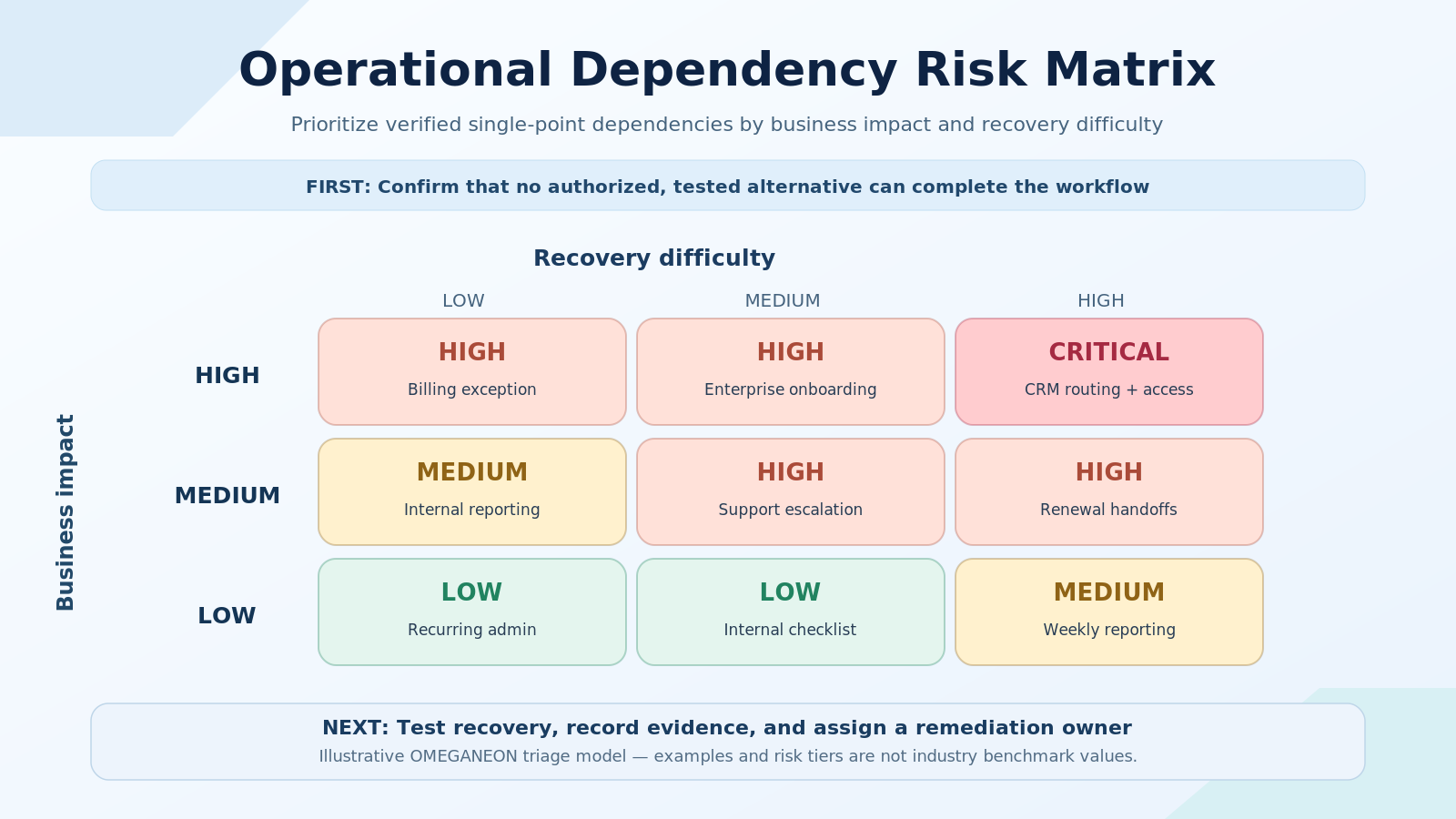
Figure 2. Operational Dependency Risk Matrix — an illustrative OMEGANEON triage model for selecting which verified dependencies to fix first. Example workflow placements are hypothetical.
Simple triage guide
| Business impact | Recovery is easy | Recovery needs coordination | Recovery is difficult |
|---|---|---|---|
| High | High | High | Critical |
| Medium | Medium | High | High |
| Low | Low | Low | Medium |
These tiers are OMEGANEON assessment categories, not ratings prescribed by NIST or ISO.
For each high- or critical-priority workflow, document a concrete consequence of interruption. Examples include a delayed customer kickoff, inability to update contracted billing terms, stalled renewals, or a manual reporting backlog.
The Ready.gov Business Impact Analysis approach explicitly includes lost or delayed income, additional expenses, contractual obligations, customer effects, and the timing of a disruption in a business impact assessment.
A useful first output is a Top Five Dependency Register: five workflows, five failed alternatives, five recovery owners, and a clear order for action.
5. Run a Key-Person Absence Test
An org chart and an SOP are inputs. An absence test provides execution evidence.
Choose one high-priority workflow and stage a controlled exercise without interrupting production customer activity.
The test protocol
- Define the scenario. Example: “The primary CRM administrator is unavailable for one business day.”
- Name the replacement owner. Choose someone authorized to perform the job, but not its usual operator.
- Set the task. Run a representative sales-to-CS handoff, including one approved exception, in a safe test environment or controlled dry run.
- Restrict informal rescue. The original owner does not answer process questions during the measured exercise. A designated safety lead can stop the test if necessary.
- Capture the evidence. Record access failures, missing instructions, wrong decisions, manual workarounds, elapsed time, and approvals.
- Repair and rerun. Update the runbook, decision logic, permissions, fallback path, or automated workflow, then repeat the exercise.
Measure what matters:
- Time to resume: elapsed time before the authorized backup can proceed.
- Completion rate: required test tasks completed correctly.
- Escalation dependency: tasks that still require the unavailable operator.
- Permission correctness: actions completed within approved access boundaries.
- Recovery repeatability: whether a second attempt works from the documented process alone.
A pass means the predefined test cases met their acceptance criteria. Record the test date, environment, participants, and outstanding failures. Re-test after major workflow changes.
Google's published Site Reliability Engineering practices describe using documented playbooks and rehearsed incident response rather than relying on one expert to improvise the recovery path. The same design principle is useful when testing business-process continuity.
Turn the dependency map into a Key-Person Absence Test with defined acceptance criteria.
6. Fix the Highest-Risk Path, Not the Entire Company at Once
Once a dependency has been verified, select the smallest change that restores a functioning alternative.
| Failure discovered | First remediation | What to verify |
|---|---|---|
| Only one person knows the steps | Capture rules, inputs, exception paths, and a runbook | Backup completes the workflow |
| One employee holds production credentials | Establish organization-owned access and authorized recovery roles | Backup gets the minimum required access |
| Founder is the sole routine approver | Define decision thresholds and delegated authority | Routine cases proceed without founder intervention |
| One automation script has no maintainer | Version the workflow, document dependencies, add monitoring and rollback | A second operator diagnoses and restores it |
| Customer context is trapped in messages | Make approved context available within the handoff workflow | Next owner can proceed without searching for the original person |
This is also where automation becomes useful. A governed workflow can preserve triggers, execution states, approval rules, exceptions, audit records, and recovery steps in a shared operational system.
But changing who executes the work does not automatically resolve concentration. If the entire new automation depends on one unshared administrator account or one undocumented engineer, the company has simply moved the point of failure.
The continuity design needs an owner, a backup, permission boundaries, a recovery path, and a repeatable test.
7. From Single-Person Dependency to Institutional Capability
At OMEGANEON, we use Institutionalized Automation to describe a method for turning individual-dependent operating knowledge into governed, executable, auditable, and transferable workflows.
The implementation model connects four activities:
Capture: Record process steps, exceptions, decisions, ownership, system requirements, and actual examples of what goes wrong.
Execute: Move repetitive operations into a workflow with explicit triggers, states, assignments, retries, exception handling, and AI-assisted steps where appropriate.
Govern: Apply Agent Permission Boundaries (APB) across six primitives—System, Data, Action, Limit, Duration, Identity. Route high-risk actions through Human-in-the-Loop (HITL) approvals; preserve relevant audit logs.
Verify: Run controlled absence and recovery tests, assign backup operators, and monitor whether the system remains operable after changes.
These controls are consistent with the OWASP AI Agent Security Cheat Sheet, which emphasizes least-privilege tool access, approval for high-risk actions, and structured logging.
The commercial result is operational continuity that can be demonstrated, rather than a promise that “automation will take care of it.” OMEGANEON's AI Workflow Implementation & Managed Operations (AIWIA) model is designed around implementing and maintaining that execution layer.
8. Your First Operational Dependency Audit
You can start with one 60-minute working session involving a COO or Head of Ops and the owners of your highest-impact workflows.
Use the following checklist:
- Choose five workflows connected to revenue, customer delivery, billing, or operating controls.
- Name the primary operator and the authority required for every significant action.
- Identify where decision rules, exception handling, and system configuration actually live.
- List the accounts, integrations, credentials, and external services each process requires.
- Check for a tested, authorized backup operator or automated alternative.
- Estimate business impact and recovery difficulty for dependencies without an alternative.
- Run one controlled absence test for the highest-priority workflow.
- Assign a remediation owner, acceptance criteria, and a retest date.
The audit should produce three concrete assets: a Dependency Map, a Prioritized Risk Register, and an Absence Test Record.
A growing startup should be able to answer a simple question about its critical work:
If one person became unavailable tomorrow, would the business still know what to do—and have the authority and systems to do it?
That answer tells you where to start building institutional capability.
Go Deeper: Institutionalized Automation
Institutionalized Automation: From Individual Know-How to Institutional Capability
OMEGANEON's whitepaper documents the method for capturing operational knowledge, building governed workflows, defining permission boundaries, and verifying business continuity through repeatable tests.
Read Institutionalized Automation — From Individual Know-How to Institutional Capability
Discuss Your Critical Workflows with OMEGANEON
Related OMEGANEON Insights
- Your Startup Shouldn't Depend on One Person to Keep Running. — Key-Person Risk and business continuity.
- Is Your Founder Becoming Your Startup's Biggest Bottleneck? — founder approval and decision dependencies.
- The Hidden Cost of Knowledge Silos in Growing Startups — scattered operational knowledge and repeated handoffs.
References
- NIST. (2010). SP 800-34 Rev. 1: Contingency Planning Guide for Federal Information Systems. Official publication.
- ISO. (2019; amended 2024). ISO 22301 — Business continuity management systems. Official overview.
- Avelino, G., Passos, L., Hora, A., & Valente, M. T. (2016). A Novel Approach for Estimating Truck Factors. International Conference on Program Comprehension. University of Waterloo publication record.
- Ready.gov. Business Impact Analysis. Official guidance.
- Google. Site Reliability Engineering — Introduction. Google SRE Book.
- OWASP. AI Agent Security Cheat Sheet. Official cheat sheet.
More on Operational Continuity
Keep critical workflows running when key people are unavailable.
Read how OMEGANEON captures operating knowledge, builds governed workflows, and verifies continuity through its five-stage framework and ICVS.
Build better operations.
Keep learning.
Practical research on AI workflows, operating costs, and scaling startup operations. Delivered by email.
The subscription form loads as you reach this section.
See the framework. Explore the work.
Institutionalized Automation
From Individual Know-How to Institutional Capability: five stages for capturing knowledge, governing execution and verifying continuity through ICVS.
Read the frameworkSECURITY FRAMEWORKAgent Permission Boundaries, Human Approval & Audit Logs
Review the six APB permission primitives, human oversight and auditability used to bound business-system access.
Read the frameworkWHITEPAPERScaling, Just Like Drag-and-Drop.
Inspect control flow, human checkpoints and recovery responsibilities in practical implementations.
Read the frameworkRELATED CASE STUDY / START HEREERP Document Operations: From Manual Documentation to Managed AI Workflows
Follow missing-information and QA failures into controlled exception paths.
Explore the case studyRELATED CASE STUDYAI-Powered Government Contract Opportunity Discovery & Qualification
Review source freshness, qualification and exception-recovery responsibilities.
Explore the case studyRELATED CASE STUDYScaling Creator Monetization Without Scaling Operational Work
Explore revenue exceptions and transferable operating logic.
Explore the case study