In this article
Your startup can grow beyond its original operators—without losing the knowledge, control, or continuity that keeps critical work moving.
A customer signs a contract. The CRM marks the opportunity as closed-won. Onboarding should begin. But the one person who understands the handoff is on leave, the exception rules live in private messages, and the backup team cannot tell which actions are authorized.
The company has software, people, and documentation. The missing component is transferable execution.
That is the operational problem behind single-person dependency: a critical workflow depends on one individual for knowledge, decisions, access, or execution. The practical response is to establish a workflow that the organization can operate, govern, recover, and verify independently of its original owner.
At OMEGANEON, we call that approach Institutionalized Automation.
This guide brings together four connected operational issues—key-person risk, founder dependency, knowledge silos, and single points of failure—and turns them into a practical implementation and verification process for Series A and Series B startups.
1. The Moment You Discover the Workflow Belongs to One Person
Hypothetical case — the company, employees, workloads, and numbers below are fictional and serve as design examples.
Nora is COO of a 68-person Series B B2B SaaS company. The company is signing larger accounts and increasing onboarding volume. Its Sales-to-Customer Success handoff spans a CRM, contract repository, ticketing platform, implementation board, and provisioning system.
Sarah, a senior operations specialist, has kept that entire sequence running for two years. He resolves missing deal details, knows which enterprise contracts require security reviews, updates CRM fields, routes implementation tasks, and fixes provisioning exceptions.
When Sarah becomes unavailable for two weeks, the team discovers that he was not simply an experienced contributor. He was the execution bridge between five systems and several teams.
"We thought our onboarding process was documented," Nora says. "We had checklists in every tool. What we didn't have was one clear, authorized path that anyone else could follow when Sarah wasn't here."
Sales can see the contract. Customer Success can see the account. Engineering can see the provisioning request. No one can reconstruct the full set of decisions needed to complete the handoff.
The response should not be to make every colleague learn Sarah's entire job. It is to capture the operating knowledge behind the process, establish decision rights, build a controlled execution path, and assign a tested backup.
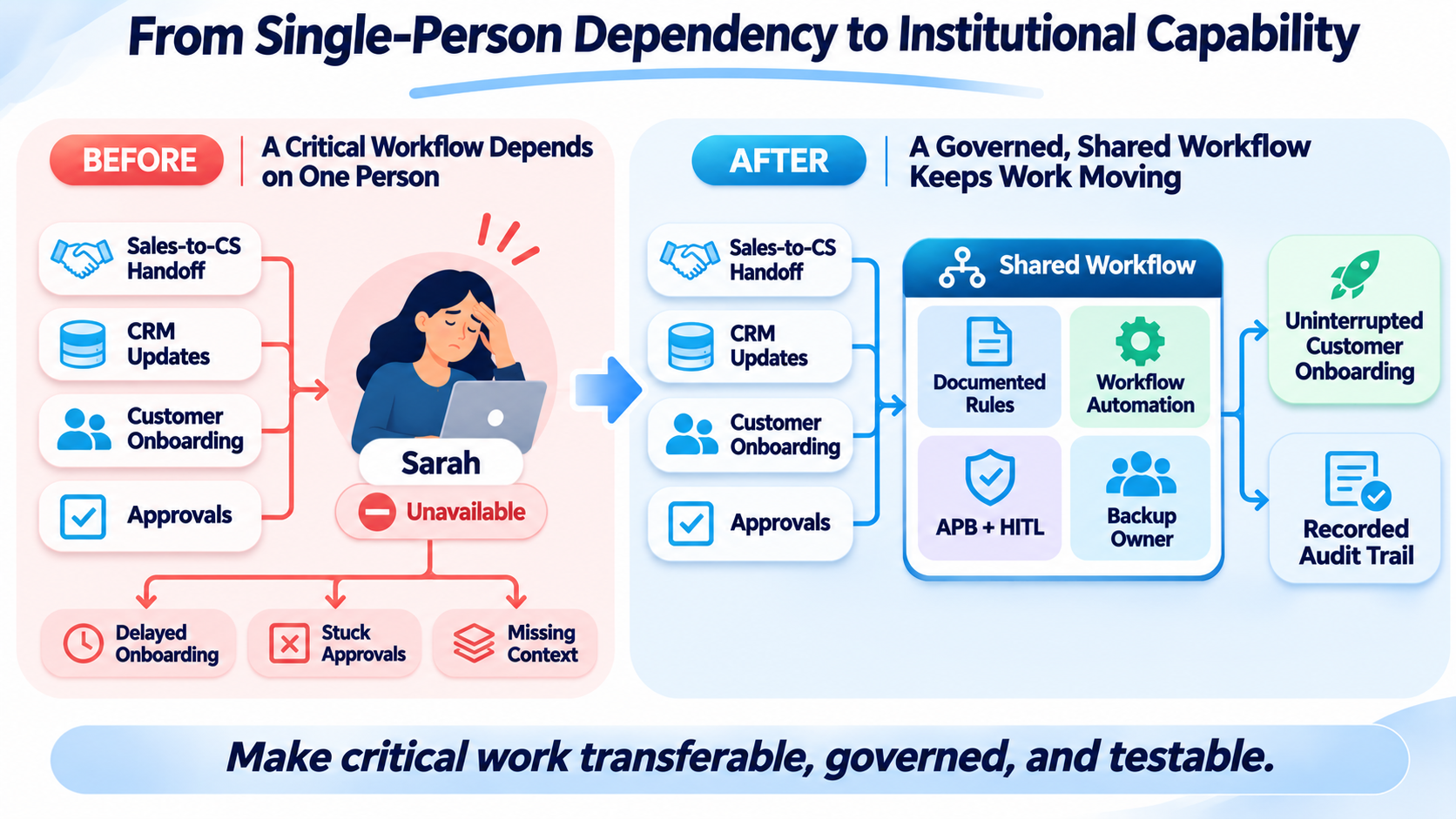
Figure 1. Before and after: the hypothetical workflow moves from individual dependency to a shared operating design.
2. Find All Four Types of Single-Person Dependency
A dependency assessment should look beyond who performs the task. The source of operational fragility is often hidden in one of four places.
| Dependency | What it looks like | What to inventory |
|---|---|---|
| Knowledge | Only one person understands exceptions, customer history, or unwritten rules | Decision records, SOPs, edge cases, source documents |
| Execution | Only one employee can run the process end to end | Triggers, handoffs, task sequence, recovery steps |
| Authority | All routine exceptions route to the founder or one manager | Approval policy, delegated limits, escalation rules |
| Access | One administrator or credential owner controls critical integrations | System roles, service accounts, credential recovery, backup access |
Start with workflows that influence revenue, customer commitments, billing, or ongoing service delivery. For a SaaS company, the first review set can include Sales-to-CS handoff, customer provisioning, account renewals, billing exceptions, support escalations, and CRM operations.
For every workflow, create a Dependency Record containing:
- Business outcome and accountable process owner.
- Trigger, inputs, systems, and upstream/downstream dependencies.
- Primary operator, authorized backup, and approval authority.
- Knowledge sources, decision rules, and known exceptions.
- Required permissions, limits, and recovery path.
- Last observed backup execution and test result.
The point is to expose the full execution path, not simply to draw an organizational chart.
The ISO/IAF Auditing Practices Group guidance on Organizational Knowledge distinguishes experience-based organizational knowledge from information controlled through documents alone. This makes the operational inventory especially important where customer exceptions and decision rules live primarily in employee experience.
3. Prioritize by Business Impact and Recovery Exposure
Not every single-owner task needs the same implementation effort. Prioritize the processes where an interruption creates meaningful cost or operational exposure.
Assess each candidate workflow on five dimensions:
| Dimension | Assessment question |
|---|---|
| Criticality | Which customer commitments, revenue events, or service obligations depend on this workflow? |
| Owner concentration | How many authorized people can operate the process without its original owner? |
| Knowledge readiness | Are the relevant decisions, exceptions, and system interactions available to a backup? |
| Recovery difficulty | How long would it take to restore execution after an owner becomes unavailable? |
| Control sensitivity | Which financial, contractual, security, or customer-data actions require approval? |
A practical initial ranking is Critical / High / Moderate / Low, supported by written reasons and observable evidence. A company can use numerical weights once it establishes consistent definitions for the input ratings.
The framework behind this prioritization is well established. NIST SP 800-34 Rev. 1 describes business impact analysis, recovery priorities, contingency planning, training, and testing for information systems. ISO 22301:2019 provides a broader business-continuity management framework for preparing for and responding to disruption.
Example — initial assessment for Nora's startup (illustrative):
| Workflow | Current dependency | Operational priority | First remediation |
|---|---|---|---|
| Enterprise onboarding | One person interprets exceptions and provisions accounts | Critical | Capture decisions; deploy governed handoff; test backup |
| CRM lead routing | One person owns rules and integrations | High | Version routing rules; establish controlled admin recovery |
| Monthly revenue dashboard | One analyst maintains the reporting logic | Moderate | Document definitions; create a second reviewer |
| Internal team newsletter | One employee publishes updates | Low | Share an editor checklist |
This prevents the program from becoming a documentation exercise covering hundreds of low-impact tasks. Start with the workflows where a missing person changes the company's ability to deliver.
4. Institutionalized Automation: The Five-Stage Implementation Framework
Institutionalized Automation turns individual-dependent activity into an organizational operating capability. Its five stages connect discovery, knowledge capture, execution engineering, governance, and continuity verification.
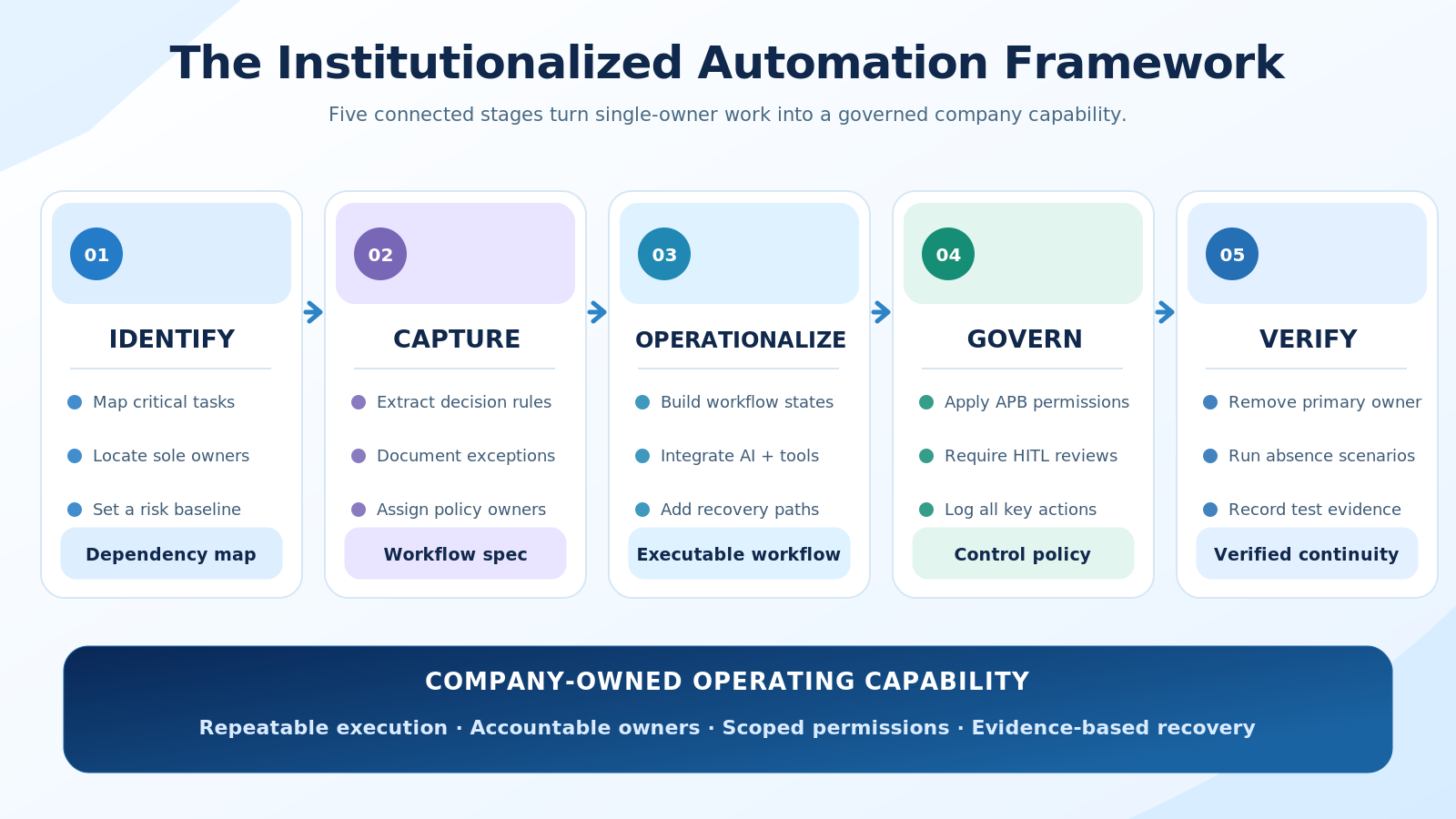
Figure 2. OMEGANEON’s five-stage implementation framework.
Stage 1 — Identify: Map the Dependency
Select a critical workflow. Trace the real sequence from initiating event to completed business outcome. Identify the owners, systems, exceptions, approvals, and failure points that currently require the original employee.
Deliverable: A validated workflow dependency map and baseline continuity assessment.
Stage 2 — Capture: Extract the Operational Knowledge
Observe the process and interview its operators. Gather representative cases, screenshots, policy documents, relevant system configuration, customer-specific exceptions, and failure history.
Turn them into an actionable specification: inputs, outputs, deterministic rules, judgment-based decisions, exception classes, ownership, and recovery procedures.
Deliverable: A versioned workflow specification with a named policy owner.
Stage 3 — Operationalize: Build the Execution System
Create a stateful workflow where standard steps execute through defined triggers, system integrations, and workers. Assign AI to bounded tasks such as extracting information, classifying requests, or assembling summaries. Keep deterministic business requirements as explicit checks and rules.
Store execution state so interrupted tasks can resume. Include retry policies, duplicate-event protection, and fallback paths.
Deliverable: An executable workflow and an operations runbook.
Stage 4 — Govern: Define Legitimate Authority
Apply permissions and decision rights before the workflow acts. Define routine authorized actions, actions requiring a named human approval, and operations that must halt for review.
Deliverable: An approved permission and escalation policy, with audit evidence.
Stage 5 — Verify: Remove the Original Owner from the Test
Run the workflow without involving its original operator. Test routine completion, exception handling, approval delegation, infrastructure failure, and recovery. Record evidence, address failures, and repeat.
Deliverable: A Key-Person Absence Test report and an ongoing verification schedule.
The sequence matters: an automation is not an organizational capability until the company can operate and maintain it without depending on the person who originally built it.
5. The Sales-to-CS Handoff: A Concrete Workflow Design
Apply the five stages to Nora's enterprise onboarding process.
Trigger: An authorized CRM event marks an opportunity closed-won and provides a unique deal identifier.
Collect: Retrieve the signed agreement, product package, implementation scope, customer contacts, security requirements, and approved handoff fields from authorized systems.
Validate: Check that the agreement is signed, required information is present, and the provisioning request matches the contractual scope. Missing or conflicting evidence pauses execution and creates a review task.
Interpret: An AI component extracts relevant onboarding requirements into structured fields. The workflow validates those fields against deterministic rules and approved source records before any consequential action.
Route: Standard, fully authorized onboarding steps follow the routine path. Nonstandard security requirements, contractual exceptions, or out-of-scope changes go to the appropriate human owner.
Execute: Create the onboarding project, assign tasks, provision the approved configuration, and notify the customer-facing team after the required permissions and approvals have been verified.
Recover: Use idempotency keys to avoid duplicate provisioning. Retry transient technical failures within defined limits, then route unresolved errors to a named operator with the execution state preserved.
Audit: Store the run identifier, source references, policy version, authorizations, action results, exceptions, and responsible identities.
The architecture follows established workflow engineering patterns. AWS Step Functions documents state-specific retries, catch handlers, timeouts, and fallback transitions. Microsoft Power Automate demonstrates how a workflow can pause and resume around named human approvers.
A successful implementation gives Nora's Customer Success team a clear operating surface: they can inspect status, handle assigned exceptions, and continue the approved process without reconstructing Sarah's memory.
6. Keep the New Workflow from Becoming Another Single Point of Failure
Replacing a person-dependent process with an opaque AI agent or a private automation script simply changes the dependency.
OMEGANEON's Agent Permission Boundaries (APB) model uses six permission primitives to define an agent's permitted operating scope:
| APB primitive | Example for customer onboarding |
|---|---|
| System | CRM, approved provisioning tool, implementation board |
| Data | Only the relevant customer's signed agreement and onboarding records |
| Action | Read fields, create tasks, provision approved services, request an exception review |
| Limit | Authorized product configuration, transaction limits, retry budget |
| Duration | Time-bounded access tied to the request lifecycle |
| Identity | Named human approver or identifiable service/agent identity |
Human-in-the-Loop (HITL) provides the required decision point for exceptions and high-risk actions. An automated step that is already authorized within policy can proceed; one exceeding scope waits for the designated reviewer.
The control design should also address the automation itself:
- Ownership: Maintain a company-approved workflow owner, backup maintainer, and policy approver.
- Portability: Retain versioned workflow definitions, decision rules, integration contracts, and recovery instructions.
- Credentials: Use scoped identities, managed secrets, revocation procedures, and tested administrative recovery.
- Observability: Record execution state, decisions, failures, and the identity behind each action.
- Change management: Test modifications before release and preserve a supported rollback procedure.
- Fallback: Define what happens when the AI service, integration provider, or workflow platform is unavailable.
These design choices align with NIST SP 800-53 Rev. 5, including least privilege (AC-6), separation of duties (AC-5), and audit and accountability controls. The OWASP Top 10 for Agentic Applications 2026 highlights risks such as tool misuse, identity and privilege abuse, and cascading agent failures that belong in an AI-enabled workflow threat model.
The operating goal is straightforward: the company should retain control of the process, its permissions, its evidence, and its recovery options.
7. Prove Continuity with a Key-Person Absence Test
A named backup is a plan. A successful, recorded takeover is evidence.
Run a controlled absence drill after the workflow is implemented and before it becomes the sole production execution path.
Test setup: Choose a representative batch of onboarding cases. Remove the original operator from the execution and approval path for the test. Grant the backup only the access approved for that role. Preserve the test environment, policy version, starting conditions, and run identifiers.
Test cases:
- Standard handoff: The workflow completes a normal onboarding sequence.
- Missing agreement: The workflow pauses and requests authoritative evidence.
- Nonstandard customer requirement: The designated approver receives a complete decision packet.
- Duplicate event: Repeated CRM events do not create duplicate onboarding projects.
- Provisioning timeout: Bounded retries and fallback work as configured.
- Primary operator absent: The backup can inspect, resume, and complete permitted tasks.
- Permission denied: An action outside APB scope is blocked and recorded.
- Policy change: The workflow uses the approved version and follows its change-control procedure.
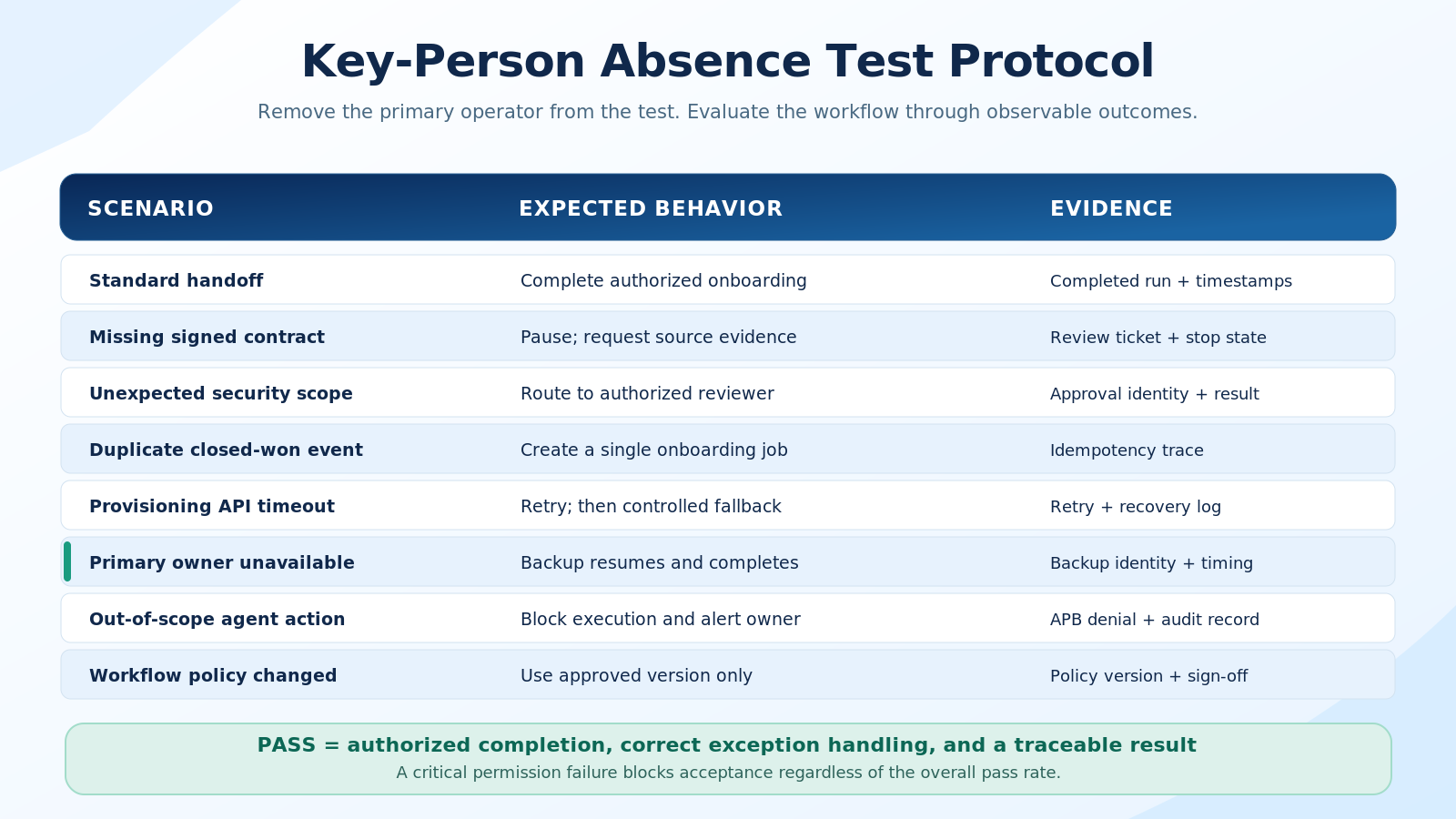
Figure 3. Operational acceptance test protocol.
Define acceptance criteria before the drill
| Measure | Definition | Evidence |
|---|---|---|
| Continuity Test Pass Rate | Passed test cases ÷ executed test cases × 100 | Test results with case IDs |
| Verified Backup Coverage | Critical workflows with a successful independent backup test ÷ critical workflows assessed × 100 | Signed test records |
| Handoff Time | Time from backup activation to the first valid completed workflow action | Event timestamps |
| Recovery Time | Time from detected interruption to restored processing | Incident timeline |
| Policy Compliance Rate | Actions satisfying the applicable authorization policy ÷ evaluated actions × 100 | Approval and access logs |
For example, if seven of eight test cases pass, the Continuity Test Pass Rate is 87.5%. This calculation belongs to the illustrative scenario. The failing case remains an open item for remediation and retesting.
Acceptance also depends on the severity of each failure. A blocked unauthorized action is a successful control outcome. An unauthorized action that executes is a critical failure requiring correction before go-live, regardless of the aggregate score.
Verify that an authorized replacement can continue the work using the ICVS requirements and acceptance gates.
8. A 30/60/90-Day Operating Plan
The following is an implementation sequence, not a delivery-time guarantee. Scope depends on the customer's systems, approvals, and workflow complexity.
| Window | Main work | Decision gate |
|---|---|---|
| Days 1–30: Discover | Inventory critical workflows; identify owners, knowledge, permissions, and interruption impact; select the first workflow | The customer approves the dependency map and target outcomes |
| Days 31–60: Implement | Capture edge cases; define rules and APB; build one end-to-end workflow; test retries, approval routing, and audit records | Routine and exception test suites meet the agreed design criteria |
| Days 61–90: Verify and operate | Run independent backup drill; fix failures; document recovery; establish ongoing ownership, monitoring, and change control | The customer accepts continuity evidence and ongoing operational responsibilities |
A strong first candidate is a bounded, high-volume workflow with clear business ownership, such as a standard Sales-to-CS handoff. Expanding to a second or third process becomes a deliberate portfolio decision after the first passes its acceptance gates.
9. Measure the Business Outcome, Not Just the Automation Count
The business case combines operating capacity, reliability, and recoverability.
Consider one illustrative onboarding workflow with 120 handoffs per month. Staff currently spend an additional 25 minutes per handoff collecting missing context and resolving recurring procedural questions.
Monthly manual rework = 120 × 25 ÷ 60 = 50 hours.
At an illustrative loaded labor rate of $65 per hour, this represents $3,250 per month in capacity value—or $39,000 over 12 months if volume and effort remain unchanged and the full recurring effort is removed.
The investment decision should also include workflow setup, API/model usage, exception review, maintenance, and any continuing manual work. Separately track interruption frequency, recovery time, and completion quality using actual workflow records.
Those measures tell management whether the company is gaining the intended operational capability: faster repeatable execution, fewer owner-dependent interruptions, and a working fallback when a key person is absent.
The most useful question to ask after go-live is not "How many workflows did we automate?" It is "Which critical processes can our company now operate without relying on a single individual's availability?"
10. The Capability Should Stay with the Company
Founders, senior operators, and subject-matter experts build knowledge that gives a growing startup its advantage. Institutionalized Automation preserves that value by placing repeatable execution, decisions, permissions, and recovery procedures into an operating system the company can own and improve.
That requires more than one AI agent, another checklist, or a second employee with a copy of the same credentials. It requires a defined workflow, legitimate authority, accountable operators, and tested continuity.
The goal is not to make people disposable. It is to make critical knowledge transferable, execution repeatable, and business continuity verifiable.
When employees move to new roles, take leave, or step away from a particular process, the company should retain the capability they helped create.
Go Deeper: The Institutionalized Automation Framework
Institutionalized Automation: From Individual Know-How to Institutional Capability
OMEGANEON's whitepaper develops the complete methodology: dependency discovery, knowledge capture, workflow-orchestrated AI, Agent Permission Boundaries (APB), Human-in-the-Loop approval, exception recovery, and Key-Person Absence Tests.
Read Institutionalized Automation — From Individual Know-How to Institutional Capability
OMEGANEON's AI Workflow Implementation & Managed Operations (AIWIA) service is designed to help companies turn approved workflow blueprints into deployed, monitored, and maintained operations.
Related OMEGANEON Insights
- Your Startup Shouldn't Depend on One Person to Keep Running. — the Key-Person Risk problem.
- How to Find Single Points of Failure in Startup Operations — locating the highest-risk dependency paths.
- How to Reduce Key-Person Risk Without Doubling Headcount — options and economics.
- How to Turn Tribal Knowledge into Executable Workflows — engineering the knowledge-transfer process.
- How to Remove Founder Approvals from Routine Workflows — practical decision-rights delegation.
References
- ISO/IAF Auditing Practices Group. Guidance on Organizational Knowledge (2016).
- NIST. SP 800-34 Rev. 1: Contingency Planning Guide for Federal Information Systems (2010).
- ISO. ISO 22301:2019 — Business Continuity Management Systems.
- NIST. SP 800-53 Rev. 5: Security and Privacy Controls for Information Systems and Organizations.
- OWASP GenAI Security Project. Top 10 for Agentic Applications 2026.
- AWS. Handling Errors in Step Functions Workflows.
- Microsoft Learn. Get Started with Power Automate Approvals.
More on Operational Continuity
- Your Startup Shouldn't Depend on One Person to Keep Running.
- Is Your Founder Becoming Your Startup's Biggest Bottleneck?
- The Hidden Cost of Knowledge Silos in Growing Startups
- How to Find Single Points of Failure in Startup Operations
- How to Reduce Key-Person Risk Without Doubling Headcount
- How to Remove Founder Approvals from Routine Workflows
- How to Turn Tribal Knowledge into Executable Workflows
Keep critical workflows running when key people are unavailable.
Read how OMEGANEON captures operating knowledge, builds governed workflows, and verifies continuity through its five-stage framework and ICVS.
Build better operations.
Keep learning.
Practical research on AI workflows, operating costs, and scaling startup operations. Delivered by email.
The subscription form loads as you reach this section.
See the framework. Explore the work.
Institutionalized Automation
From Individual Know-How to Institutional Capability: five stages for capturing knowledge, governing execution and verifying continuity through ICVS.
Read the frameworkWHITEPAPERScaling, Just Like Drag-and-Drop.
Examine the execution structure that makes business knowledge usable beyond its original owner.
Read the frameworkRELATED CASE STUDY / START HEREScaling Creator Monetization Without Scaling Operational Work
Explore transferable workflows across subscription, revenue and customer operations.
Explore the case studyRELATED CASE STUDYERP Document Operations: From Manual Documentation to Managed AI Workflows
See documented adapters, approval gates and execution records support handover.
Explore the case studyRELATED CASE STUDYAI-Powered Government Contract Opportunity Discovery & Qualification
Review structured research and qualification records that preserve decision context.
Explore the case study