In this article
Your company has systems, processes, and talented people. But what happens when the only person who knows how a critical workflow operates is suddenly unavailable?
A startup can have a CRM, a project management platform, dozens of SOPs, and an experienced operations team—yet still depend on one employee to keep an essential business process moving.
That dependency has a name: Key-Person Risk.
For growing startups, the consequences extend beyond employee turnover. Customer onboarding can stall. Revenue operations can become unpredictable. Critical approvals can accumulate. Knowledge can disappear from daily operations when the person holding it is unavailable.
The central question is simple:
Does your company own its operational capabilities, or does it merely employ the people who know how to operate them?
1. What Happens When One Person Holds an Entire Workflow Together?
A hypothetical case: Bob's startup
The following scenario is fictional and illustrates an operational dependency.
My name is Bob. I'm the COO of a 48-person B2B SaaS startup.
We recently raised our Series A. Our sales pipeline is expanding, new customers are coming in, and we're preparing to scale our Customer Success operations.
Everything appears to be working.
Our CRM tracks deals. Our project management system tracks onboarding tasks. We have internal documentation and a small but capable Customer Success team.
There's just one problem.
Sarah is the only person who knows exactly how our customer onboarding process works.
She knows which customers require special provisioning. She remembers the exceptions negotiated during sales. She knows who to contact when integrations fail, which internal approvals are necessary, and which steps can be skipped under specific circumstances.
On Monday morning, Sarah becomes unexpectedly unavailable.
A new enterprise customer is waiting for onboarding. Another needs an integration configured. A third has a contractual requirement that the rest of the team can't find.
The CRM says the deals are closed.
The project management system shows open tasks.
But nobody knows which action should happen next.
My team starts searching through Slack messages, old emails, and scattered documentation.
Eventually, I become the escalation point for decisions I never handled before.
We had the software. We had the employees. We had the documentation. What we lacked was an operational process that someone else could reliably execute.
Sarah was our onboarding expert. She had also become our single point of operational dependency.
And I discovered that distinction only after the workflow stopped.
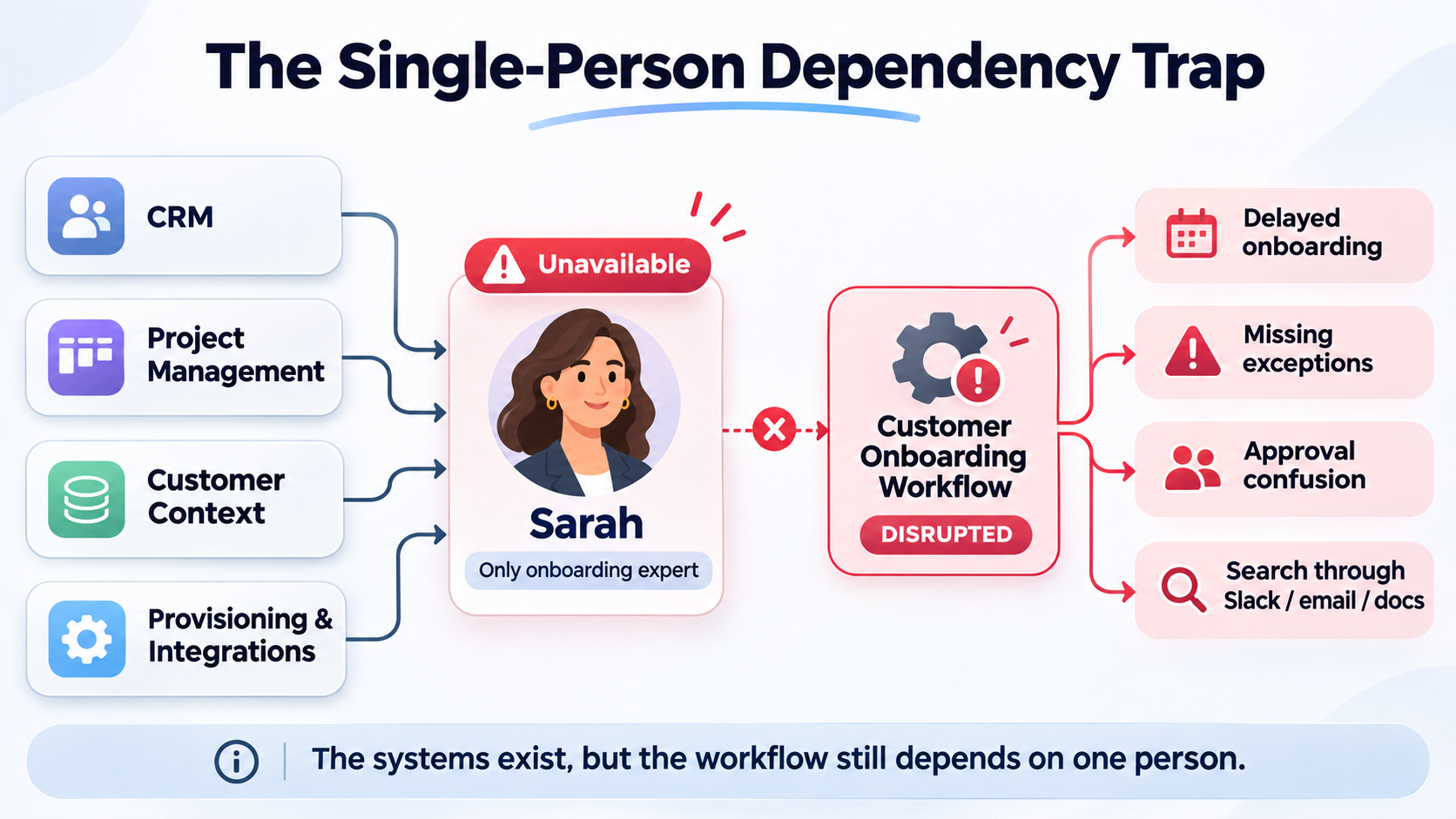
Figure 1 — The Single-Person Dependency Trap. Four business systems exist, but the customer onboarding workflow still depends on Sarah. Original OMEGANEON illustration; hypothetical scenario.
2. Where Key-Person Dependencies Hide
Key-Person Risk develops when critical operational knowledge, authority, or execution capability is concentrated in one individual.
In growing startups, these dependencies appear in several forms.
A. Execution Dependency
Only one person knows how to complete a critical process from beginning to end.
Examples include:
- A RevOps specialist who manages CRM routing, pipeline hygiene, and revenue reporting.
- A Customer Success manager who coordinates every enterprise onboarding.
- An operations engineer who maintains all internal integrations.
When that person becomes unavailable, the workflow loses its primary operator.
B. Decision Dependency
A process continues to require the judgment or approval of one individual.
A founder might approve every pricing exception. A COO might personally coordinate every unusual customer request.
As transaction volume increases, decisions accumulate around a limited number of people.
The result is an operational bottleneck directly connected to an individual's availability.
C. Knowledge Dependency
Critical business knowledge exists primarily in someone's memory, messages, or private notes.
This includes customer-specific agreements, undocumented procedures, exception-handling rules, and historical decisions.
The organization has access to the person's expertise while that person is available. The underlying operational knowledge remains difficult to transfer.
This problem has an established basis in knowledge management.
The ISO and International Accreditation Forum's guidance on Organizational Knowledge discusses organizational knowledge, including experience-based and tacit knowledge, and the challenges of making that knowledge available and usable.
D. System Access Dependency
One employee is the only person able to administer a business-critical system or integration.
Examples include ownership of automation credentials, integration configurations, deployment procedures, and recovery controls.
An operational process cannot be transferred successfully unless the replacement operator also has the appropriate authorization and system access.
These dependencies are especially important when multiple business systems are connected through a single person's configuration or manual intervention.
Understand the four mechanisms of individual dependency before choosing what to change.
3. The Operational Cost of Losing One Key Person
The business impact of Key-Person Risk depends on the workflow involved.
Consider three examples.
| Critical workflow | Single-person dependency | Business exposure |
|---|---|---|
| Sales-to-CS handoff | One person interprets customer requirements | Delayed onboarding and inconsistent commitments |
| Revenue operations | One employee maintains CRM rules and reporting | Pipeline data errors and interrupted reporting |
| Customer support escalation | One specialist handles complex exceptions | Longer resolution times and customer dissatisfaction |
The financial exposure can be evaluated through four operating dimensions.
Revenue exposure: Which revenue-generating, billing, onboarding, or renewal activities are interrupted?
Recovery cost: How many working hours are required to reconstruct the process, restore access, and resolve accumulated exceptions?
Delivery impact: Which customer commitments, internal service levels, or operational deadlines are affected?
Management overhead: How much executive and senior employee time is redirected toward resolving the interruption?
For a startup actively scaling revenue, these are operational costs that deserve explicit measurement.
The NIST Contingency Planning Guide, SP 800-34 Rev. 1, provides a structured approach to business impact analysis, recovery priorities, dependencies, and continuity testing for information systems.
The same impact-analysis discipline offers a useful foundation for evaluating person-dependent business workflows.
4. How to Identify Your Startup's Critical Dependencies
Start with the workflows that directly influence revenue, customer delivery, and ongoing operations.
For each workflow, answer five questions.
1. Who owns execution?
Identify the person responsible for performing the operational steps and handling exceptions.
2. Where does the required knowledge live?
Locate procedures, decision rules, system configurations, customer-specific context, and recovery instructions.
3. Who can execute the workflow if its owner is unavailable?
Identify an authorized backup and determine whether that person can complete the process independently.
4. What happens when an exception occurs?
Determine whether alternative escalation routes, approval authorities, and recovery procedures exist.
5. Has the replacement process been tested?
Have someone other than the primary owner execute the workflow using the available systems, instructions, and permissions.
A simple internal assessment can then classify workflows by their dependency exposure:
| Risk level | Operational condition |
|---|---|
| High | The workflow cannot continue without its primary owner |
| Medium | A backup exists, but requires substantial manual reconstruction or assistance |
| Low | An authorized backup can execute the workflow using established procedures |
| Verified continuity | A controlled absence test confirms the workflow meets its documented acceptance criteria |
These categories are an illustrative OMEGANEON assessment model, not a published industry-standard scoring system.
The objective is to establish a clear answer to one question:
Can the workflow continue when its original operator is removed from the execution path?
That answer creates a starting point for remediation.
5. From Individual Dependency to Institutional Capability
Identifying Key-Person Risk is the first step. The next is to change how critical operations are designed.
At OMEGANEON, we describe this approach as Institutionalized Automation.
Institutionalized Automation is the practice of transforming individual-dependent operational knowledge into governed, executable, auditable, and transferable organizational workflows.
The objective is to preserve operational capability within the company while allowing employees to contribute, improve, and oversee its execution.
This transformation has four components.
A. Capture Operational Knowledge
Document the actual process, including the parts omitted from traditional SOPs.
Capture:
- Triggers and required inputs.
- Business rules and decision thresholds.
- System interactions and authorized actions.
- Exceptions, escalation conditions, and recovery procedures.
- Human responsibilities and approval ownership.
The resulting process definition becomes a shared organizational resource.
B. Turn Knowledge into Executable Workflows
Translate the process definition into a structured workflow that can coordinate software systems, employees, and AI agents.
For example, a customer onboarding workflow can:
- Detect a newly closed deal in the CRM.
- Retrieve the required customer information.
- Validate contractual and onboarding requirements.
- Create the appropriate implementation tasks.
- Route exceptional cases to authorized reviewers.
- Record execution status and relevant decisions.
The workflow maintains a defined execution structure, while AI handles tasks requiring language understanding, information extraction, or contextual reasoning.
C. Establish Governance and Accountability
Institutionalized workflows require clear operational boundaries.
OMEGANEON's architecture uses Agent Permission Boundaries (APB), defined through six permission primitives:
System, Data, Action, Limit, Duration, and Identity.
Routine, authorized operations can execute automatically. Higher-risk actions follow defined Human-in-the-Loop (HITL) approval requirements.
Execution logs, access restrictions, and exception records make the process observable and auditable.
This approach is consistent with the NIST principle of least privilege, which restricts system access to the authorizations required to perform assigned tasks.
D. Verify Operational Continuity
A workflow becomes a stronger organizational capability when its operation can be transferred and tested.
Run a controlled Key-Person Absence Test:
- Temporarily remove the primary operator from the test scenario.
- Assign the workflow to an authorized backup or established automation.
- Execute representative standard and exceptional cases.
- Measure task completion, recovery time, escalation performance, and policy compliance.
- Record failures, correct the workflow, and repeat the test.
The ISO 22301 business continuity standard provides a broader framework for preparing, maintaining, and improving an organization's ability to continue operations during disruptions.
These principles can inform how companies structure their operational continuity tests.
For a startup, the desired outcome is tangible: critical work continues through a documented, controlled process even when the original owner is unavailable.
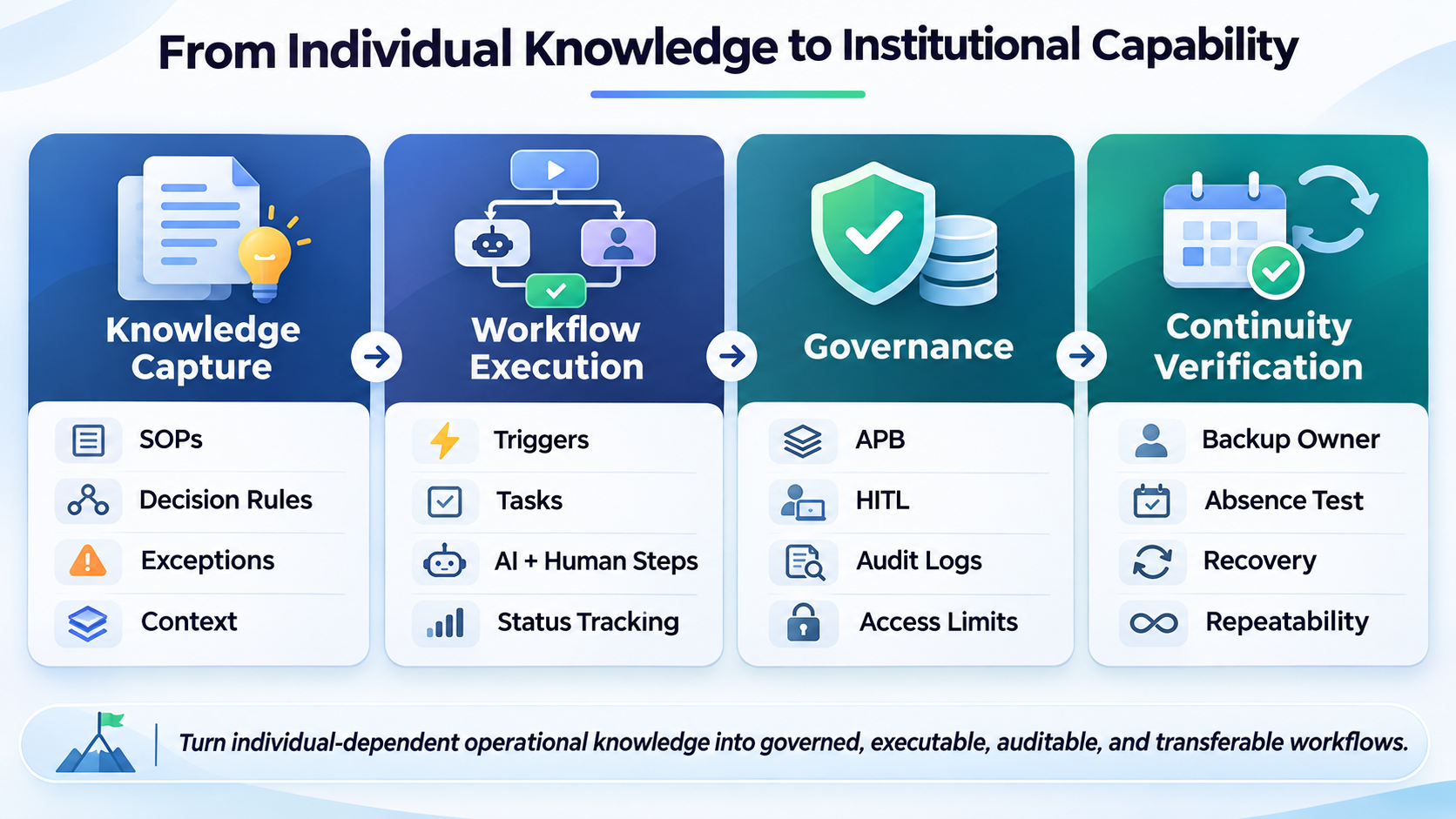
Figure 2 — From Individual Knowledge to Institutional Capability. The four components of the OMEGANEON Institutionalized Automation approach. Original OMEGANEON illustration.
6. What Bob's Startup Could Look Like After Institutionalization
Return to Bob's customer onboarding process.
Before Institutionalized Automation
A closed-won deal enters the CRM.
Sarah reviews the account, remembers the relevant exceptions, coordinates provisioning, assigns tasks, and personally resolves unusual requests.
Other employees depend on Sarah for the workflow's execution.
When Sarah is unavailable, the company must reconstruct her decisions.
After Institutionalized Automation
The closed-won event triggers a defined workflow.
Customer requirements are collected from authorized sources, validated against documented rules, and routed through a structured onboarding sequence.
Routine actions execute under defined permissions.
Exceptional requirements generate approval tasks for designated operators.
Every critical action has an owner, a recorded status, and an escalation path.
An authorized backup can inspect the workflow and take over outstanding decisions.
The result is a process whose execution rules, operational history, and recovery procedures remain available to the organization.
Bob's company gains something more durable than an automated task.
It gains an operational capability that can be maintained, transferred, tested, and improved.
Future-state workflow for the hypothetical scenario.
7. Build a Company That Retains Its Capabilities
High-performing employees are essential to growing companies.
They build customer relationships, solve unusual problems, create operational knowledge, and improve existing processes.
That knowledge becomes more valuable when the organization can retain and apply it beyond one person's daily involvement.
Institutionalized Automation creates a path toward that outcome through knowledge capture, structured workflow execution, governance, and continuity verification.
For a Series A or Series B startup, this creates an opportunity to scale operations with greater consistency while reducing critical dependencies on individual employees.
The question is no longer simply whether a task can be automated.
The more important question is whether your company can continue performing its critical work without depending on the constant availability of a particular person.
Because the strongest operational systems preserve what your people have built.
Go Deeper: Institutionalized Automation
From Individual Know-How to Institutional Capability
OMEGANEON's whitepaper explores the Institutionalized Automation framework, including its workflow architecture, governance model, operational continuity testing, and implementation methodology.
Read Institutionalized Automation — From Individual Know-How to Institutional Capability
Discuss Your Critical Workflows with OMEGANEON
Identify where your operations depend on individual employees, determine the continuity requirements, and explore an implementation plan through OMEGANEON's AI Workflow Implementation & Managed Operations services.
References
- ISO & IAF, Auditing Practices Group — Guidance on Organizational Knowledge (2016). Official guidance.
- NIST, SP 800-34 Rev. 1: Contingency Planning Guide for Federal Information Systems (2010). Official publication.
- ISO, ISO 22301:2019 — Business Continuity Management Systems. Official standard overview.
- NIST, Least Privilege — Computer Security Resource Center Glossary. Official definition.
More on Operational Continuity
Keep critical workflows running when key people are unavailable.
Read how OMEGANEON captures operating knowledge, builds governed workflows, and verifies continuity through its five-stage framework and ICVS.
Build better operations.
Keep learning.
Practical research on AI workflows, operating costs, and scaling startup operations. Delivered by email.
The subscription form loads as you reach this section.
See the framework. Explore the work.
Institutionalized Automation
From Individual Know-How to Institutional Capability: five stages for capturing knowledge, governing execution and verifying continuity through ICVS.
Read the frameworkWHITEPAPERScaling, Just Like Drag-and-Drop.
Explore how workflow structure preserves operating knowledge and defines responsibility.
Read the frameworkRELATED CASE STUDY / START HEREERP Document Operations: From Manual Documentation to Managed AI Workflows
See document preparation, validation and approval captured in a managed workflow.
Explore the case studyRELATED CASE STUDYScaling Creator Monetization Without Scaling Operational Work
Explore reusable revenue operations rather than personal operating memory.
Explore the case studyRELATED CASE STUDYAI-Powered Government Contract Opportunity Discovery & Qualification
See opportunity context retained in source-linked briefs and decision records.
Explore the case study