In this article
Your startup has a leadership team, operating systems, and clear growth targets. So why does an ordinary customer request still need the founder's approval?
In the early stages, the founder's direct involvement keeps the company moving. They know the product, the customers, and the exceptions. They can make decisions before a formal process even exists.
Then the company grows. More customers, more employees, more handoffs—and more decisions routed to the same person.
A founder who once accelerated execution becomes the default approval layer for the entire organization. The business starts moving at the speed of the founder's availability.
This is founder dependency: critical operational decisions and knowledge remain concentrated in one person long after the team has grown beyond them.
1. When Every Decision Still Goes Through the Founder
A hypothetical case: Alex's company
This first-person scenario is fictional. The company, employees, and events are illustrative.
I'm Alex, the founder and CEO of a 63-person B2B SaaS startup. We recently raised our Series B, and our team is growing.
Our Head of Sales owns the pipeline. Customer Success runs onboarding. Operations manages our internal systems. I hired strong leaders precisely so they could own these functions.
But on Tuesday morning, my messages look like this:
- Sales: “Can we approve this customer-specific pricing exception?”
- Customer Success: “The customer asked for a different onboarding sequence. Do we need your sign-off?”
- Operations: “Can we change the CRM routing rule for enterprise accounts?”
- Finance: “Should we proceed with this vendor renewal?”
None of these messages is a company-defining strategic decision. Yet every team has learned that the safest path is to ask me.
I answer one request, two more arrive. By the time I finish, a customer's kickoff has moved, a sales proposal is waiting, and an operations change has been postponed.
I hired managers, but the company still routes ordinary work through me.
The problem isn't that the team lacks talent. The problem is that our decision rights, exceptions, and operating rules were never transferred out of my head.
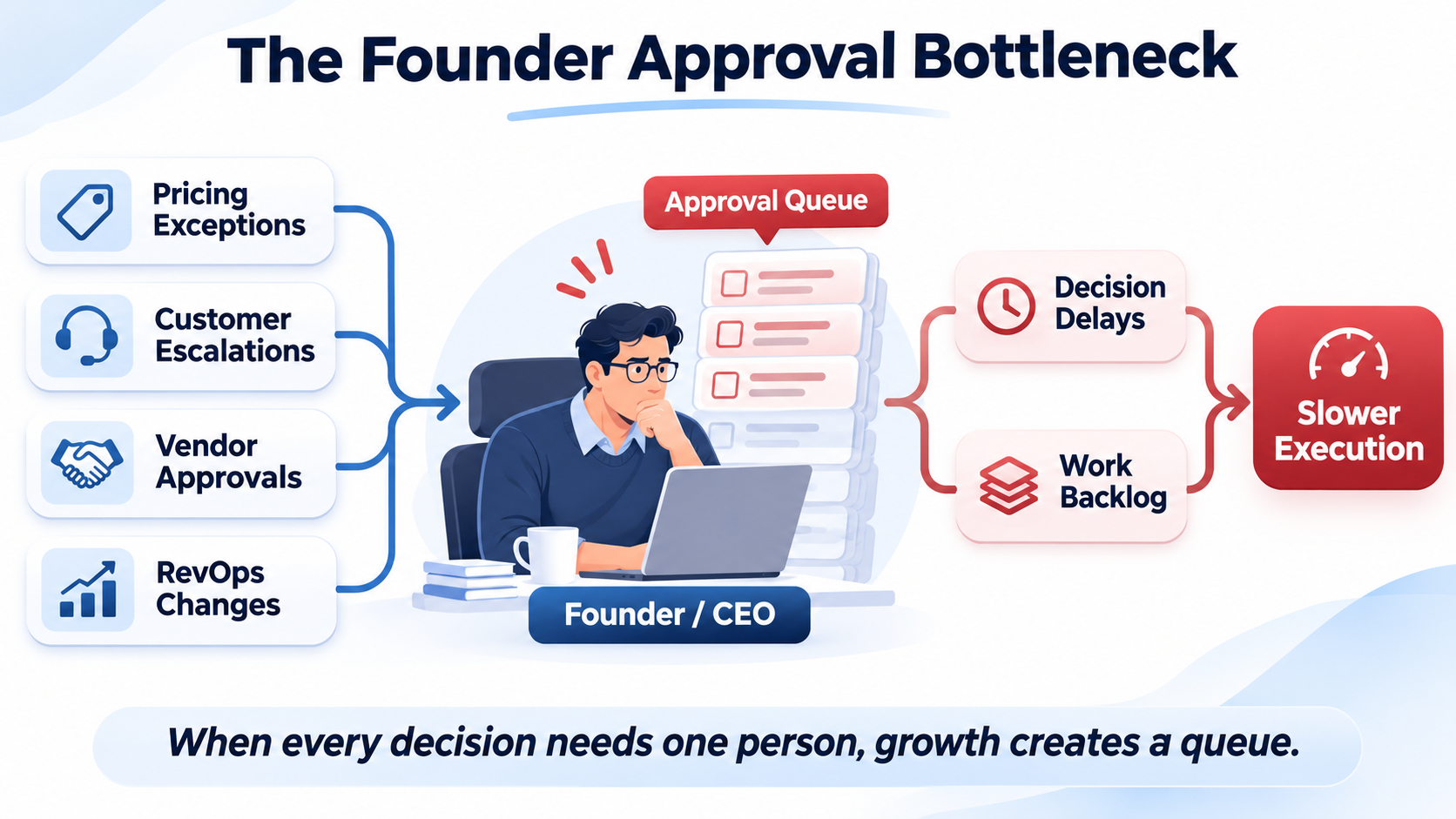
Figure 1. The Founder Approval Bottleneck — pricing, customer escalation, vendor approvals, and RevOps changes all depend on a single decision-maker.
2. Why Founder Dependency Gets Worse as a Startup Scales
A founder initially combines several jobs: strategist, escalation owner, customer expert, final approver, and historian of why the business works the way it does.
This concentration is convenient when the team is small. As functions specialize, it creates four distinct dependencies.
Approval dependency
Routine spending, discounts, account changes, and internal requests require the founder's direct sign-off, even when the criteria are already known.
Exception dependency
Teams can handle standard work but escalate every unusual case because no approved exception-handling framework exists.
Knowledge dependency
The founder remembers past concessions, unwritten policies, product promises, and operational shortcuts that the company hasn't formalized.
Relationship dependency
Important customer, partner, or vendor interactions are routed back to the founder because the relationship context and decision authority haven't been transferred.
These dependencies create a recurring pattern: every additional employee increases the company's capacity to initiate work, but the founder remains the limiting point for completing it.
Research supports the importance of delegation as startups grow. In a 2024 mixed-methods study, Vincenzo Butticè, Massimo G. Colombo, and Paola Rovelli examined authority over strategic decisions in startups and found greater delegation among VC-backed firms in their sample. The study also described how different types of investors relate to distinct delegation arrangements. Read the research in the Journal of Industrial and Business Economics.
A separate 2023 qualitative study of 37 startup founders by Mitchell Davidson documented changes in founders' approaches to delegation as their ventures developed. Read the study in Intersect.
The management decision is practical: which responsibilities genuinely need founder judgment, and which should be owned by a defined operating system?
3. The Operational Cost of a Founder Approval Queue
A bottleneck is more than a crowded inbox. It changes how fast the organization can respond to customers, execute decisions, and improve internal operations.
| Workflow | Dependency on founder | Operational consequence |
|---|---|---|
| Sales pricing | Founder approves repeatable exceptions | Proposals wait for sign-off |
| Customer onboarding | Founder validates unusual customer commitments | Launch activities stop at escalation |
| RevOps | Founder approves routine routing or process changes | Data and process improvements queue up |
| Vendor operations | Founder handles routine purchasing decisions | Work is delayed while the decision is pending |
Start by measuring five numbers over an actual workweek:
- Founder approval share: requests personally decided by the founder ÷ all approval requests.
- Approval lead time: elapsed time from request submission to final decision, reported separately by decision type.
- Escalation backlog: unresolved requests past their defined response deadline.
- Routine decision hours: founder time spent on repeatable operating decisions.
- Decision reversal rate: completed decisions later reversed or corrected ÷ decisions reviewed.
These measures separate the visible symptoms—waiting and rework—from the underlying issue: unclear ownership and rules.
A simple founder-time model
Suppose a founder handles 30 routine approval requests per week, spending 12 minutes on each. That's six founder hours each week spent reviewing routine decisions, before counting context switching and the time employees spend waiting.
Those values are illustrative inputs, not a measured industry benchmark. A company's actual approval logs can be used to replace them.
The objective is not to remove every human approval. It is to reserve scarce executive attention for decisions that actually require executive authority.
4. Which Decisions Actually Need the Founder?
Most businesses already have informal decision rules. A sales manager knows the standard discount range. Operations knows which CRM changes are reversible. Finance knows which purchases are preapproved.
The missing piece is an explicit Decision Authority Matrix that employees and systems can execute consistently.
Here is an illustrative matrix for a growing B2B SaaS company:
| Decision type | Execution route | Accountable authority | Guardrail |
|---|---|---|---|
| Standard CRM record update | Automated | RevOps owner | Approved fields, validation, audit log |
| Pricing within an approved policy | Delegated | Sales leader | Margin floor and contract policy |
| Customer onboarding exception | Delegated human review | Head of Customer Success | Written service boundaries and SLA |
| Change to security-sensitive access | Specialist approval | Security owner | Least privilege and recorded authorization |
| New commercial commitment outside policy | Founder / executive review | CEO, with Legal or Finance as needed | Explicit risk and contractual review |
This is an example authority model. Each company defines its own limits, responsibilities, and legal or contractual approval requirements.
The critical separation is between three routes:
Route 1 — Routine, preauthorized work. Execute according to established rules, within explicit action and data boundaries.
Route 2 — Standard exceptions. Route to a designated team lead or functional owner with authority and a backup.
Route 3 — Strategic or high-risk decisions. Preserve founder or executive review when the decision sits outside established policy or changes the company's risk exposure.
The founder should define the boundaries of these routes. They should not be the mandatory queue for all three.
5. Moving Routine Decisions into Governed Workflows
A delegation policy becomes operational when it is connected to an executable process.
An email saying “ask the Sales Lead instead” is only the beginning. The workflow needs a trigger, a clear decision rule, permissions, a defined owner, an exception route, and evidence of what happened.
Step 1 — Capture the rules already used by the founder
Collect recent approval requests and decisions. For each one, record the request type, required information, decision criteria, authorized approver, exception conditions, and final result.
Step 2 — Translate decision rights into workflow logic
When an eligible request arrives, the workflow should recognize its category, validate the required information, apply the policy, and select the appropriate route.
For example, a standard customer onboarding modification within an established service policy can go directly to the Customer Success owner. A new contractual obligation must go through the company's designated higher-level approval path.
Step 3 — Apply Agent Permission Boundaries (APB)
OMEGANEON's Institutionalized Automation approach defines six permission primitives for AI-enabled operations:
- System: which application or service can be accessed.
- Data: which records and fields can be used.
- Action: which operations are authorized.
- Limit: thresholds and quantitative constraints.
- Duration: when and for how long authorization remains valid.
- Identity: whose authority is used and who is accountable.
These permissions are designed around the NIST least-privilege principle: users and processes should receive only the access necessary to complete their assigned tasks.
Step 4 — Preserve Human-in-the-Loop (HITL) checkpoints
Sensitive transactions and nonstandard cases should pause for the authorized human reviewer before execution. Google Cloud's agentic design guidance describes the human-in-the-loop pattern as a predefined point where a workflow waits for human review, correction, or approval.
Standard approval platforms already illustrate this execution model. Microsoft Power Automate documents sequential and multi-approver routing, including workflows that wait for assigned reviewers before continuing.
Step 5 — Log decisions and maintain a recovery path
Record the request, routing decision, applied policy version, human approver where applicable, result, and exception history. Assign a fallback owner for unavailable approvers, with authorization defined in advance.
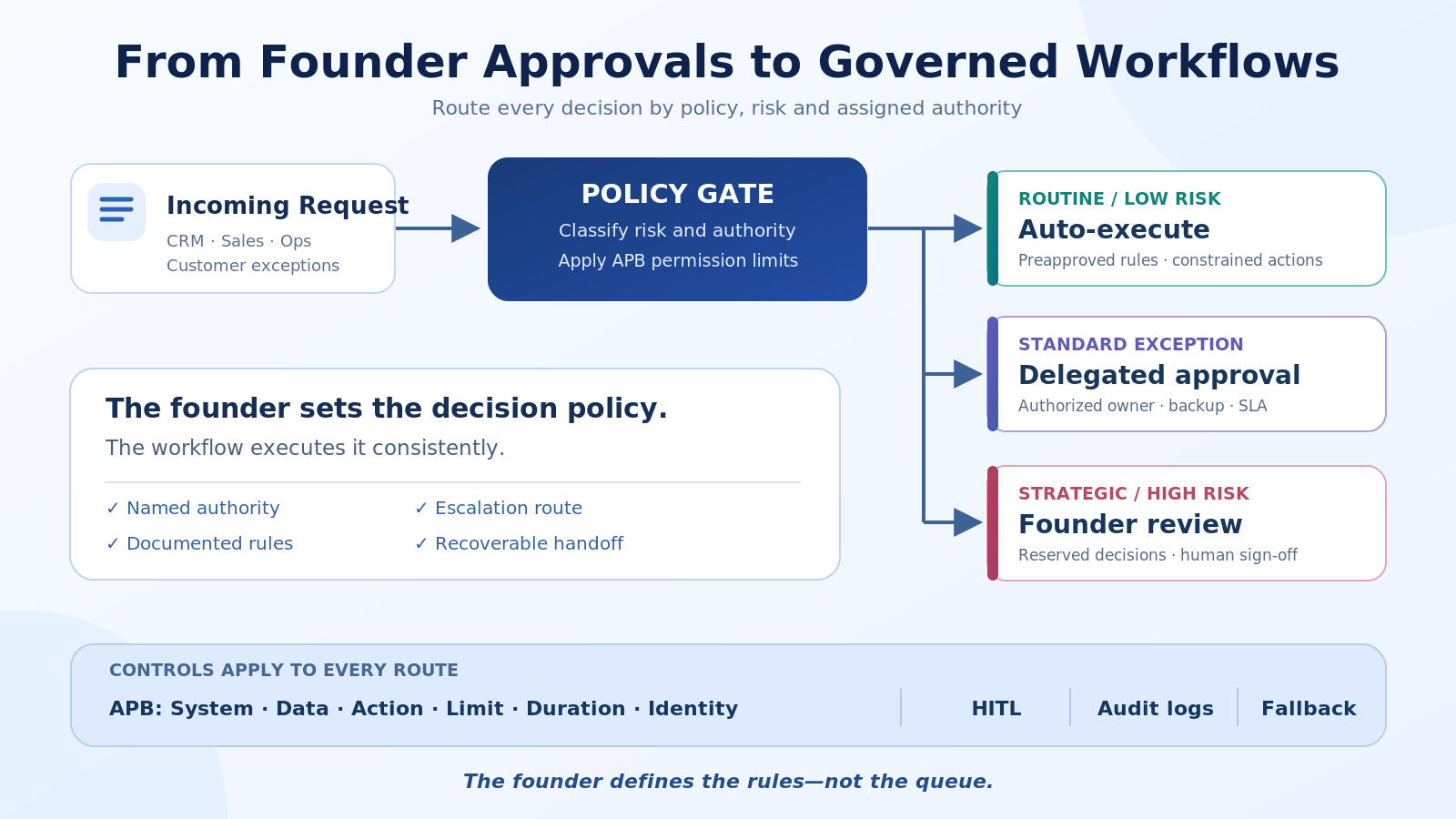
Figure 2. From Founder Approvals to Governed Workflows — decision policy routes work to authorized execution rather than automatically escalating everything to the founder.
This is the operational difference between informal delegation and a governed workflow: decision rights are explicit, execution paths are reliable, and exceptions have an accountable destination.
Follow an illustrative Sales-to-Customer-Success handoff that separates routine execution from reserved decisions.
6. Run the Founder Absence Test
Once a workflow has been restructured, test whether it still depends on the founder.
Choose a bounded operational process such as a routine pricing exception, an onboarding modification, or an internal CRM rule change.
Test procedure
- Define a realistic request, its required inputs, and the expected acceptance criteria.
- Make the founder unavailable for the controlled test.
- Have the authorized team or workflow handle the request.
- Include one standard case and one exception case.
- Verify that the right person or system executed each step, approvals were respected, and the final result was recorded.
- Measure response time, task completion, policy violations, and any escalation failures.
A clean test result is more useful than a broad promise about efficiency. It demonstrates that an operating process can run within defined controls without waiting on the founder.
Track Founder Absence Test Pass Rate as: successful test scenarios meeting all acceptance criteria ÷ total test scenarios. Report the numerator, denominator, test scope, and date with the percentage.
7. Keep the Founder's Judgment. Remove the Default Dependency.
The purpose of founder-independent operations is not to distance the founder from the business. It is to let the founder spend attention where it creates the greatest value: strategy, leadership, product direction, important relationships, and genuinely consequential decisions.
For Alex's fictional company, the new operating model is straightforward:
- Sales handles pricing inside approved commercial limits.
- Customer Success owns routine onboarding changes and exceptions within its authority.
- RevOps executes approved CRM changes with validation and audit records.
- Security-sensitive actions follow explicit specialist and executive approval boundaries.
- The founder handles the small set of decisions reserved in the authority matrix.
The company gains a clearer operating structure. Teams gain defined authority. Customers no longer wait on the founder for routine work. And the founder retains visibility into the business through reporting and exceptions rather than constant manual intervention.
Your company shouldn't need your permission to keep moving. It should need your judgment where your judgment matters most.
8. From Founder Dependency to Institutional Capability
At OMEGANEON, we call the broader transformation Institutionalized Automation: converting person-dependent operating knowledge and decision logic into governed, executable, auditable, and transferable workflows.
Through AI Workflow Implementation & Managed Operations (AIWIA), the implementation path is:
Discover dependencies → Document decision rules → Build governed workflows → Test founder absence → Operate and improve.
This connects founder delegation to a concrete system of operational ownership: clearly defined permissions, human checkpoints, audit records, fallback responsibilities, and managed maintenance.
The founder remains essential to setting direction. The company becomes less dependent on the founder to complete routine execution.
Go Deeper: Institutionalized Automation
Institutionalized Automation: From Individual Know-How to Institutional Capability
OMEGANEON's whitepaper presents the full framework for transferring individual-dependent operational knowledge into institutional capabilities, including governance, workflow architecture, and continuity verification.
Read Institutionalized Automation — From Individual Know-How to Institutional Capability
Discuss your workflows with OMEGANEON. Identify where approvals, exceptions, and operational knowledge still depend on your founder—and design an implementation path around your actual decision boundaries.
Related Insights: Your Startup Shouldn't Depend on One Person to Keep Running.
References
- Butticè, V., Colombo, M. G., & Rovelli, P. (2024). “Venture capital and the delegation of decision authority in startups: an exploratory study.” Journal of Industrial and Business Economics, 51, 893–923. https://link.springer.com/article/10.1007/s40812-024-00313-4
- Davidson, M. (2023). “Evolution of the Founder: Shifts in Delegation.” Intersect: The Stanford Journal of Science, Technology, and Society, 16(3). https://ojs.stanford.edu/ojs/index.php/intersect/article/view/2661
- Microsoft Learn. “Get started with approvals.” https://learn.microsoft.com/en-us/power-automate/get-started-approvals
- NIST Computer Security Resource Center. “Least privilege.” https://csrc.nist.gov/glossary/term/least_privilege
- Google Cloud Architecture Center. “Choose a design pattern for your agentic AI system” (Human-in-the-loop pattern). https://docs.cloud.google.com/architecture/choose-design-pattern-agentic-ai-system/
More on Operational Continuity
Keep critical workflows running when key people are unavailable.
Read how OMEGANEON captures operating knowledge, builds governed workflows, and verifies continuity through its five-stage framework and ICVS.
Build better operations.
Keep learning.
Practical research on AI workflows, operating costs, and scaling startup operations. Delivered by email.
The subscription form loads as you reach this section.
See the framework. Explore the work.
Institutionalized Automation
From Individual Know-How to Institutional Capability: five stages for capturing knowledge, governing execution and verifying continuity through ICVS.
Read the frameworkWHITEPAPERScaling, Just Like Drag-and-Drop.
Separate the work a system can prepare from the consequential judgment a person must retain.
Read the frameworkRELATED CASE STUDY / START HEREAI-Powered Government Contract Opportunity Discovery & Qualification
See routine screening prepare an evidence-linked queue for authorized pursuit decisions.
Explore the case studyRELATED CASE STUDYERP Document Operations: From Manual Documentation to Managed AI Workflows
Follow automated drafting and QA into a defined human approval step.
Explore the case studyRELATED CASE STUDYScaling Creator Monetization Without Scaling Operational Work
Explore event-driven subscription tasks and exception handling.
Explore the case study