In this article
Your startup has the knowledge to serve its customers. The problem is that the next person who needs that knowledge cannot reliably find it, understand it, or use it in time.
A sales concession lives in an email thread. An integration exception is buried in Slack. The latest onboarding checklist sits in a shared document. The reason behind a customer-specific decision exists only in an employee's memory.
Each fragment makes sense to the person who owns it. Together, they create a knowledge silo: critical operational context is separated from the people and workflows responsible for taking the next action.
For a growing B2B startup, the cost shows up as delayed handoffs, repeated work, slower customer onboarding, and escalating dependence on a few experienced employees.
The useful question for a COO is straightforward: How much of your team's time and delivery capacity is consumed simply by reconstructing what the company already knows?
1. A Customer Is Ready to Onboard. The Knowledge Isn't.
Hypothetical scenario — the company, people, and events below are fictional.
I'm Maya, Head of Customer Success at a 62-person Series B enterprise software startup.
Sales has just closed a valuable account. The handoff looks complete: the opportunity is marked Closed Won in our CRM, and the onboarding ticket has been created.
Then our implementation specialist asks a simple question: Did we promise SSO configuration before kickoff?
The CRM contains a generic implementation note. The account executive remembers discussing an accelerated schedule but cannot find the final approval. A Slack thread contains a security exception. The signed commercial addendum is stored in another team's drive. Our standard onboarding SOP describes the usual sequence, but it does not include this customer's requirements.
The customer is ready. The team is capable. The answer exists somewhere in the company.
Yet progress stops while people search, message each other, reconcile conflicting versions, and decide who can approve the next step.
The problem is not a missing tool. It is a broken connection between knowledge and execution.
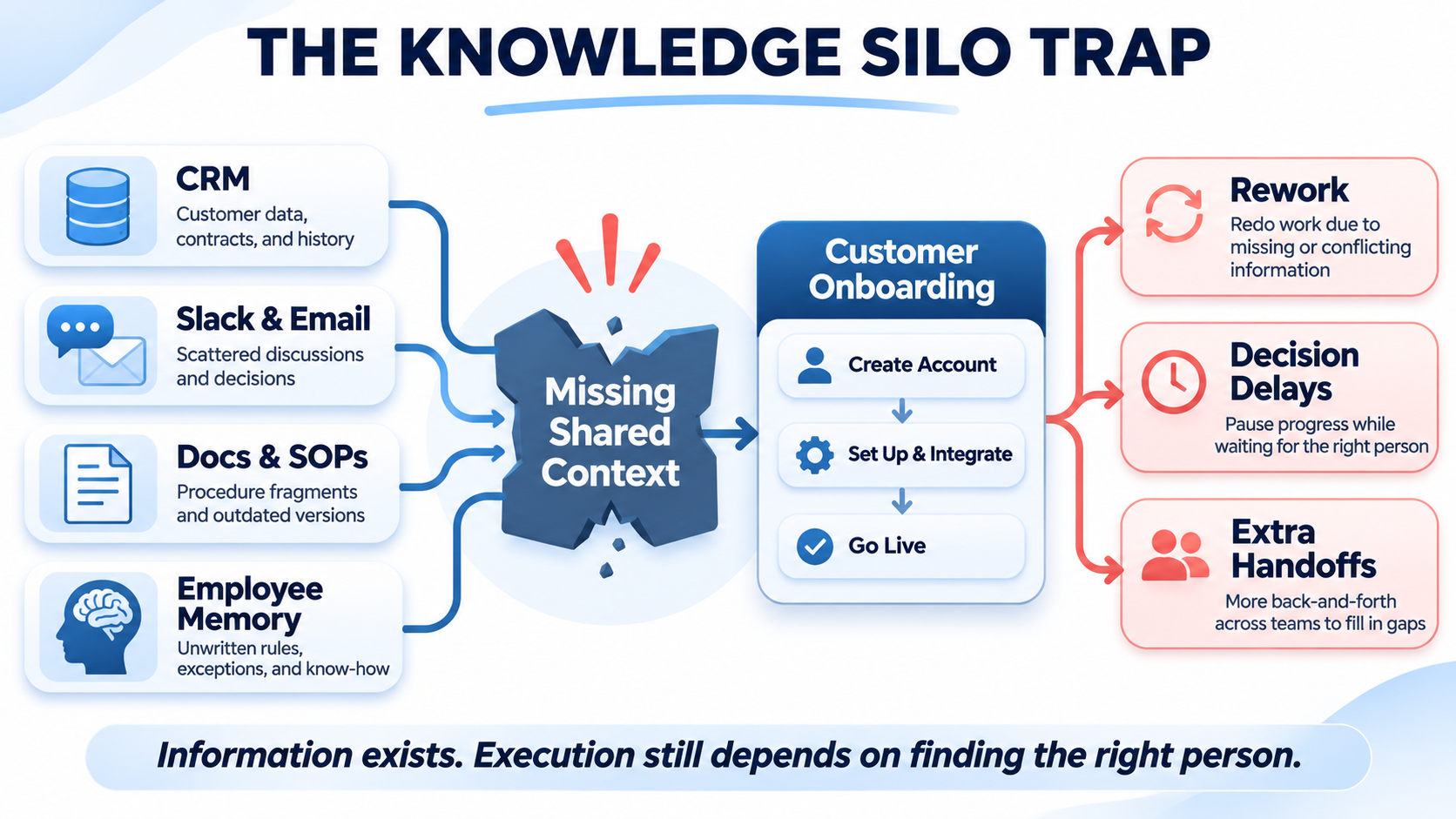
Figure 1. The Knowledge Silo Trap — an illustrative customer onboarding workflow where scattered context creates rework, delays, and extra handoffs.
2. Where Knowledge Silos Form as Startups Scale
Fast-growing companies create new knowledge continuously: pricing exceptions, enterprise security requirements, product workarounds, escalation decisions, implementation sequences, and lessons from previous customers.
Silos appear in four practical places.
Person silos: the answer lives with an individual
A senior account manager remembers why a customer received an exception. An operations specialist knows how to repair a failed CRM integration. A founder knows which purchasing requests require additional scrutiny.
A coworker must locate that person before the work can continue.
Tool silos: related context lives in separate systems
CRM, ticketing, documents, messaging, billing, and project management tools each contain part of the operational record. The systems capture their own activities, while the handoff requires a connected view of the decision.
The team can retrieve the information only by reconstructing the conversation across tools.
Decision silos: the rule was agreed, but the reasoning was lost
An exception was approved last quarter. Nobody recorded its scope, expiration date, owner, or the evidence behind the approval.
The next employee sees an outcome without the decision rule that produced it.
Process silos: the SOP and the real workflow have diverged
The official procedure describes normal conditions. Actual delivery depends on additional approvals, manual checks, and customer-specific workarounds that the process has not captured.
New employees learn the actual method by shadowing someone experienced.
These patterns reflect a well-established distinction between tacit knowledge (experience and judgment) and explicit knowledge (knowledge that can be articulated and shared). In his 1994 Organization Science paper, Ikujiro Nonaka describes how organizations develop knowledge by connecting these forms. Read the research.
The ISO/IAF Auditing Practices Group's guidance on Organizational Knowledge likewise identifies experience-based knowledge as a resource needed for processes and services, and stresses making it available for use. Read the ISO/IAF guidance.
3. The Operational Cost Appears in Four Places
Knowledge silos turn ordinary work into a chain of information-recovery activities.
| Cost driver | What the team does | Operational consequence |
|---|---|---|
| Search time | Finds the latest agreement, correct document, system state, or decision owner | Fewer hours available for customer delivery |
| Clarification time | Messages colleagues, schedules calls, reconciles conflicting answers | More handoffs and interrupted focus |
| Rework | Repeats configuration, reporting, analysis, or customer setup using corrected context | Additional labor and repeated verification |
| Delivery delay | Waits for missing information or authorization before the next workflow step | Longer onboarding cycles and exposure to missed commitments |
The issue is measurable in broader workplace research. Atlassian's State of Teams 2025 surveyed 12,000 knowledge workers and 200 executives and reported that leaders and teams spend approximately 25% of their time searching for answers. 2025 research overview.
In Atlassian's subsequent analysis of that study, 56% of surveyed employees reported still needing to contact someone or schedule a meeting to obtain the information they needed. Atlassian's analysis, July 2025.
These findings describe the respondents in Atlassian's study. Your own operating cost is determined by your team's actual handoffs, rework, and delay records.
4. A Practical Model for Quantifying Knowledge-Silo Costs
A startup can establish a baseline without implementing new software first.
Choose one workflow—such as Sales-to-Customer-Success handoff—and log three categories of directly attributable work for 30 days:
- Minutes searching for missing operational information.
- Minutes spent clarifying or reconciling that information with colleagues.
- Hours spent repeating work caused by incomplete, incorrect, or outdated context.
Keep the categories mutually exclusive: count each minute once.
Direct coordination and rework cost can be calculated as:
Monthly cost = (Search hours + Clarification hours + Rework hours) × Fully loaded hourly labor cost
Worked example: a hypothetical onboarding team
Assume the following observed activity for one month:
| Activity | Illustrative input | Hours |
|---|---|---|
| Finding information | 90 searches × 12 minutes | 18 |
| Clarifying missing context | 40 escalations × 15 minutes | 10 |
| Rework after missing-context errors | 10 cases × 90 minutes | 15 |
| Total measured time | 43 hours |
At an illustrative loaded labor cost of $90 per hour:
- Monthly direct labor exposure: 43 × $90 = $3,870.
- Annualized at the same monthly rate: $3,870 × 12 = $46,440.
All figures in this table are hypothetical inputs for demonstrating the calculation. They are not OMEGANEON customer results or market benchmarks.
The model separates direct labor from additional business consequences. Track those separately:
- Onboarding cycle time: calendar days from Closed Won to first production use.
- Missed contractual milestones: count and documented credit, penalty, or remediation cost.
- Delayed collections: amount and duration of cash receipt pushed back, recorded as timing exposure rather than lost revenue.
- Escalation concentration: percentage of cases routed to one employee or founder.
This creates a baseline for deciding which workflow deserves engineering attention first.
5. Turning Fragmented Knowledge into Shared Operational Capability
A useful knowledge initiative ends with a team being able to execute a process consistently using the information the organization already owns.
That outcome requires four connected steps.
Capture: map the actual work
Review recent completed cases rather than relying only on a written SOP. Identify required inputs, authoritative records, approvals, recurring exceptions, and who resolved each decision.
For an enterprise onboarding process, this includes contractual terms, security requirements, provisioning prerequisites, escalation owners, and handoff acceptance criteria.
Define: convert experience into controlled rules
Create a clear, versioned operating model. Specify the owner, trusted source, business rule, approval threshold, exception path, and expiration or review condition for each decision.
The key deliverable is a process another authorized operator can follow and maintain.
Execute: connect the rules to workflow orchestration
A workflow can read approved CRM and contract fields, validate required data, create tasks, request missing information, route exceptions for approval, and record each transition.
AI can handle extraction, classification, and contextual analysis where appropriate. Structured workflow logic handles sequencing, state, retries, monitoring, and recovery. AWS documents concrete Retry and Catch mechanisms for workflow fault handling in AWS Step Functions.
For OMEGANEON's approach, operations are governed using Agent Permission Boundaries (APB)—System, Data, Action, Limit, Duration, Identity—along with Human-in-the-Loop (HITL) approvals for higher-risk actions and audit logs for operational visibility.
Verify: test whether the next operator can run the process
Assign the workflow to a backup owner who did not design it. Provide the defined system access and operating instructions. Run ordinary cases and exceptions, record failures, and revise the process.
The capability is strengthened when the team can demonstrate an actual handoff under controlled test conditions.
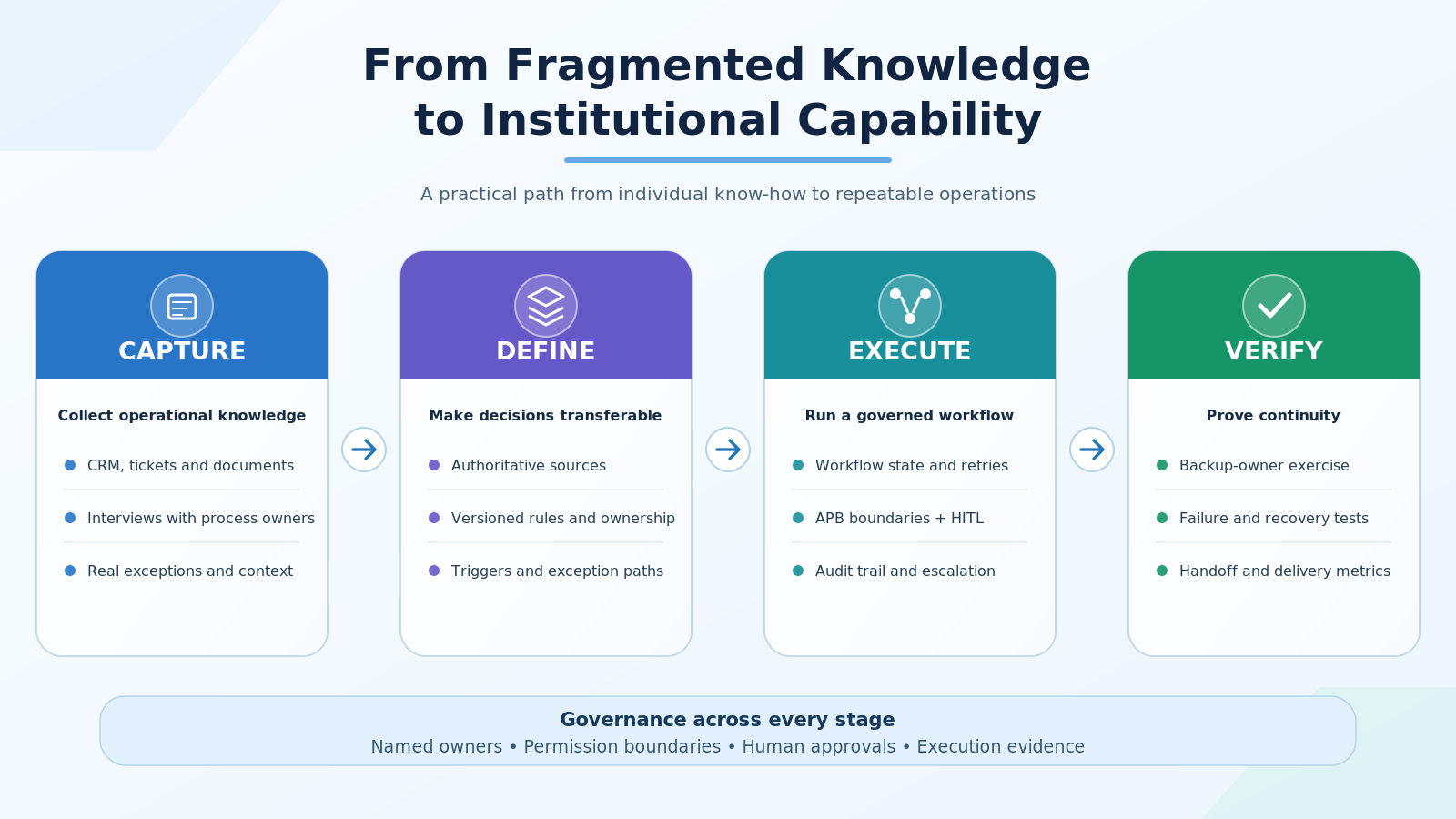
Figure 2. From Fragmented Knowledge to Institutional Capability — capture operational context, define transferable rules, execute governed workflows, and verify continuity.
Explore what makes knowledge an organization-controlled operational capability.
6. What a 30-Day Pilot Should Prove
Start with a high-volume workflow where missing context causes repeated delays. Sales-to-CS handoff, enterprise onboarding, recurring reporting, and support escalation are concrete candidates for a growing B2B SaaS company.
A pilot should have a written baseline and acceptance criteria.
| Metric | Baseline question | Pilot measurement |
|---|---|---|
| Information retrieval time | How long does it take to get the right answer? | Median minutes per completed case |
| Missing-context escalation rate | How many cases require asking another person? | Escalated cases ÷ total cases |
| Rework hours | How much labor repeats because critical context was absent? | Rework hours per 100 cases |
| Handoff readiness | Does the receiving team have required inputs and permissions? | Complete handoffs ÷ total handoffs |
| Independent execution | Can the workflow run without the primary expert? | Absence-test cases passed ÷ tested cases |
Pilot sequence: map the workflow; collect baseline evidence; define rules and approval ownership; implement a controlled path; test cases with a backup operator; compare results against the baseline.
A useful output is a customer-visible record of which steps were tested, which exceptions required approval, and what remains to be improved.
7. Build Operations That Preserve What Your Team Has Learned
Knowledge grows as a startup wins customers, solves unusual problems, and expands across functions. The company becomes more capable when that experience is preserved in the way work is performed.
Institutionalized Automation is OMEGANEON's method for turning individual-dependent operational knowledge into governed, executable, auditable, and transferable workflows.
The business objective is operational continuity: faster handoffs, less duplicated work, clearer decision ownership, and critical processes that authorized teammates can take over.
Your team's knowledge should move the work forward—even when the person who originally learned it is unavailable.
Go Deeper: Institutionalized Automation
Institutionalized Automation: From Individual Know-How to Institutional Capability
OMEGANEON's whitepaper covers the formal framework, workflow architecture, permission governance, and operational continuity tests behind this approach.
Read Institutionalized Automation — From Individual Know-How to Institutional Capability
Discuss Your Knowledge-Dependent Workflows with OMEGANEON
Related OMEGANEON Insights
- Your Startup Shouldn't Depend on One Person to Keep Running. — Key-Person Risk and organizational continuity.
- How to Turn Tribal Knowledge into Executable Workflows — Technical implementation.
- How to Eliminate Single-Person Dependencies in Critical Workflows — Framework in practice.
References
- Atlassian, State of Teams 2025, research overview (survey of 12,000 knowledge workers and 200 executives). https://atlassianblog.wpengine.com/state-of-teams-2025
- Atlassian, Stop Mistaking Storage for Strategy, July 7, 2025. https://www.atlassian.com/blog/work-management/stop-mistaking-storage-for-strategy
- Nonaka, I. (1994), A Dynamic Theory of Organizational Knowledge Creation, Organization Science, 5(1), 14–37. https://doi.org/10.1287/orsc.5.1.14
- ISO & IAF Auditing Practices Group (2016), Guidance on Organizational Knowledge. https://committee.iso.org/files/live/sites/tc176/files/PDF%20APG%20New%20Disclaimer%2012-2023/ISO-TC%20176-TF_APG-OrganizationalKnowledge2015.pdf
- AWS, Handling Errors in Step Functions Workflows. https://docs.aws.amazon.com/step-functions/latest/dg/concepts-error-handling.html
More on Operational Continuity
Keep critical workflows running when key people are unavailable.
Read how OMEGANEON captures operating knowledge, builds governed workflows, and verifies continuity through its five-stage framework and ICVS.
Build better operations.
Keep learning.
Practical research on AI workflows, operating costs, and scaling startup operations. Delivered by email.
The subscription form loads as you reach this section.
See the framework. Explore the work.
Institutionalized Automation
From Individual Know-How to Institutional Capability: five stages for capturing knowledge, governing execution and verifying continuity through ICVS.
Read the frameworkWHITEPAPERScaling, Just Like Drag-and-Drop.
Connect fragmented context through an explicit workflow rather than another isolated knowledge store.
Read the frameworkRELATED CASE STUDY / START HEREERP Document Operations: From Manual Documentation to Managed AI Workflows
See project materials consolidated into traceable, versioned deliverables.
Explore the case studyRELATED CASE STUDYAI-Powered Government Contract Opportunity Discovery & Qualification
Explore public records and contract history assembled into evidence-linked briefs.
Explore the case studyRELATED CASE STUDYScaling Creator Monetization Without Scaling Operational Work
See revenue and customer context connected across an operating system.
Explore the case study