In this article
OMEGANEON Insights · AI Workflow Implementation & Managed Operations · For COOs, RevOps, and Heads of Operations
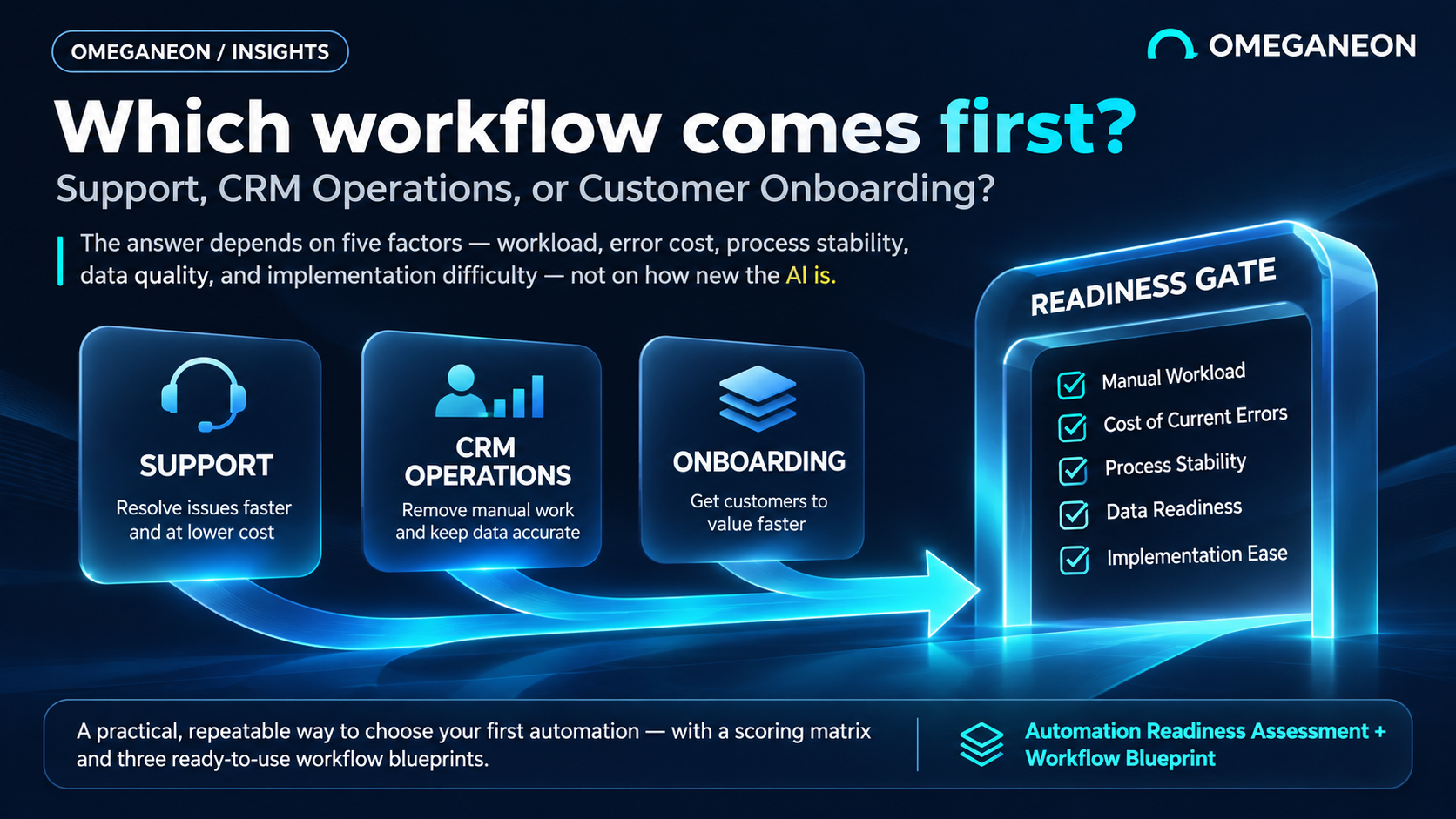
Your support team is buried in tickets. Sales is chasing missing CRM fields. Customer Success is still copying information from closed-won deals into onboarding spreadsheets.
All three teams want automation. Which workflow gets the first implementation budget?
Start with the task that combines the highest measurable operational burden with the strongest process and data readiness. The newest AI capability is not a prioritization strategy.
Why all three deserve attention
Customer support has strong field evidence. In a study published in The Quarterly Journal of Economics in 2025, researchers examined an AI assistant deployed across 5,172 customer-support agents. Access to the assistant increased issues resolved per hour by 15% on average. Source: Brynjolfsson, Li, and Raymond, 2025.
CRM operations have a documented time problem. Salesforce's 2026 State of Sales research reports that sales representatives spend 60% of their workweek on non-selling activities, including manual data entry, research, and other supporting work. Source: Salesforce, 2026.
Onboarding has a visibility problem. OnRamp's 2026 State of Customer Onboarding survey of 161 onboarding and customer success leaders found that 62% lacked real-time visibility into customer onboarding progress. Source: OnRamp, 2026.
These studies identify substantial operational workloads. Your own workflow data determines the first project.
The first decision: choose a task, not a department
“Automate customer support” is too broad. “Classify incoming tickets and assign them to the correct queue” is a testable workflow.
The same distinction applies everywhere:
| Function | First workflow to assess | Keep under human control |
|---|---|---|
| Support | Ticket categorization, routing, and response drafting | Disputes, sensitive escalations, discretionary refunds |
| CRM Operations | Field validation, duplicate detection, assignment, and handoff updates | Destructive record merges and material opportunity changes |
| Customer Onboarding | Closed-won intake, checklist creation, task ownership, and milestone reminders | Scope changes, commercial promises, sensitive access approvals |
Use rules to validate known conditions, APIs to move approved data, AI to interpret unstructured inputs, and people to approve consequential exceptions.
The five-factor Automation Readiness Score
Evaluate each candidate using the same five factors, based on the last 30 days of activity. Score each factor from 1 to 5.
| Criterion | Weight | Score 1 | Score 2 | Score 3 | Score 4 | Score 5 |
|---|---|---|---|---|---|---|
| Manual workload | 25% | Under 10 h/mo | 10–24 h | 25–49 h | 50–99 h | 100+ h |
| Cost of current errors | 25% | Under $250/mo | $250–999 | $1k–4,999 | $5k–14,999 | $15k+/mo |
| Process stability | 20% | Under 40% of cases follow SOP | 40–59% | 60–74% | 75–89% | 90%+ |
| Data readiness | 15% | Under 50% complete and correct | 50–69% | 70–84% | 85–94% | 95%+ |
| Implementation ease | 15% | 5+ difficult systems / custom interfaces | 4 systems, extensive integration | 3 supported systems | 2 supported systems | 1 system / native workflow |
Calculation:
Readiness Score = 20 × (0.25 × Workload + 0.25 × Error Cost + 0.20 × Stability + 0.15 × Data Readiness + 0.15 × Ease)
How to verify the inputs:
- Workload: workflow volume × observed minutes per event.
- Error cost: documented rework, credits, penalties, and confirmed contractual impact. Mark estimates without records UNKNOWN.
- Stability: sample real cases; count those that follow the documented path without an unplanned exception.
- Data readiness: audit the required fields for both completeness and accuracy.
- Ease: count actual system dependencies, supported integrations, and implementation constraints.
The thresholds and weights form an OMEGANEON illustrative decision rubric. UiPath's published Automation Hub assessment independently identifies process stability, structured data, process variability, and implementation ease as important assessment inputs. Source: UiPath Automation Hub.
Example: three workflows at one hypothetical Series B startup
Suppose a startup has a high-volume support queue, a moderately fragmented CRM, and a more variable enterprise onboarding process. Its assessment might look like this:
| Workflow | Workload (25%) | Error cost (25%) | Stability (20%) | Data (15%) | Ease (15%) | Score |
|---|---|---|---|---|---|---|
| Support: ticket triage + routing | 5 | 3 | 4 | 5 | 5 | 86 / 100 |
| CRM: field hygiene + routing | 4 | 4 | 5 | 3 | 4 | 81 / 100 |
| Onboarding: sales-to-CS handoff | 3 | 5 | 3 | 3 | 3 | 70 / 100 |
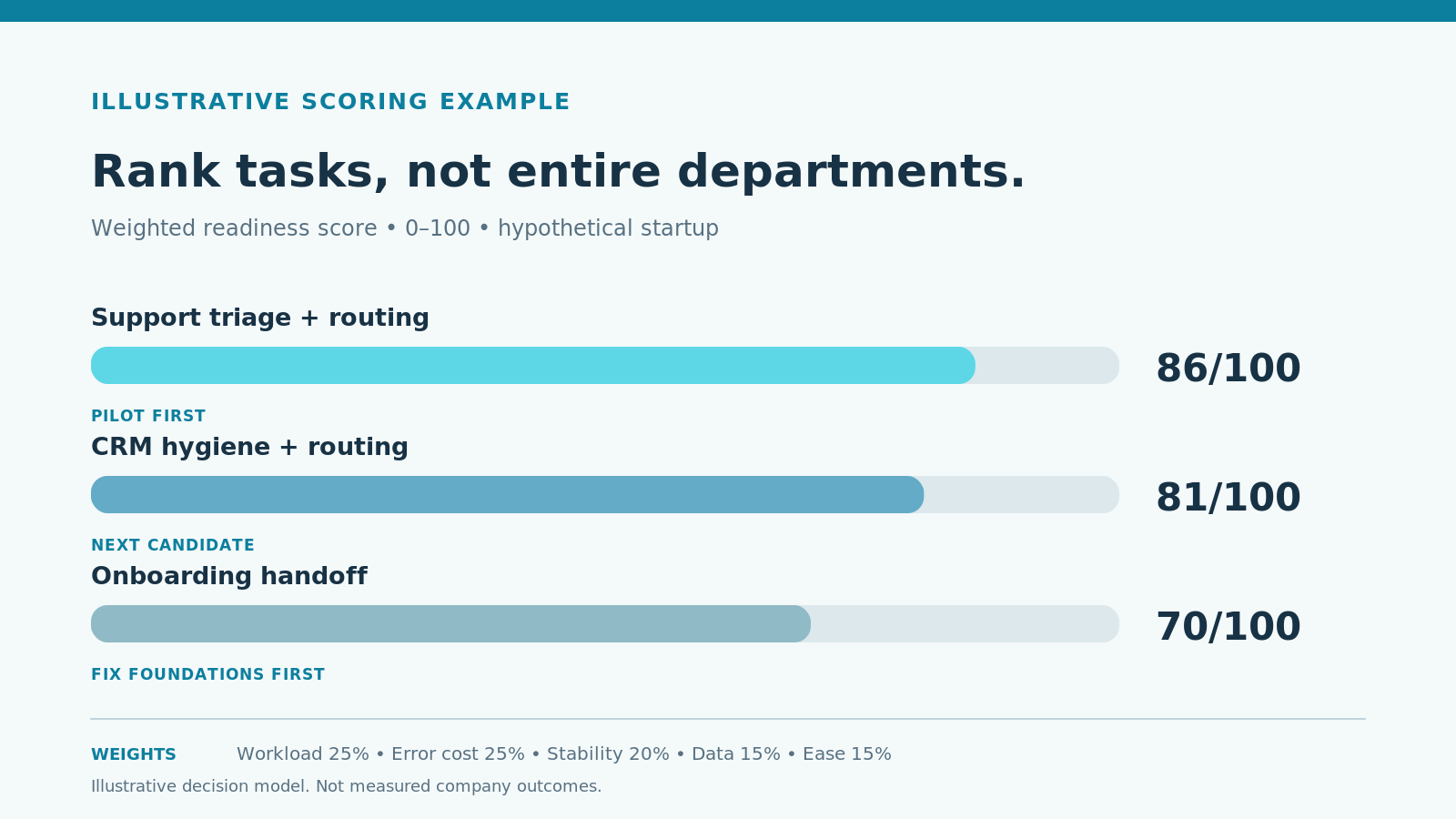
Decision: pilot support ticket triage and routing first. It has a high work volume, consistent inputs, and a narrow, reversible first use case. Keep CRM hygiene second. Improve onboarding field quality and process consistency before expanding automation.
Change the evidence, and the ranking changes. An enterprise SaaS startup with few support tickets, costly onboarding delays, and a highly standardized implementation process can score onboarding first.
What should the first implementation actually do?
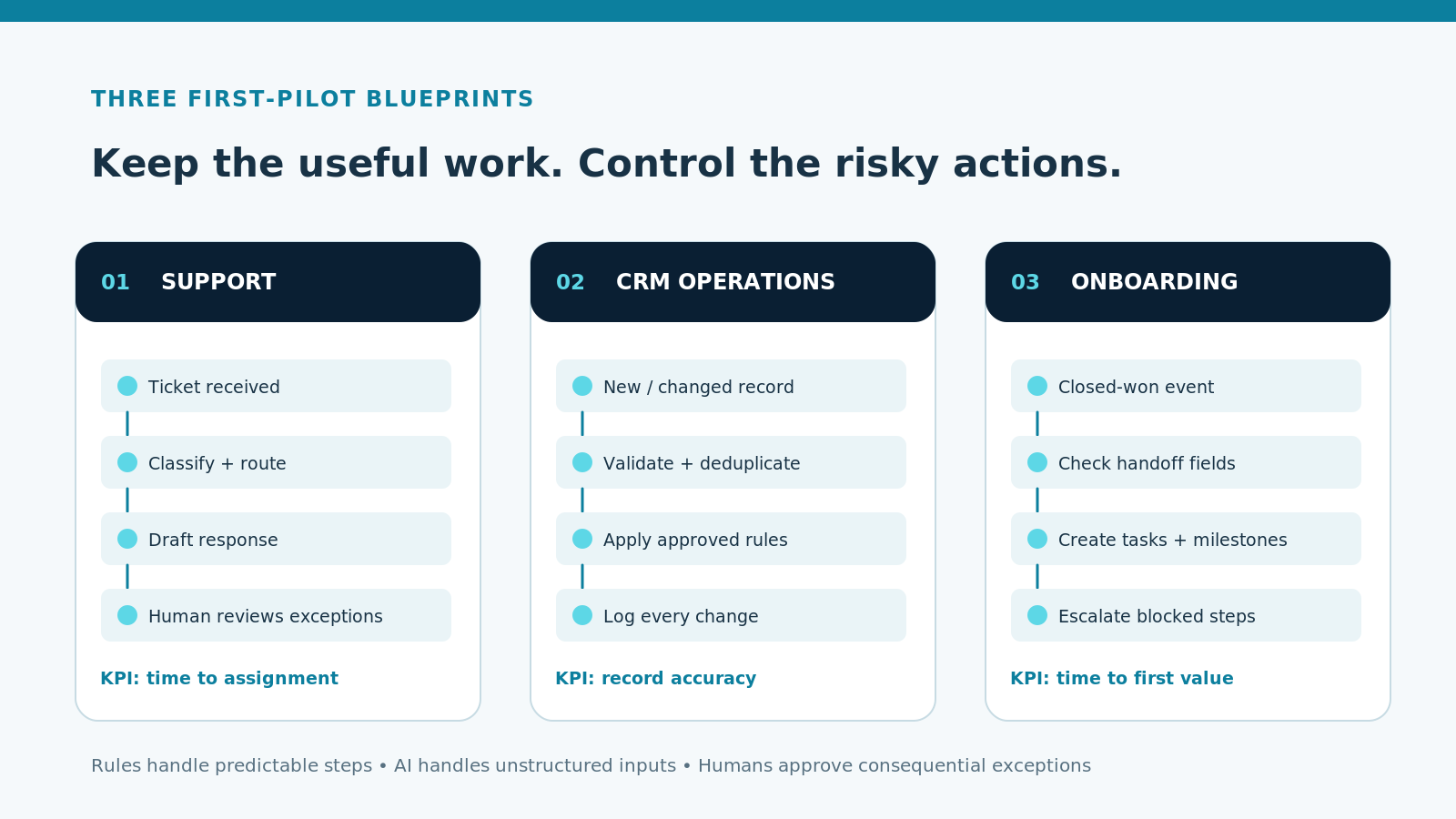
Option A: Support — organize the queue before automating resolution
Trigger: New ticket arrives.
Workflow: Detect category → read approved context → assign a queue → draft a response where appropriate → escalate exceptions → record the decision.
Measure: Time to assignment, incorrect-routing rate, agent handling time, reopened tickets, and human overrides.
First boundary: Do not make unauthorized refunds, account changes, or contractual commitments.
Option B: CRM Operations — make the system of record dependable
Trigger: Contact, account, or opportunity is created or updated.
Workflow: Validate required fields → flag duplicates → apply approved routing rules → notify the owner → record each update.
Measure: Missing-field rate, duplicate rate, assignment latency, incorrect-owner rate, and manual correction time.
First boundary: Require approval for destructive merges or changes to important commercial fields.
Option C: Customer Onboarding — repair the sales-to-CS handoff
Trigger: Deal is marked closed-won and satisfies the handoff requirements.
Workflow: Check account and contractual data → request missing fields → create the onboarding project → assign tasks → track milestones → escalate blocked steps.
Measure: Time from closed-won to kickoff, missing handoff data, stalled milestones, and time to first value.
First boundary: Route changes in scope, customer-specific promises, and privileged access requests to named human owners.
Follow the transition from manual SOPs to scalable operations when defining the first implementation scope.
A high score is not permission to deploy
Before live automation, each workflow must pass three implementation gates:
- Defined process: A documented trigger, expected outcome, exception path, and accountable owner.
- Verified data: Authorized access to the correct source of truth, with test cases for missing or conflicting inputs.
- Operational controls: Human-in-the-loop approvals, audit logs, monitoring, and a tested stop or rollback path.
OMEGANEON defines authorization through Agent Permission Boundaries (APB): System, Data, Action, Limit, Duration, and Identity. An agent's ability to do something is separate from its permission to do it.
NIST's AI Risk Management Framework Playbook recommends documenting human oversight, maintaining relevant audit histories, measuring errors, and tracking overrides. Source: NIST AI RMF Playbook — Measure.
A failed gate means fix the workflow first, regardless of its numerical score.
Translate a pilot into measurable economics
Consider a hypothetical support queue with 800 tickets per month. An observed manual triage process takes 8 minutes per ticket. The redesigned workflow saves 3 minutes per ticket.
- Existing triage workload:
800 × 8 / 60 = 106.7 hours/month - Capacity returned:
800 × 3 / 60 = 40 hours/month - Labor-equivalent capacity at $50 per loaded hour:
40 × $50 = $2,000/month
That $2,000 is a capacity valuation. Record realized budget savings separately. Then subtract implementation and operating costs, and measure ticket-routing accuracy and customer outcomes alongside time saved.
The actual first-project decision uses your verified baseline, not these sample figures.
From readiness to a Workflow Blueprint
An actionable assessment should end with five deliverables: a map of the current workflow, a ranked candidate list, a documented permission and exception design, a narrowly scoped pilot, and a measurement plan with baseline and acceptance criteria.
OMEGANEON's approach: Workflow Assessment → Automation Readiness Score → Workflow Transformation Blueprint → Controlled Implementation → Verified Outcomes → Managed Operations.
The goal is not to deploy the largest AI agent. It is to remove an operational bottleneck without creating a new one.
Start with a Workflow Assessment. Identify the first workflow your startup is ready to automate — and the evidence needed to justify it.
Research and methodology
- Brynjolfsson, E., Li, D., & Raymond, L. (2025). Generative AI at Work. The Quarterly Journal of Economics, 140(2), 889–942.
- Salesforce (2026). State of Sales, Seventh Edition — Startup and SMB Findings.
- OnRamp (2026; updated October 5, 2026). 2026 State of Customer Onboarding. Survey of 161 customer success and onboarding leaders.
- UiPath (accessed November 2026). Automation Hub — Detailed Assessment Algorithm.
- National Institute of Standards and Technology. AI Risk Management Framework Playbook — Measure.
Turn a recurring bottleneck into a managed workflow.
Explore how workflow-orchestrated AI connects business execution, human approvals and ongoing operations—and how to measure the result.
Build better operations.
Keep learning.
Practical research on AI workflows, operating costs, and scaling startup operations. Delivered by email.
The subscription form loads as you reach this section.
See the framework. Explore the work.
Scaling, Just Like Drag-and-Drop.
Connect workflow selection to implementation structure, human checkpoints and ongoing operation.
Read the frameworkRELATED CASE STUDY / START HEREERP Document Operations: From Manual Documentation to Managed AI Workflows
Start with a bounded document workflow: defined inputs, QA rules, approval and delivery.
Explore the case studyRELATED CASE STUDYScaling Creator Monetization Without Scaling Operational Work
Explore customer lifecycle, subscription and revenue workflows as adjacent candidates.
Explore the case studyRELATED CASE STUDYAI-Powered Government Contract Opportunity Discovery & Qualification
Compare another candidate: repetitive research and opportunity qualification.
Explore the case study