In this article
The operating system for turning more closed-won customers into activated accounts—without expanding the team at the same rate.

A B2B SaaS company signs 60% more customers. Sales celebrates. The onboarding team now has to provision 60% more environments, collect 60% more implementation inputs, coordinate more customer stakeholders, resolve more data exceptions, and prove that every account is ready for production.
The familiar response is to open more onboarding roles. But there is another way to finance the next wave of customers: reduce the amount of manual operating work required per completed onboarding.
This is a capacity-engineering problem. The business needs a reliable increase in completed, accepted onboardings per month, not another dashboard full of tasks labeled “done.” An AI workflow makes that increase possible by organizing the repeatable work around the people who still own customer relationships and high-risk decisions.
This article shows exactly how to design that workflow, when it creates enough capacity to change the hiring plan, what it costs, and which acceptance evidence matters before the company increases volume.
Evidence versus scenario. Survey figures and labor-market data below are linked to their original publications. All customer counts, time savings, staffing assumptions, AIWIA fees, and financial returns in the worked example are hypothetical, not OMEGANEON client results.
The operating bottleneck between closed-won and first value
Customer onboarding does not begin with a kickoff call. It begins when the commercial agreement becomes an operational obligation: commercial terms, account identity, entitlements, contacts, deployment conditions, and the promised first outcome must move into a delivery system.
That transition frequently spreads across a CRM, email, spreadsheets, issue trackers, identity management, product administration, and customer support. Every manual handoff adds work. A missing billing field blocks provisioning. The wrong technical contact delays integration. The implementation manager discovers an exception in a thread that was never attached to the account record.
This friction is visible in recent industry surveys:
- Thinkific and Centiment's 2026 customer onboarding study surveyed 699 customer success and onboarding professionals. 69% of leaders said their onboarding process was fully documented and followed consistently, versus 46% of practitioners. The difference is a measurable signal of execution variability.
- GUIDEcx's 2026 B2B onboarding study surveyed 200 professionals across 18 industries. Only 9% reported real-time visibility into the health of their onboarding portfolio; 48% identified customer engagement as their biggest challenge.
- In the same Thinkific survey, 48% selected higher early churn or disengagement as a business consequence they had experienced from inconsistent or repetitive onboarding, and 38% selected slower time-to-value. These are respondent-reported consequences—not a measured causal effect of any particular automation product.
The commercial opportunity is therefore concrete: build an execution layer that connects sales handoff to onboarding completion, preserves customer-specific judgment, and produces evidence for every milestone.
Design the workflow around a completed customer—not a completed task
Before automating, define the unit of output. For a product-led SaaS account, this could be “workspace provisioned, data connection validated, at least one authorized end-user activated, and customer owner accepting the handoff.” For an enterprise software implementation, the acceptance definition includes contract-specific configuration, integrations, security checks, and the signed rollout milestone.
A useful operational unit contains four elements:
- Entry condition: signed agreement and required commercial metadata available.
- Completion condition: agreed access, configuration, validation, and customer activation evidence present.
- Exception condition: explicit owner and next action for failed integrations, missing data, access mismatches, and blocked dependencies.
- Audit record: who authorized the action, which systems changed, the workflow version, the evidence, and the completion timestamp.
The metric is accepted onboardings per month, supported by time-to-first-value, rework, exceptions, customer completion, and access-control measures. The workflow should never turn an incomplete or unauthorized setup into a “completed” account simply to improve throughput.

What the AI workflow actually takes over
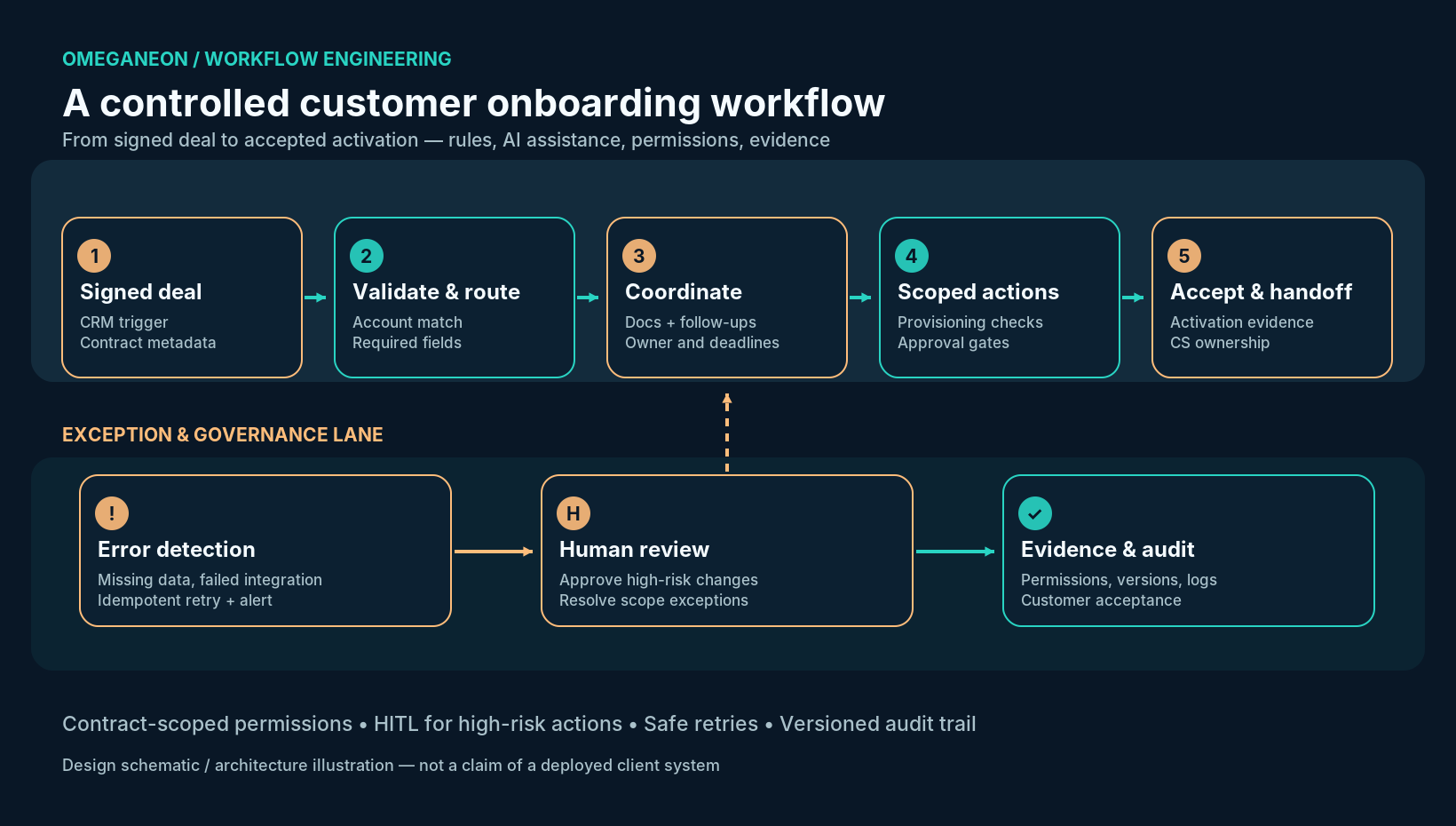
AI does not need to conduct every customer conversation or interpret every contractual exception. A controlled workflow can remove the repetitive orchestration that surrounds those moments.
| Stage | Automated execution | Human responsibility |
|---|---|---|
| Sales → CS handoff | Ingest closed-won event; deduplicate account; validate fields; create onboarding record | Resolve ambiguous scope or mismatched contract data |
| Readiness | Request missing documents; classify response; track owners and deadlines | Decide whether a customer-specific exception changes scope |
| Provisioning | Execute approved entitlement and configuration steps under bounded permissions | Approve high-risk privilege, data, or production changes |
| Data & integrations | Validate formats, retry safe failures, compare expected and actual outcomes | Resolve material mismatches and integration decisions |
| Customer coordination | Issue status updates, reminders, dependency alerts, and meeting preparation | Lead kickoff, advise customer, negotiate constraints |
| Acceptance & handoff | Assemble evidence package, verify required checks, synchronize CRM/CS status | Approve release, customer acceptance, and ongoing success plan |
This is workflow-orchestrated AI, not an unbounded agent with unlimited tools. Deterministic rules handle states, deadlines, entitlements, retries, and approval gates. AI handles unstructured documents, request classification, exception summaries, and drafts that remain inside approved controls.
The permission boundary matters. OWASP's LLM06:2025 Excessive Agency guidance calls for least-privilege tools, downstream authorization, and human approval for high-impact operations. In a real onboarding system, adding a user and granting administrator privileges should not be the same action path.
A worked example: 100 to 160 onboardings with the same four-person team
Consider a fictional Series A/B B2B SaaS company with four onboarding specialists. It completes 100 customer onboardings per month and is planning for 160 per month. The goal is to protect onboarding quality and customer activation without increasing specialist headcount.
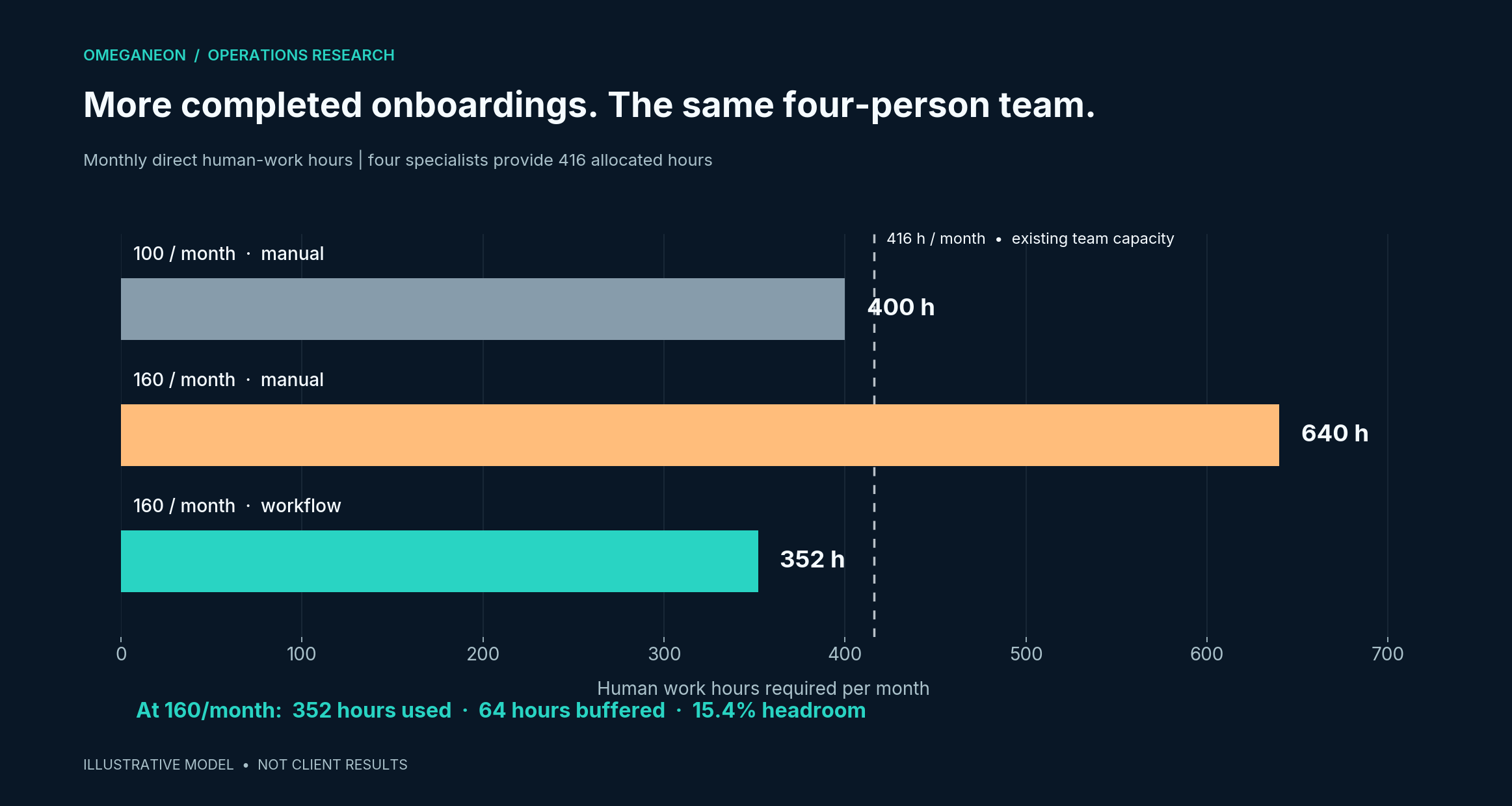
The company allocates 160 scheduled hours per specialist per month, of which 65% are available for hands-on onboarding after meetings, planning, internal coordination, and other duties. Its direct onboarding capacity is:
4 specialists × 160 hours × 65% = 416 direct onboarding hours/month.
Currently, each completed onboarding requires 4.0 hours of direct human work. The existing 100 customers consume 400 hours/month, nearly the available allocation. Serving 160 with the same manual process would require 640 hours/month. At 104 allocated onboarding hours per specialist, the manual plan requires seven specialists in total.
The proposed workflow is scoped to bring direct human touch time to 2.2 hours per completed customer through a combination of rules, integrations, AI assistance, approvals, and exception routing:
| Work per completed customer | Manual | With workflow | Hours recovered |
|---|---|---|---|
| Intake, duplicate checks, record routing | 0.5 h | 0.1 h | 0.4 h |
| Approved workspace provisioning | 1.0 h | 0.3 h | 0.7 h |
| Documents, reminders, status follow-up | 0.8 h | 0.2 h | 0.6 h |
| Data validation and exception resolution | 0.8 h | 0.7 h | 0.1 h |
| Kickoff and customer-specific judgment | 0.9 h | 0.9 h | 0.0 h |
| Total | 4.0 h | 2.2 h | 1.8 h |
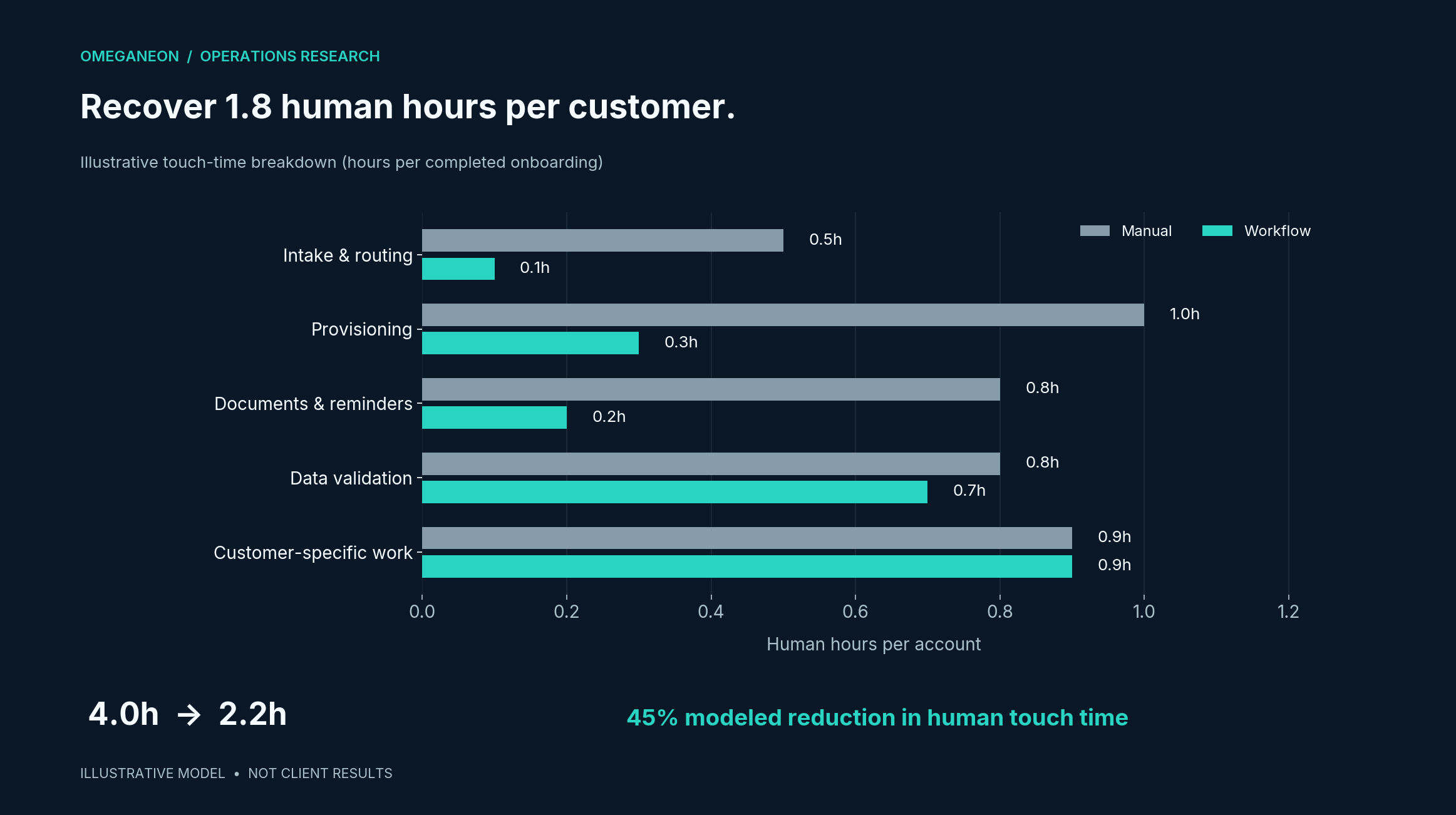
The modeled change is a 45% reduction in direct human touch time per onboarding. That number is an explicit scenario target, not an industry average or an observed OMEGANEON outcome.
At the new volume, 160 × 2.2 = 352 direct hours/month. Four specialists still provide 416 allocated hours, leaving 64 hours of buffer (15.4% of available capacity). The same team can meet the assumed workload target while preserving capacity for variation and escalations.
The company has not automated customer trust. It has automated repetitive work around customer trust: data capture, routing, provisioning under authority, deadlines, auditability, and predictable follow-through.
Explore the multi-workflow financial modeling in Scale Operations. Not Overhead. for the complete investment framework behind this analysis.
Turn the capacity result into an operating budget
A throughput model matters when it changes a real budget decision. Suppose the company uses $9,000/month per onboarding specialist in fully loaded employer cost—a planning assumption including wages, payroll burden, benefits, and equipment allocation. For outside context, the U.S. Bureau of Labor Statistics' June 2026 Employer Costs for Employee Compensation reports $54.00/hour worked for full-time U.S. private-industry employees across occupations; the scenario's $9,000 monthly figure is a separate assumed staffing budget, not a BLS estimate for onboarding specialists.
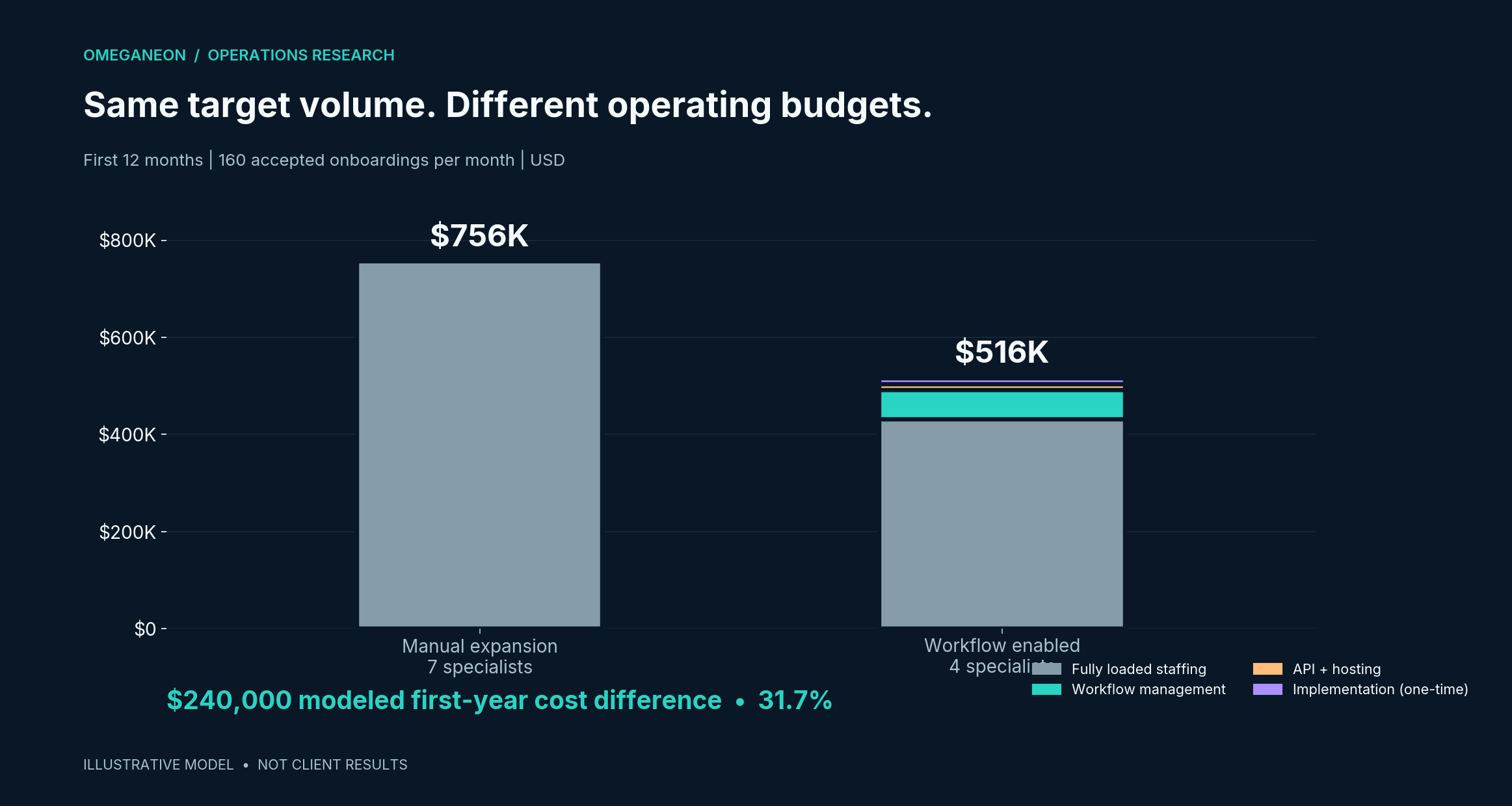
For this illustration, the company compares two plans for 160 completed onboardings/month over twelve months:
| First-year budget | Expand manually | Four specialists + workflow |
|---|---|---|
| Onboarding specialists | 7 | 4 |
| Fully loaded staffing | $756,000 | $432,000 |
| Workflow implementation (one time) | — | $12,000 |
| Workflow management ($5,000/month) | — | $60,000 |
| AI/API, hosting and monitoring ($1,000/month) | — | $12,000 |
| Total first-year cost | $756,000 | $516,000 |
| Cost per completed onboarding | $393.75 | $268.75 |
The modeled difference is $240,000 in first-year avoided operating expense, a 31.7% lower budget for the same target volume. The $12,000 implementation charge, $5,000 monthly managed fee, and $1,000 monthly usage/hosting allowance are illustrative, not published fixed quotes or signed customer terms.
The economically relevant comparison is incremental: the manual scaling plan adds three new specialists at $9,000/month each ($27,000/month). The workflow alternative adds $6,000/month of managed services and infrastructure, plus a $12,000 one-time implementation. The stabilized monthly operating cost advantage is $21,000 before the one-time implementation charge.
This is an avoided-hiring case. Existing four-person payroll continues in both plans. The model does not claim layoffs, booking an immediate accounting gain, lower churn, or increased ARR. If the three hires have not been approved or budgeted, the amount should be presented as capacity delivered without that future expense, not a reduction in current monthly cash burn.
The operational break-even point: 2.6 hours per customer
The decisive threshold is easy to calculate:
Available hours ÷ target customers = 416 ÷ 160 = 2.6 human hours per completed onboarding.
Above 2.6 hours, the four-person team lacks the allocated capacity to finish 160 customers monthly. At 2.6, it has no operating buffer. At the target 2.2, it operates with 64 hours of monthly headroom.
| Actual touch time after implementation | Specialists required for 160/month | First-year cost (including workflow) | Difference vs. manual seven-person plan |
|---|---|---|---|
| 3.0 h | 5 | $624,000 | $132,000 |
| 2.6 h | 4 | $516,000 | $240,000 |
| 2.2 h (target) | 4 | $516,000 | $240,000 |
| 2.0 h | 4 | $516,000 | $240,000 |
Every row is a scenario—not a vendor performance claim. At 3.0 hours, the company would still need one additional specialist to serve 160 customers under the stated work allocation. At 2.6 hours, it has zero buffer. At 2.0 hours, it buys more future capacity, but the modeled staffing cash cost does not fall further because the headcount is already four.
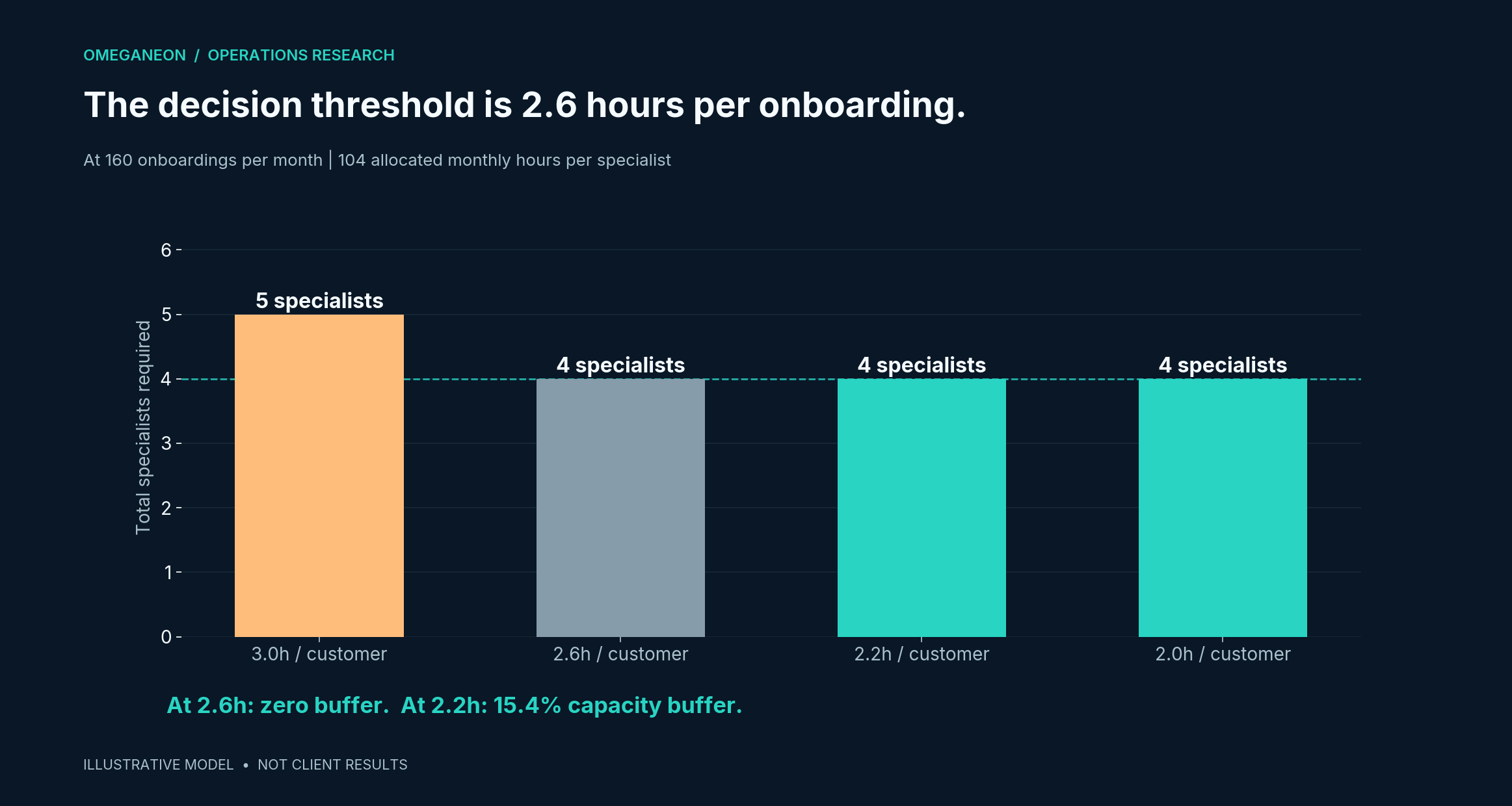
This is why a financial proposal needs both a per-customer touch-time target and a quality/exception acceptance gate. A fast workflow that fails provisioning, loses audit records, or delays customer activation cannot be credited with completed onboardings.
Instrument the workflow for outcomes the COO can sign off
The smallest credible acceptance package includes these six measurements:
| Measurement | Definition | Required evidence |
|---|---|---|
| Accepted onboarding volume | Customers meeting the agreed completion definition per month | Timestamped account and milestone records |
| Human touch time | Total verified human work hours divided by completed onboardings | Time sampling or event-linked activity logs |
| Time to first value | Time from agreed start event to first specified customer outcome | Product event and customer-side confirmation |
| Exception rate and recovery | Failed or blocked runs; time until safe resolution | Error events, retries, escalation records |
| Rework and data quality | Duplicate records, mismatches, incorrect access, failed setup | Validation results and correction audit trail |
| Authorization and acceptance | Unapproved high-risk actions; documented human sign-offs | Permission logs, approvals, customer acceptance |
The team should measure a manual baseline, then run the proposed workflow on the same account types and comparable complexity bands. Large enterprise implementations and low-touch self-serve activations do not belong in one undifferentiated average.
Set production criteria in the signed Statement of Work. For example, a customer and provider could agree on a target touch-time threshold, zero unauthorized high-risk writes, defined exception recovery windows, and completion of all contracted readiness checks. Those are proposed acceptance criteria, not pre-verified performance promises.
The workflow should also handle blocked or incomplete customer inputs correctly. Limited reminders, explicit customer ownership, expiry/escalation rules, and clean handoffs reduce the burden on the onboarding team without endlessly pursuing an unresponsive customer.
A 4-week path from hypothesis to evidence
OMEGANEON's standard $4,000 / 4-week Paid Pilot is positioned as a contract-scoped, authorized sandbox pilot. Its current standard presentation is one high-value workflow; the actual number of workflows, scope, and acceptance boundaries are set by the signed agreement and SOW. The pilot does not itself authorize production access or a live customer rollout.
For an onboarding pilot, the scope can be a specific workflow such as closed-won-to-provisioning-readiness:
Days 1–10 — Discovery and baseline. Map the current Sales → CS handoff, sample real cases where authorized, record touch-time drivers, identify exception types, and specify the customer's acceptance definition.
Days 11–20 — Workflow build. Implement validated intake, account matching, status orchestration, document requests, permitted provisioning simulations, and approvals inside the authorized environment.
Days 21–35 — Replay and exception testing. Reproduce normal cases, missing fields, duplicates, misconfigured entitlements, nonresponsive customers, and service interruptions. Capture exact artifacts and failure recovery.
Days 36–45 — Evidence review and decision. Present the operational touch-time estimate, safety results, audit trail, exception coverage, implementation delta, and production-readiness gaps. The client decides whether to proceed to a separate formal implementation and managed operations engagement.
Production deployment follows the signed contract, applicable privacy/security controls, customer authorizations, and an explicit go-live acceptance. OMEGANEON then manages monitoring, changes, incident recovery, and performance evidence through ongoing operations.
Test the assumptions against the whitepaper’s financial sensitivity and break-even analysis.
The decision in one page
A COO comparing a new onboarding hire with workflow implementation needs five answers:
- Demand: How many completed onboardings must the business deliver in the next quarter?
- Capacity: How many human hours will that require, and how many are currently available?
- Scope: Which repeatable steps can be executed under explicit permissions, with humans retaining exceptions and customer-specific decisions?
- Economics: Does verified touch-time reduction cross a real staffing threshold after implementation and managed costs?
- Acceptance: What evidence demonstrates quality, recovery, customer activation, and authorized execution?
This turns onboarding from an expanding coordination burden into a governed operating capability. The objective is not fewer human conversations. The objective is more customers reaching first value without every new contract creating a proportional new operating position.
Scale customer onboarding. Keep the customer relationship human. Put the repeatable work into a managed workflow.
OMEGANEON — AI Workflow Implementation & Managed Operations
Next step: Request a Customer Onboarding Workflow Blueprint or start a conversation about the $4,000 / 4-week Paid Pilot. The live website should connect this call to action to its existing Start a Chat / Paid Pilot entry point.
Sources and model notes
Independent/public measurement: U.S. Bureau of Labor Statistics, Employer Costs for Employee Compensation (June 2026). Industry surveys (vendor-sponsored, with respondent counts disclosed): Thinkific × Centiment, State of Customer Onboarding 2026 (n=699) and GUIDEcx, State of Customer Onboarding 2026 (n=200 B2B). Security design reference: OWASP LLM06:2025 Excessive Agency.
Scenario model: 4 current specialists, 160 scheduled hours per person per month, 65% direct onboarding allocation, volume rising from 100 to 160 completed accounts per month, touch time changing from 4.0 to 2.2 hours per completed account, $9,000 fully loaded monthly specialist cost, $12,000 implementation, $5,000 monthly managed service, $1,000 monthly infrastructure and API allowance. Exact calculations are provided in calculation notes inside the publication package. There are no actual customer results in this article.
Put One Workflow Into Operation
Start a Paid Pilot — $4,000 · 4 weeks · One workflow.
Get a Workflow Assessment to define the implementation scope, acceptance criteria and Managed Operations plan.
Fund operating capacity with a clear investment case.
Compare full operating costs, multi-workflow economics, workforce transition paths and financial sensitivity—then set the evidence gates for implementation.
Build better operations.
Keep learning.
Practical research on AI workflows, operating costs, and scaling startup operations. Delivered by email.
The subscription form loads as you reach this section.
See the framework. Explore the work.
Agent Permission Boundaries, Human Approval & Audit Logs
Review the six APB permission primitives, human oversight and auditability used to bound business-system access.
Read the frameworkWHITEPAPERScaling, Just Like Drag-and-Drop.
Connect operating economics with implemented workflows and verifiable engineering evidence.
Read the frameworkRELATED CASE STUDY / START HEREERP Document Operations: From Manual Documentation to Managed AI Workflows
Review measured document execution, deterministic QA and human approval evidence.
Explore the case studyRELATED CASE STUDYScaling Creator Monetization Without Scaling Operational Work
Explore implemented customer lifecycle and revenue operations workflows.
Explore the case studyRELATED CASE STUDYAI-Powered Government Contract Opportunity Discovery & Qualification
See source-linked research, qualification rules and controlled review workflows.
Explore the case study